The Proust Effect : What is The Proust Effect
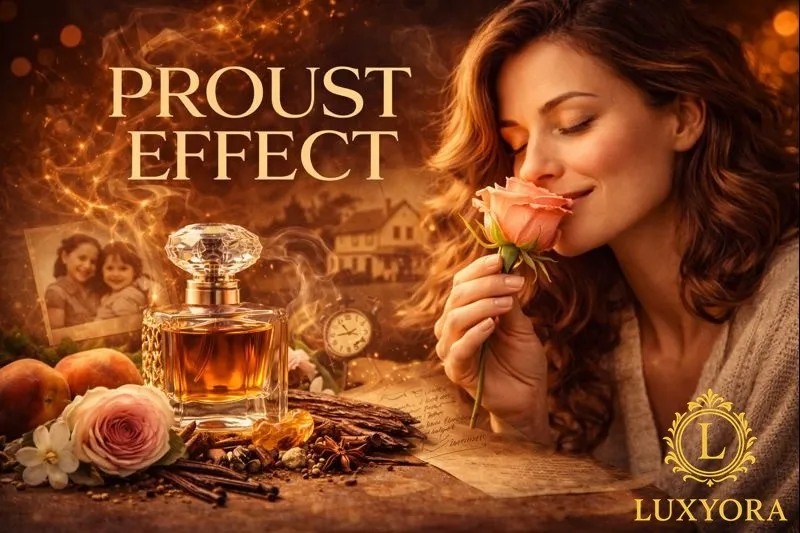
The Proust Effect describes a powerful and deeply human phenomenon: the way a simple scent can instantly unlock a vivid, emotional memory – often more intense and detailed than memories triggered by sight or sound. The term is named after French writer Marcel Proust, who famously described how the aroma of a madeleine dipped in tea transported him back to his childhood with overwhelming clarity.
In perfumery, this effect is nothing short of magical.
Why Smell Is Different
Scientifically, the Proust Effect exists because the olfactory system is directly connected to the brain’s limbic region, which governs emotion, mood, and long-term memory. Unlike visual or auditory information, which passes through multiple processing centers, scent molecules travel a more direct neural route.
This explains why:
- A trace of jasmine can evoke a grandmother’s garden
- A particular cologne can resurrect memories of a first love
- The smell of rain, spices, or clean linen can feel instantly familiar
Scent doesn’t just remind us of the past; it recreates the emotional atmosphere of the moment.
Memory That Feels Alive
What makes scent-evoked memories so powerful is their emotional intensity. Research shows that memories triggered by smell are often:
- More vivid
- More emotionally charged
- More immersive
You don’t simply remember the moment you feel it again. This is why fragrance often feels personal, intimate, and deeply tied to identity.
The relationship between scent and memory is remarkable, but the journey from cherished aroma to personal signature is even more compelling. Explore the complete guide in How Scent Becomes Part of Personal Identity.
How Perfumers Use the Proust Effect
In the fragrance world, the Proust Effect plays a central role in how perfumes are designed. Perfumers, often referred to as Noses, intentionally choose ingredients known to carry strong emotional associations.
Certain notes are widely linked to memory:
- Vanilla, milk, soft musks: comfort and safety
- Citrus and herbs: freshness and energy
- Woods and resins: grounding, warmth, nostalgia
- Florals: intimacy, romance, familiarity
By blending these elements, perfumers don’t just create a scent, they create an emotional narrative.
Why Some Scents Feel Instantly Familiar
Have you ever smelled a fragrance that felt comforting even though you’d never worn it before? That’s the Proust Effect at work. Our brains associate certain smells with
universal experiences: home, warmth, celebration, care, which is why some fragrances feel “known” the moment you encounter them.
This is also why brands often describe perfumes in emotional terms rather than technical ones. They’re not just selling notes; they’re offering feelings, moments, and memories.
Behind the Proust Effect is a deeper relationship between scent, emotion, and memory that continues to fascinate scientists and perfumers alike. Learn more in The Science of Scent: How Fragrance Affects Mood and Memory.
Fragrance as a Time Machine
Whether it’s:
- The smell of rain hitting dry earth
- Spices from a childhood kitchen
- Sunscreen and sea air from summer holidays
- A candle that smells like winter evenings
Fragrance acts like a time machine, quietly carrying us back to moments that shaped who we are. It reconnects us to places, people, and emotions we didn’t realize we were still holding onto.
Why the Proust Effect Matters
Understanding the Proust Effect helps us appreciate fragrance as more than a beauty product. Perfume becomes an emotional experience, a personal archive of memory
stored in scent. It explains why people become fiercely loyal to certain fragrances and why scent often feels more intimate than fashion.
A perfume doesn’t just sit on your skin, it becomes part of your story.
References
- Proust, M. (2018). In Search of Lost Time (Modern translation). Penguin Classics.
- Nez Éditions. (2020). The Big Book of Perfume: For an Olfactory Culture (J. Doré, Ed.). Nez Éditions.
- Herz, R. S. (2022). The Scent of Desire: Discovering Our Enigmatic Sense of Smell. William Morrow.
- Herz, R. S., & Engen, T. (2019). Odor memory: Review and analysis. Psychonomic Bulletin & ; Review, 26(5), 1601 – 1618.
- Schlintl, C., Zorjan, S., & Schienle, A. (2022). Olfactory imagery as a retrieval method for autobiographical memories. Psychological Research.
- Kontaris, I., & East, B. S. (2020). Behavioral and neurobiological convergence of odor-evoked emotion and emotion-driven olfactory perception. Frontiers in Behavioral Neuroscience.
- Spence, C. (2021). The scent of attraction and the smell of success. Cognitive Research: Principles and Implications, 6(1), 46.
- National Institute of Health. (2024). Olfaction, memory, and emotion. NIH Publications.