Perfumery : What is Perfumery | Luxyora
Perfumery is the discipline of designing and producing fragrances, everything from fine perfume (eau de parfum, extrait) to scented personal care (body wash, shampoo, deodorant) and home products (candles, diffusers, detergents). In the fragrance industry, perfumery is not only “making something smell nice.” It is a structured process that blends creative composition, chemistry, sensory evaluation, safety compliance, manufacturing practicality, and brand storytelling into a product that can be replicated consistently at scale.
Modern perfumery is also increasingly shaped by regulatory updates, ingredient sustainability, and AI-assisted formulation tools.
1) What “Perfumery” Means in Professional Fragrance Terms
In industry language, perfumery involves:
- Selecting and combining raw materials (natural extracts + aroma chemicals)
- Building a fragrance structure (top/heart/base) that evolves over time
- Optimizing performance (projection, longevity, trail/sillage)
- Ensuring stability (product and packaging compatibility)
- Meeting safety and labeling requirements for each product category and market
Perfumery operates within a commercial ecosystem: brands, fragrance houses, evaluators, labs, and regulatory teams collaborate to deliver a fragrance that meets a brief and can be manufactured safely, legally, and profitably.
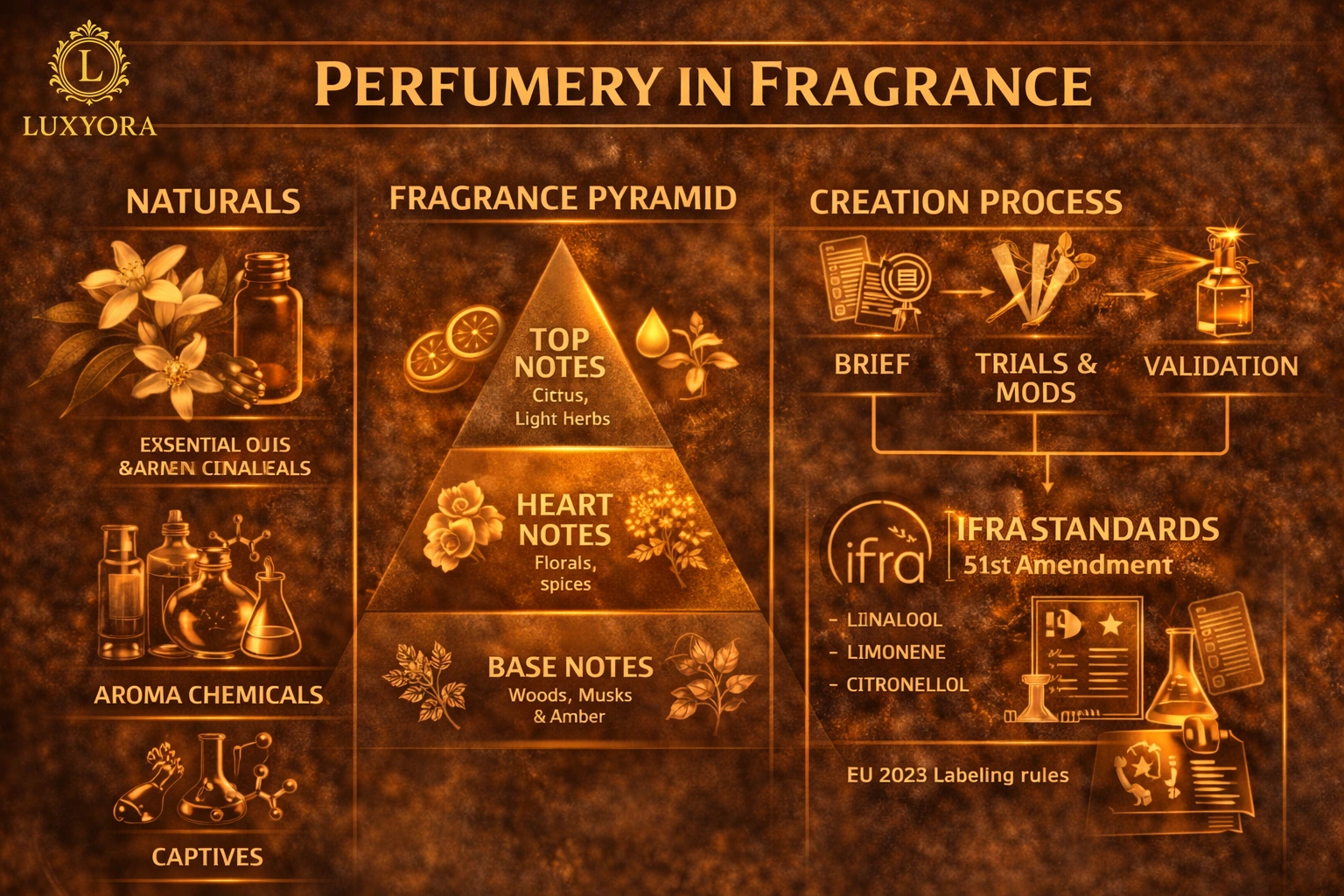
2) The Perfumer’s Palette: Naturals, Synthetics, and “Captives.”
A perfumer composes with three major ingredient families:
A) Natural raw materials
These include essential oils, absolutes, resinoids, and other botanical-derived aromatics (citrus oils, jasmine absolute, frankincense resin extract). Definitions of natural aromatic materials are standardized in vocabulary work such as ISO 9235:2021 (Aromatic natural raw materials), which formalizes key terms used globally across fragrance and flavor supply chains.
B) Aroma chemicals (synthetic or nature-identical molecules)
These molecules give perfumers precision and consistency: modern musks, ambers, woods, clean “linen” notes, watery/ozonic facets, and highly stable floral boosters. They also help reduce pressure on scarce natural resources and improve performance in challenging product bases such as detergents and soaps.
C) Captives
“Captives” are proprietary molecules owned by specific fragrance houses. They are valuable because they can deliver a signature smell and competitive differentiation that others can’t legally copy.
3) Fragrance Structure: The “Olfactive Pyramid” and Time-Evolution
A core idea in perfumery is that perfume is time-based. What you smell at first spray is not what you smell two hours later.
Many educational sources explain perfumery structure through the fragrance pyramid:
- Top notes: the first impression is fresh, bright, volatile (citrus, aldehydes, light herbs)
- Heart (middle) notes: the main theme florals, spices, aromatics
- Base notes: the long-lasting foundation woods, musks, amber, resins
This pyramid is not a strict formula, but it is a helpful model for understanding how perfumers control lift, body, and dry-down.
Rich perfumery keywords: top notes, heart notes, base notes, dry-down, diffusion, sillage, longevity, accord building, fixatives, radiance.
4) Concentration Levels: Parfum vs EDP vs EDT (Why it Matters)
Perfumery also includes “format engineering.” The same fragrance idea can be sold as:
- Extrait/Parfum: higher fragrance concentration, often deeper, longer-lasting
- Eau de Parfum (EDP): strong, common modern format
- Eau de Toilette (EDT): lighter, more top-note driven
- Eau de Cologne/body mist: freshest and most fleeting
These differences affect not only strength but also the balance of materials, since some notes dominate more at higher concentrations and some bloom better in lighter formats.
Some fragrances linger for hours while others feel lighter and fresher, and the explanation lies in more than just the scent itself. Learn the essentials in Eau de Parfum vs Eau de Toilette vs Cologne.
5) The Perfumery Creation Process: Brief → Mods → Validation → Launch
A) The brief (creative + commercial blueprint)
A project starts with a brief: target audience, mood, budget, competitive benchmarks, region, and product type (fine fragrance, shampoo, or detergent).
B) Modifications (“mods”) and evaluation
Perfumers create multiple versions, adjusting:
- sweetness vs freshness
- floral density vs transparency
- clean musk vs warm amber
- intensity and cost
C) Stability, safety, and compliance
A fragrance must meet safety standards and regulatory requirements for each market and use case. This is a major modern driver of decision-making in perfumery.
IFRA Standards are a key global framework: the 51st Amendment (2023) is part of IFRA’s continuing updates that guide safe use of fragrance ingredients and mixtures.
In cosmetics sold in the EU, perfumery must also account for labeling rules. For example, Commission Regulation (EU) 2023/1545 amends the EU Cosmetics Regulation to address requirements for labeling fragrance allergens.
This means perfumery is inseparable from compliance: the creative palette is shaped by what can be used, at what levels, and in which product categories.
6) Fine Fragrance vs Functional Fragrance: Two “Worlds” of Perfumery
Fine fragrance perfumery
Focuses on artistic storytelling, signature identity, and sensorial luxury, often built around a hero theme (e.g., neroli, rose, oud) and a refined, long dry-down.
Functional perfumery (personal care, home care, fabric care)
Must also solve technical problems:
- surviving high-pH soap bases
- smelling clean on wet hair
- lasting on fabric through wash/dry cycles
- masking malodors in deodorants and cleaners
In functional perfumery, performance and stability can be as important as beauty.
7) Technology in Perfumery: AI Tools, Digital Maps, and Rapid Sampling
Perfumery is becoming more computational without losing its artistic core.
A widely cited industry example is Givaudan’s “Carto” (2019), an AI-assisted tool designed to help perfumers explore combinations using an “Odour Value Map,” paired with rapid robotic sampling to accelerate iteration.
Mainstream beauty reporting has described this shift as AI supporting faster exploration and helping manage complexity while still emphasizing that human perfumers provide taste, emotion, and cultural nuance.
8) Training and Careers: How Perfumery Expertise is Built
Professional perfumery is typically learned through a combination of:
- chemistry + formulation basics
- intensive smelling practice (building “olfactory memory”)
- lab discipline and evaluation training
- mentorship and iterative creation
Institutions like ISIPCA describe perfumery education as the mastery of the balance between creativity and real chemistry, with training in formulation and evaluation.
Programs co-developed with industry (e.g., IFF-linked training descriptions) frame perfumery as both a foundational craft and modern innovation.
References
Başer, K. H. C., & Buchbauer, G. (Eds.). (2021). Handbook of Essential Oils: Science, Technology, and Applications (3rd ed.). CRC Press.
Pearlstine, E. (2022). Scent: A Natural History of Fragrance. Yale University Press.
Sell, C. S. (2019). Fundamentals of Fragrance Chemistry. Wiley-VCH.
Allure. (2023). The ChatGPT of fragrance has arrived (AI tools and perfumery). (Allure)
CosmeticsDesign-Europe. (2019, April 18). Givaudan launches artificial intelligence tool for perfumers. (CosmeticsDesign-Europe.com)
European Union. (2023, July 26). Commission Regulation (EU) 2023/1545 amending Regulation (EC) No 1223/2009 as regards labelling of fragrance allergens in cosmetic products. EUR-Lex. (Eur-Lex)
Givaudan. (2019, April 3). Givaudan Fragrances launches “Carto”, its artificial intelligence-powered tool (press release). (Givaudan)
Givaudan. (2019). Carto: The future of fragrance formulations (tool overview). (Givaudan)
International Fragrance Association (IFRA). (2023, July 5). Notification of the 51st Amendment to the IFRA Standards. (IFRA)
International Fragrance Association (IFRA). (2023, June 30). Guidance for the use of IFRA Standards (51st Amendment) (PDF). (Cloudfront)
International Fragrance Association (IFRA). (2023, June 30). Index of IFRA Standards – 51st Amendment (PDF). (Cloudfront)
ISIPCA. (2026, January 6). Training programs (perfumery education overview). (ISIPCA)
ISIPCA. (2026). Fragrances: Perfumery training courses (formulation, evaluation, creation). (ISIPCA)
IFF. (n.d.). ISIPCA Masters-level scent design & creation program overview (industry-linked training description). (IFF)
ISO. (2021). ISO 9235:2021 Aromatic natural raw materials — Vocabulary (sample PDF). (Iteh Standards)
Scentamor. (2025, June 23). The fragrance pyramid explained (top/heart/base notes). (scent amor)
Craftovator. (2022, September 21). Understanding the fragrance pyramid and scent notes. (Craftovator Studio)