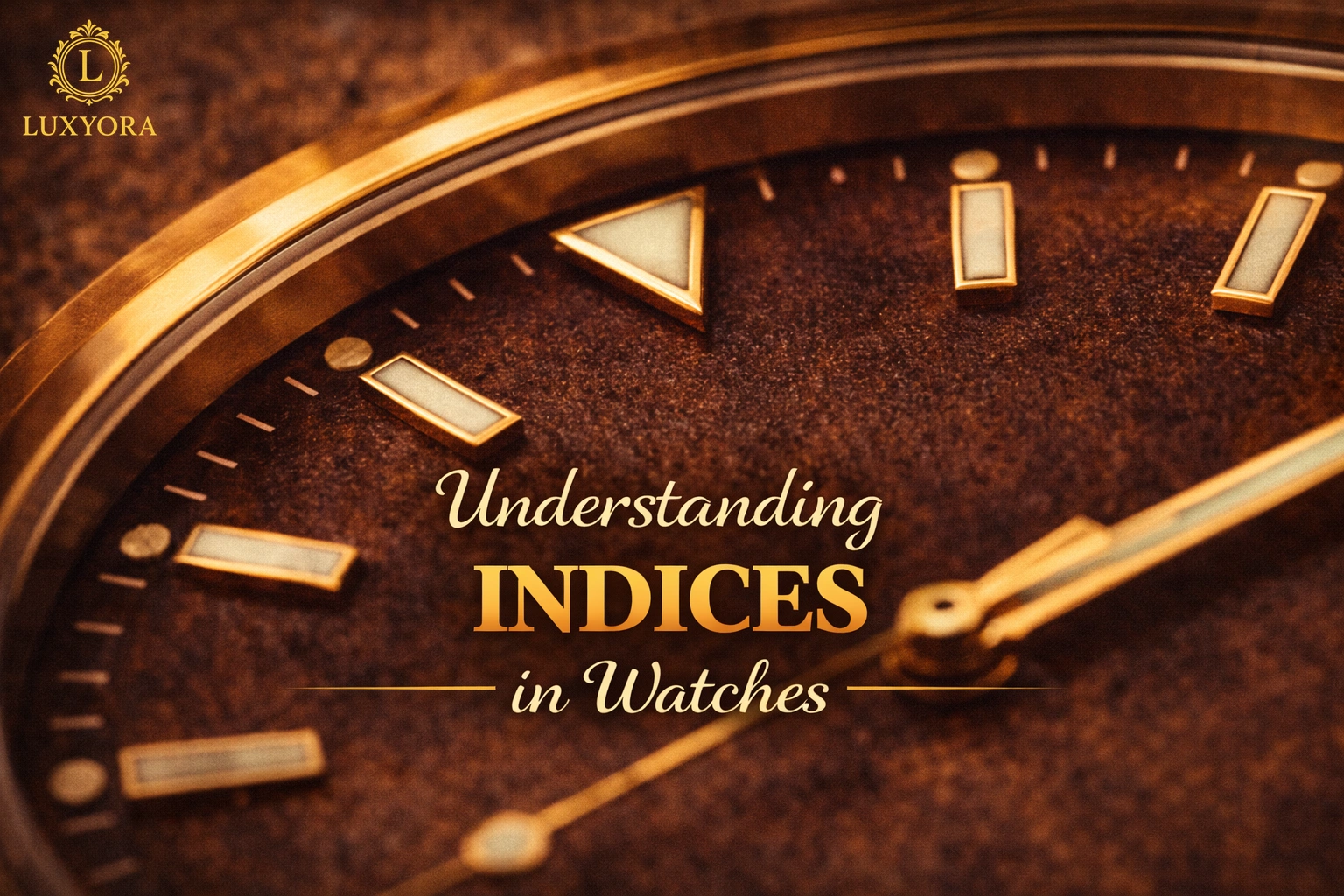
Indices : What are Indices | Luxyora
In watchmaking, indices (also called hour markers or dial markers) are visual references around a watch dial that indicate hours (and sometimes minutes/seconds). Indices may be numerals (Arabic/Roman), batons, dots, triangles, applied metal markers, or printed/painted markers, and they play a far bigger role than most people realize. Indices determine how quickly you can read the time, how “premium” a dial feels, and whether the design conveys dress-watch elegance, tool-watch clarity, or sports-watch utility.
In industry terms, indices sit at the intersection of human factors (readability) and craft execution (dial furniture, finishing, alignment, lume). A dial can have a great color and texture, but if the indices are poorly proportioned, misaligned, or low-contrast, the watch will feel visually “wrong” every time you glance at it
1) What Indices Do (Core Functions)
A. Provide a time-reading framework
Indices provide eye anchor points, enabling you to interpret hand positions instantly. This is especially important for:
- Fast “at-a-glance” time reading
- Precise minute reading when paired with a minute track
- Low-light visibility when combined with lume
B. Support safety/clarity in tool watches
For dive-capable watches, legibility isn’t just convenience, it’s function. The divers’ watch standard ISO 6425:2018 specifies that, after exposure to light, readability in darkness must allow the time to be read with the minute indicator clearly distinguishable from the hour indicator, and for analogue displays, markings indicating every 5 minutes must be readable, along with an indication that the watch is running.
While ISO 6425 focuses on the entire watch, it emphasizes the importance of clear dial information, with indices and minute markers playing a direct role.
C. Communicate design identity
Indices function like typography in branding: small choices have a significant aesthetic impact. Baton indices signal modern minimalism, Roman numerals lean traditional, and a bold triangle at 12 o’clock reads “diver” instantly.
2) Applied vs Printed Indices (The Big Industry Distinction)
Applied indices
Applied indices are separate, physical markers (often metal) attached to the dial, typically via tiny posts, adhesive, or other fixing methods. They add depth, shadow, and light-play, which is why they are strongly associated with a more premium or refined look.
Why brands use them
- Strong dimensional “luxury” feel
- Better light-catching and visual hierarchy
- Often allow lumens to be filled into cavities for a stronger glow
Potential downside
- If poorly made or poorly attached, applied indices can loosen (rare on good watches, but possible in low-quality builds). Some discussions also note that printed indices can’t “fall off,” which is a practical advantage in certain designs.
Printed/painted indices
Printed (or painted) indices are markings applied directly to the dial surface. They can be extremely crisp and durable when executed well, and they’re common in tool watches and minimalist designs.
Why brands use them
- Cleaner, flatter, often more “instrument-like” appearance
- Can support thinner dial construction
- Cost-effective while still offering excellent legibility
Common perception
- Printed indices can feel less “premium” than applied markers in dress categories, but they are often preferred in vintage-style watches where flat printing matches the era.
3) Common Index Styles (Rich Keywords and Visual Vocabulary)
Below are the most common index categories used in product descriptions, collector terminology, and watch retail listings:
Baton indices
Rectangular or stick markers (applied or printed). Seen in modern dress, sport-luxury, and minimalist watches.
Dot indices
Round markers are often used in sporty and dive designs, frequently lumed for visibility.
Arabic numeral indices
Bold and readable; common for pilot/field styles and contemporary sports watches.
Roman numeral indices
Classic and formal; often used in traditional dress watches.
Triangle index at 12 o’clock
A widely recognized “orientation marker” in dive-watch language, helping instant alignment/reading, especially in low light with lume.
Mixed indices
Many watches combine applied batons with Arabic numerals at key positions (e.g., 12–3–6–9) to balance elegance and quick reading.
4) Luminous Indices (Lume Plots, Lume-Filled Markers, and Sandwich Effects)
Luminous indices are markers coated or filled with photoluminescent material to glow in the dark. They’re critical for tool watches and any watch intended for night use.
Two common lume approaches
- Printed lume: lume applied/printed onto the dial surface (can be efficient and clean).
- Lume filling: lume paste filled into applied markers or shaped dial recesses, often enabling thicker lume for a stronger glow.
A discussion of lume methods notes that achieving brighter lume depends on maximizing application area and thickness, and that lume filling via metal indices can be more complex and costly than printing.
ISO-related legibility context
ISO 6425:2018 specifies legibility requirements (time readability, five-minute markings, running indicator) under light and in darkness, underscoring that indices and minute markers must be designed for clarity, not just appearance.
5) Materials and Finishing: Why Indices Signal Quality
Indices are small components, but they reveal a lot about manufacturing:
- Polished applied indices reflect light sharply and can appear high-end when the edges are crisp.
- Brushed indices reduce glare and provide a more utilitarian feel.
- Gold-tone or rhodium-tone finishes align indices with case/hand color for a cohesive design.
- Gem-set indices (e.g., diamond markers) are used in luxury categories where jewelry value is part of the appeal.
A key design principle is alignment and consistency: indices should be evenly spaced, centered, and matched in height (for applied sets). Any skew is immediately visible because the dial is the watch’s focal plane.
6) How to Evaluate Indices Like a Pro (Practical Checklist)
Use this quick checklist when judging a watch dial:
- Contrast: Are indices clearly visible against the dial color/texture?
- Proportion: Do marker sizes match the watch style (dress vs tool vs diver)?
- Alignment: Do indices line up perfectly with minute track/hand positions?
- Depth and finishing: Are the applied markers crisp and evenly finished?
- Lume performance: Is lume evenly applied and logically prioritized (strong minute markers, clear orientation)?
- Durability logic: Tool watches often choose printed markers for simplicity; dress watches often choose applied markers for refinement. Both can be “right” when coherent.
Conclusion
In watch-industry terminology, indices are more than decoration. They are the dial’s core information system, shaping legibility, usability, lume performance, and perceived quality. Understanding the major index types (baton, dot, Arabic, Roman), the construction methods (applied vs. printed), and the role of lume and alignment provides readers with a strong foundation for evaluating watches as an informed enthusiast or professional. In tool categories, standards such as ISO 6425:2018 reinforce a simple truth: indices are designed to be read clearly, quickly, and reliably.
References
Carathea. (2026). Watch indices explained: Types, styles & what they mean. Retrieved February 5, 2026. (Carathea)
Helios Watch Store. (2025, December 15). How indices can make or break a dial. (Helios Watch Store)
International Organization for Standardization. (2018). ISO 6425:2018—Horology—Divers’ watches [Standard]. (ISO)
Kapoor Watch Co. (2024, December 14). Understanding hour markers: Style, function and precision. (kapoorwatch.com)
Kapoor Watch Co. (2025, March 26). Evolution of sandwich dial watches: From military roots to modern luxury (lume printing vs lume filling discussion). (kapoorwatch.com)
Nixon. (2024, April 18). Watch dial 101: Hour and minute markers. (Nixon US)
The 1916 Company. (2025). Watch glossary (dial components terminology). Retrieved February 5, 2026. (Everest Bands)
Wristler. (2025, December 25). Classification of watch dial markers: Complete guide. (DuMarko)
Brunner, G. L. (2019). The Watch Book—Compendium. teNeues.
Stone, G., & Pulvirent, S. (2018). The watch, thoroughly revised: The art and craft of watchmaking. Abrams.