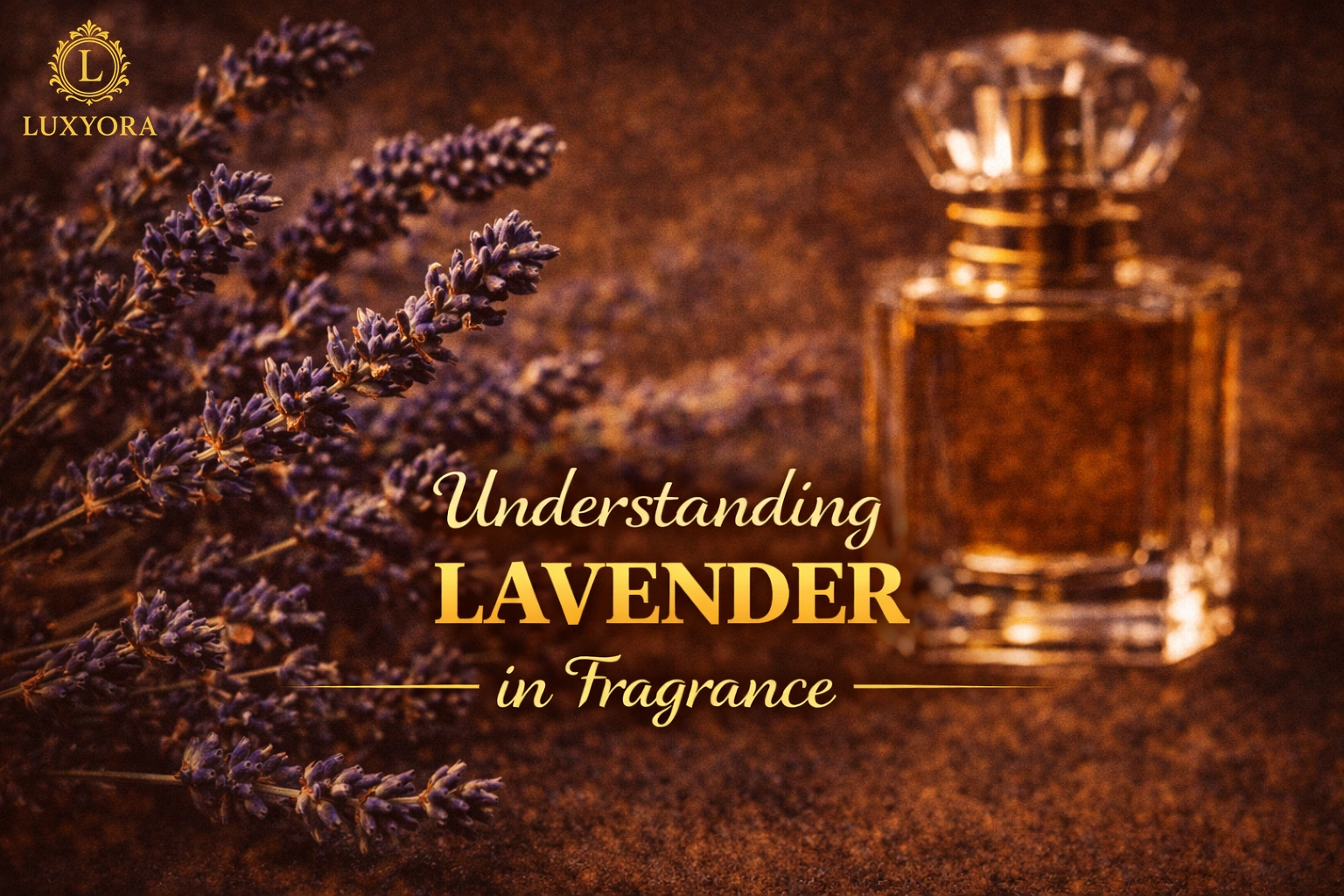
Lavender : What is Lavender | Luxyora
In perfumery, lavender is a cornerstone of the aromatic-floral family, used to create everything from classic fougère fragrances (often described as “barbershop” scents) to contemporary clean, musky, spa-like compositions. In industry terms, “lavender” does not always mean a single raw material. On a fragrance pyramid, lavender may represent lavender essential oil, lavender absolute, lavandin fractions, or a lavender accord built from multiple materials to reproduce lavender’s recognizable character.
Lavender’s enduring popularity comes from its unusual versatility: it can smell fresh and herbal, floral and soft, sweet and creamy, or even cool and camphoraceous depending on the botanical source, extraction method, and how a perfumer blends it with other notes.
1) What “Lavender” Means as a Fragrance Note
When a perfume lists “lavender,” it usually implies one of three possibilities:
A. Lavender essential oil
This is the most common natural lavender material in fine fragrance. Ingredient compendia describe lavender oils as obtained by hydrodistillation from the stems and flowers and commonly list key components such as linalool and linalyl acetate.
B. Lavender absolute
Lavender absolute is a more concentrated aromatic material with a deeper, rounder profile than the essential oil (often perceived as richer and slightly sweeter). Many brands use it to give a floral “body” rather than only a fresh aromatic lift.
C. A lavender accord
A “lavender accord” is a constructed impression of lavender made by blending naturals and aroma chemicals. Brands may do this for style control, cost, stability, or to achieve a specific “clean lavender” profile that feels modern.
2) Lavender’s Smell Profile: Key Descriptors and “Rich Keywords.”
Professional fragrance descriptions for lavender frequently include:
- Aromatic (fresh, recognizable lavender signature)
- Herbal (green, slightly bitter, plant-like freshness)
- Floral (soft, petal-like nuance under the herbs)
- Camphoraceous (cool, medicinal edge in some lavender styles)
- Clean / barbershop (soapy, freshly groomed feel in fougère contexts)
- Powdery-musk (lavender softened by modern musks)
A widely used industry reference database also notes lavender oil’s naturally occurring components and its fresh, sweet, floral character, which helps explain why lavender can feel both comforting and crisp.
3) The Chemistry Behind Lavender’s Signature
Lavender’s smell is not “one molecule.” It’s a molecular balance, and the two most influential constituents commonly discussed are:
Linalool
Contributes fresh, floral, slightly woody brightness, helping lavender feel airy and clean.
Linalyl acetate
Adds smoothness and softness, often responsible for lavender’s more “polished” and rounded sensation.
A peer-reviewed paper in Molecules reports lavender oil samples in which linalyl acetate and linalool are the principal constituents, providing illustrative percentages (e.g., linalyl acetate around 28.9% and linalool around 24.3% in a tested oil sample).
Perfumery takeaway: Oils with more linalyl acetate often feel smoother and sweeter, while oils with more sharp terpenic components can feel more herbal/camphoraceous.
4) Lavender vs Lavandin: A Practical Industry Distinction
In fragrance production, you’ll often see lavender and lavandin used differently.
- Lavender usually refers to Lavandula angustifolia materials (classic refined lavender character).
- Lavandin (a hybrid) can provide a strong aromatic lift and is widely used in perfumery and functional fragrance.
Ingredient descriptions of lavandin materials may highlight an “aromatic and floral note with a clean fresh character,” sometimes with fruity or hay-like nuances that keep it close to lavender’s identity.
5) Lavender’s Most Famous Role: The Fougère “Barbershop” Structure
Lavender is historically inseparable from the fougère family, one of the most influential masculine fragrance structures in modern perfumery. In simplified teaching terms, a classic fougère often centers on:
- Lavender (aromatic lift and identity)
- Coumarin/tonka-like effects (sweet hay/almond warmth)
- Mossy/woody depth (traditionally oakmoss-like effects, now often modernized)
A contemporary perfume education article traces the history of fougère back to Fougère Royale (1882) and explicitly links the “barbershop clean” sensation to the effects of lavender, woods, and coumarin.
Why lavender works here: it creates instant cleanliness and structures an aromatic “spine” that prevents sweet notes from becoming heavy and prevents woods from becoming too dry.
6) Modern Lavender Styles: From Clean Musks to Gourmand-Aromatic
Lavender has expanded far beyond classic men’s fougères. Today, perfumers use it in several popular directions:
A. Clean lavender + musk (modern “fresh linen” aesthetic)
Lavender is often paired with musks to create an airy, smooth, and comforting effect, often marketed as “clean,” “soft,” or “skin-like.”
B. Lavender + vanilla/tonka (aromatic gourmand)
This contrast of herbal freshness on top and warm sweetness underneath creates a highly wearable “comfort” profile. Lavender keeps vanilla from feeling too sugary; vanilla makes lavender feel less sharp.
C. Lavender in niche “dark aromatic” blends
Lavender can be pushed into smoky, resinous territory by pairing with incense, leather facets, or darker woods.
7) Safety, Oxidation, and Standards: Why Perfumers Treat Lavender Seriously
Professional perfumery requires strict adherence to safe use levels, especially because natural materials are complex mixtures that can change over time. One important lavender-related topic is oxidation, particularly of components such as linalool.
A RIFM/Elsevier safety assessment update for linalool (CAS 78-70-6) reflects how the industry evaluates fragrance ingredient safety across endpoints such as skin sensitization and other toxicological considerations.
A later update is also noted in the scientific literature record for the linalool safety assessment (published in 2025), indicating that the field continues to refine guidance as new data emerge.
Reader-friendly takeaway: Lavender in perfume is widely used, but responsible brands formulate within standards, control oxidation risks, and design products for safe wear.
8) Sustainability and Traceability: Lavender as a Supply-Chain Ingredient
Lavender is also an agricultural product, so fragrance houses increasingly document origin, processing, and sustainability characteristics. For example, some ingredient compendium entries include yield information and processing details, and certain materials list sustainability attributes (e.g., renewable/biodegradable claims and certifications for specific lavandin products).
For consumers, this means “lavender” can be part of a brand’s broader story about responsible sourcing, farmer partnerships, and ingredient transparency, especially in premium perfumery.
9) How to Smell Lavender Like a Perfumer
A simple smelling method that builds strong fragrance literacy:
- Opening (0–2 min): Is it crisp/herbal or smooth/sweet?
- Heart (5–20 min): Do you sense a polished “softness” (often tied to linalyl acetate) or a sharper aromatic edge?
- Drydown (30+ min): Does it become musky-clean, woody, or warm-tonka?
Compare a lavender-heavy fougère to a lavender-musk “clean” scent, and you’ll quickly understand how one note can define multiple genres.
Conclusion
In fragrance, lavender is a master key: a note that can be classic or modern, masculine-coded or genderless, brisk or cozy. Whether used as lavender oil, lavender absolute, lavandin, or a carefully crafted lavender accord, it remains essential because it provides both identity and structure, especially in fougère and clean-aromatic compositions. Understanding lavender’s signature components (notably linalool and linalyl acetate), its role in fragrance architecture, and the safety/sourcing context gives readers a strong, industry-level grasp of what “lavender” truly means in perfumery.
References
Api, A. M., Belsito, D., Botelho, D., Bruze, M., Burton, G. A., Jr., Buschmann, J., … Cancellieri, M. A. (2022). Update to RIFM fragrance ingredient safety assessment: Linalool (CAS Registry Number 78-70-6). Food and Chemical Toxicology, 159, 112687. https://fragrancematerialsafetyresource.elsevier.com/sites/default/files/78-70-6.pdf (fragrancematerialsafetyresource.elsevier.com)
Api, A. M., et al. (2025). 2nd update to RIFM fragrance ingredient safety assessment, linalool (CAS Registry Number 78-70-6). Food and Chemical Toxicology. PubMed record. https://pubmed.ncbi.nlm.nih.gov/41223921/ (PubMed)
International Flavors & Fragrances. (n.d.). Lavender oil France (LMR Naturals compendium). Retrieved February 6, 2026, from https://www.iff.com/scent/lmr-compendium/lavender-oil-france-lmr-csm/ (IFF)
International Flavors & Fragrances. (n.d.). Lavender oil Maillette (LMR Naturals compendium). Retrieved February 6, 2026, from https://www.iff.com/scent/lmr-compendium/lavender-oil-maillette-org-ref-a-csm/ (IFF)
International Flavors & Fragrances. (n.d.). Lavandin Heart (LMR Naturals compendium). Retrieved February 6, 2026, from https://www.iff.com/scent/lmr-compendium/lavandin-heart/ (IFF)
Pokajewicz, K., et al. (2021). Chemical composition of lavender essential oil (key constituents including linalyl acetate and linalool). Molecules, 26(18), 5681. https://www.mdpi.com/1420-3049/26/18/5681 (MDPI)
The Good Scents Company. (n.d.). Lavender oil France, 8000-28-0 (data page). Retrieved February 6, 2026, from https://www.thegoodscentscompany.com/data/es1096991.html (The Good Scents Company)
The Perfume Foundation. (2021, May 25). Fougère natural fragrance, a hit for Father’s Day (fougère history and lavender/coumarin context). https://www.perfumefoundation.org/blog/fougere-natural-fragrance-a-hit-for-fathers-day (THE INTERNATIONAL PERFUME FOUNDATION)
Ellena, J.-C. (2022). Atlas of perfumed botany. The MIT Press.
McCartney, S., & Scriven, S. (2021). The perfume companion: The definitive guide to choosing your next scent. Frances Lincoln/Quarto.
Sell, C. (2019). Fundamentals of fragrance chemistry. Wiley-VCH.