How to Choose the Right Shoes for Your Foot Type | Luxyora
Shoes are the closest thing we have to everyday architecture, tiny, portable structures that hold up your entire world. And yet most of us shop for them like we’re picking a dessert: by mood, by outfit, by what looks fabulous in the mirror. The problem? Your feet are not a trend cycle. They’re living, changing, quietly opinionated beings with very specific needs.
Choosing the right shoes for your foot type isn’t about sacrificing style. It’s about upgrading your standard because comfort is a luxury, and support is the ultimate polish. When your shoes truly fit your feet, everything looks better: your posture, your stride, your confidence, your willingness to take the long way home.
Step 1: Meet Your Foot Type (No Overthinking Required)
Most “foot type” talk comes down to two things: shape and movement.
1) Arch height (the curve along the inside of your foot)
- Low arches / flatter feet often roll inward more when walking (many people call this overpronation).
- High arches tend to be stiffer and may roll outward a bit more (often associated with supination).
- Neutral arches sit somewhere in the happy middle.
2) Foot shape (what your foot looks like from above)
Think: wide vs. narrow, square vs. tapered toes, and whether your feet are “slender” or more “volume-rich” across the top (instep). Two people can have the same shoe size and still need completely different fits.
Look at your old shoes (movement clue):
And Yes, Measure Your Feet.
Feet can change over time. Many adults are walking around in sizes they wore years ago, like clinging to an expired passport photo.
Step 3: Match Your Foot Type to the Right Shoe Personality
Now for the fun part: translating foot facts into shoe features.
If you have low arches or inward rolling
Your best friends are stability and structure. Look for:
- A supportive midsole that feels steady under the arch
- A firm heel counter (the back of the shoe should feel secure, not collapsible)
- A base that feels stable, not wobbly especially in sneakers
Luxury tip: structure can still be chic. Think sleek silhouettes with hidden engineering: supportive footbeds, refined shanks, and premium cushioning that doesn’t look “sporty.”
If you have high arches
High arches often crave cushioning and shock absorption. Look for:
- Plush cushioning under the heel and forefoot
- A more flexible ride that doesn’t feel like walking on a board
- Enough room in the shoe so the arch isn’t aggressively pushed upward
If a shoe feels like it’s “forcing” your arch into a new personality, skip it. Support should feel like assistance, not an argument.
If you have neutral arches
You get to be versatile, but you still need intention. Look for:
- A balanced feel: not too stiff, not too soft
- Cushioning that feels smooth and consistent
- A fit that holds the heel while letting the forefoot relax
Neutral doesn’t mean “anything goes.” It means you can choose based on comfort and use-case without constantly negotiating with your feet.
Step 4: Prioritize Fit Like It’s Couture
A perfect fit is not a number. It’s a sensation.
Toe box: Your toes should have room to lie naturally, no squeezing, no stacking, no silent suffering. Aim for about a fingertip’s worth of space between your longest toe and the end of the shoe. Bonus points if the shoe’s toe shape mirrors your own (round, square-ish, or gently tapered).
Width and volume: If your foot feels “pressed” from the sides, you need more width. If the top of your foot feels compressed, you may need more volume or different lacing/closure options. Great shoes should hold you securely without making you tense your toes to keep them on.
Fastening matters: Laces, straps, and secure closures aren’t just practical; they keep your foot from sliding forward and gripping for dear life. Slip-ons can be stylish, but they shouldn’t require your feet to do extra work.
Step 5: Choose the Right Shoe for the Right Life
Foot type is your foundation. Lifestyle is your filter.
For everyday city life:
Look for a supportive sole, a stable heel, and breathable materials. If you stand a lot, cushioning becomes non-negotiable.
For running or training:
Fit and comfort are typically the most important factors people rely on when choosing performance shoes, and for good reason. Prioritize a secure heel, appropriate cushioning, and a ride that matches your gait and training routine.
The perfect shoe isn’t always the one that looks right on the shelf, it’s the one that responds to the way your feet move, adapt, and carry you throughout the day. That idea becomes even more interesting when performance enters the conversation. Explore the details in The Best Running Shoes for Beginners.
For heels:
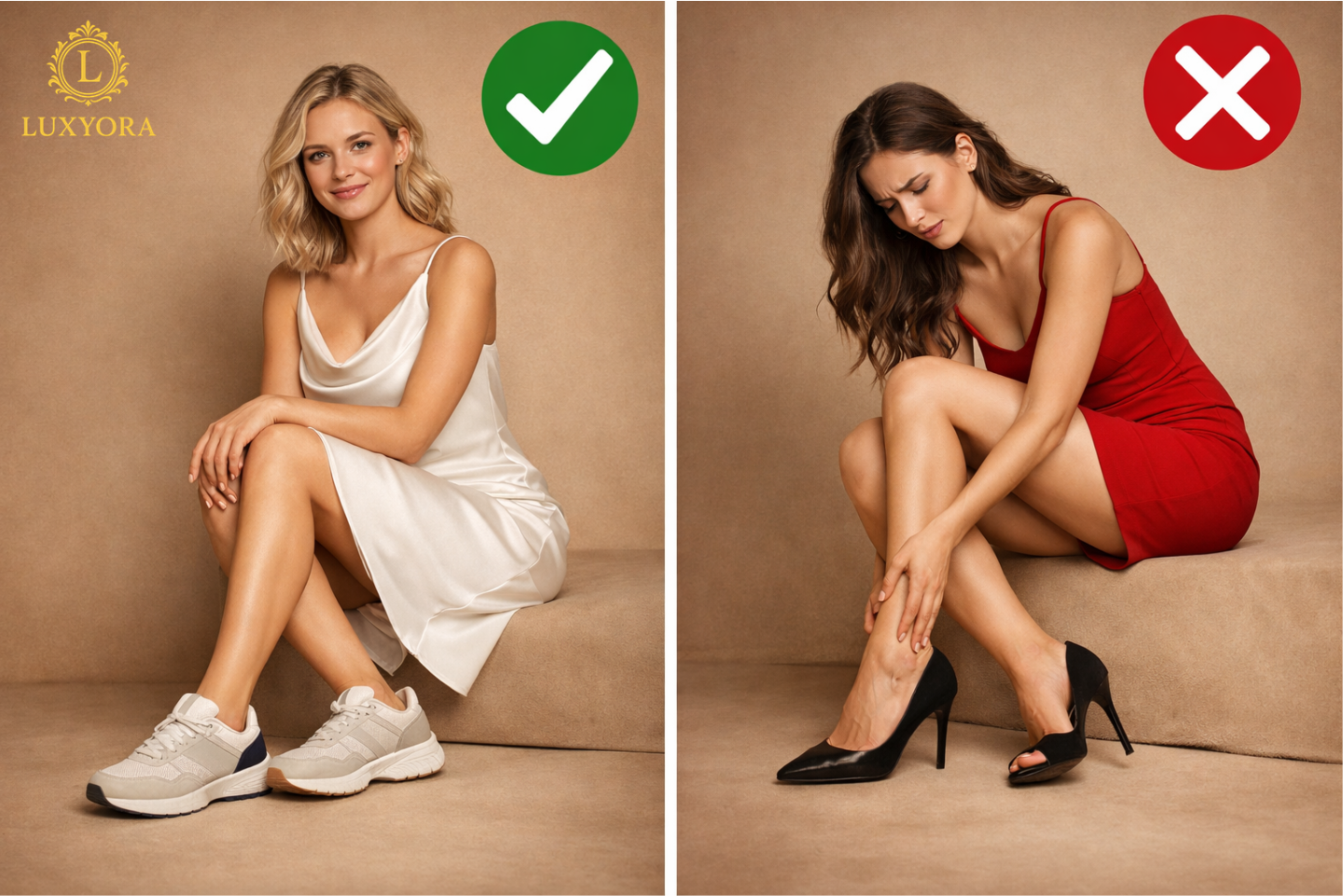
A heel can be gorgeous, but daily sky-high stilettos can shift pressure forward. For frequent wear, consider lower heel heights, wider heels, and platforms/wedges that distribute pressure more gracefully.
Step 6: Shop Smart Like a Professional
Make the buying process work for you:
- Try shoes on later in the day when feet are slightly larger
- Wear the socks or hosiery you’ll actually use
- Walk around. Turn. Stop. Start. Your feet should feel supported immediately
Don’t buy shoes that need “breaking in” to stop hurting. Pain isn’t a phase, it’s
Step 7: When to Call in the Experts
If you have persistent heel pain, numbness, recurring blisters, or joint aches that show up like clockwork, it’s worth speaking with a podiatry professional. Sometimes the right solution is a small adjustment: a better-fitting shoe, a supportive insole, or simply a roomier toe box. Your feet shouldn’t have to beg for mercy.
Luxyora Philosophy: True luxury is when beauty and biomechanics agree, when your shoes don’t just complete the look, they elevate the way you move through the world.
References:
Caselli, M. A. (2024). Selecting the proper athletic shoe. Podiatry Management (January issue). https://podiatrym.com/cme/CME124.pdf
Fife, A., Ramsey, C., Esculier, J.-F., & Hébert-Losier, K. (2024). How do runners select their shoes? An in-store experience. Footwear Science, 16(3), 191–199. https://doi.org/10.1080/19424280.2024.2353597
Guy’s and St Thomas’ NHS Foundation Trust. (2025). Choosing shoes to reduce foot pain. https://www.guysandstthomas.nhs.uk/health-information/choosing-shoes-reduce-foot-pain
NHS England. (2018). Footwear advice (Patient leaflet). https://www.england.nhs.uk/north/wp-content/uploads/sites/5/2018/12/Footwear-Advice.pdf
Romero Cardenas, C. (2024). The art of choosing the right running shoe: A review article. Journal of Foot & Ankle, 18(2), 146–155. https://doi.org/10.30795/jfootankle.2024.v18.1807
Umar, H., Idrees, W., Umar, W., Khalil, A., & Rizvi, Z. A. (2022). Impact of routine footwear on foot health: A study on plantar fasciitis. Journal of Family Medicine and Primary Care, 11(7), 3851–3855. https://doi.org/10.4103/jfmpc.jfmpc_637_21
Microfiber-based uppers are commonly marketed for durability and easy maintenance, and they can feel smooth and uniform. Just remember: microfiber “leather” isn’t leather—it’s a synthetic textile structure, often paired with coatings, and quality can range dramatically by manufacturer. (Winiw International Co., Ltd)