Lugs : What are Lugs
In watchmaking, lugs (sometimes called “horns”) are the projecting parts of a watch case that hold the strap or bracelet to the watch head, usually via spring bars. While they may look simple, lugs are among the most decisive elements of a watch’s wearability, design identity, serviceability, and even its aftermarket strap compatibility.
Understanding lugs helps collectors read spec sheets correctly, buy straps confidently, and judge how a watch will sit on the wrist.
1) What exactly are watch lugs?
A standard round watch case typically has two lugs at 12 o’clock and two lugs at 6 o’clock. Between each pair sits a spring bar (a small, spring-loaded pin) that locks into holes inside the lugs and secures the strap/bracelet. This is why lugs are central to:
- Security (keeping the watch on your wrist)
- Comfort (how the case hugs the wrist)
- Aesthetics (the “stance” and silhouette of the case)
- Customization (strap changes and strap sizing)
Many brands explicitly define lug-related dimensions and language in their glossaries and spec discussions, especially the difference between lug width and lug-to-lug.
2) Key lug measurements you must know
A) Lug width (strap size)
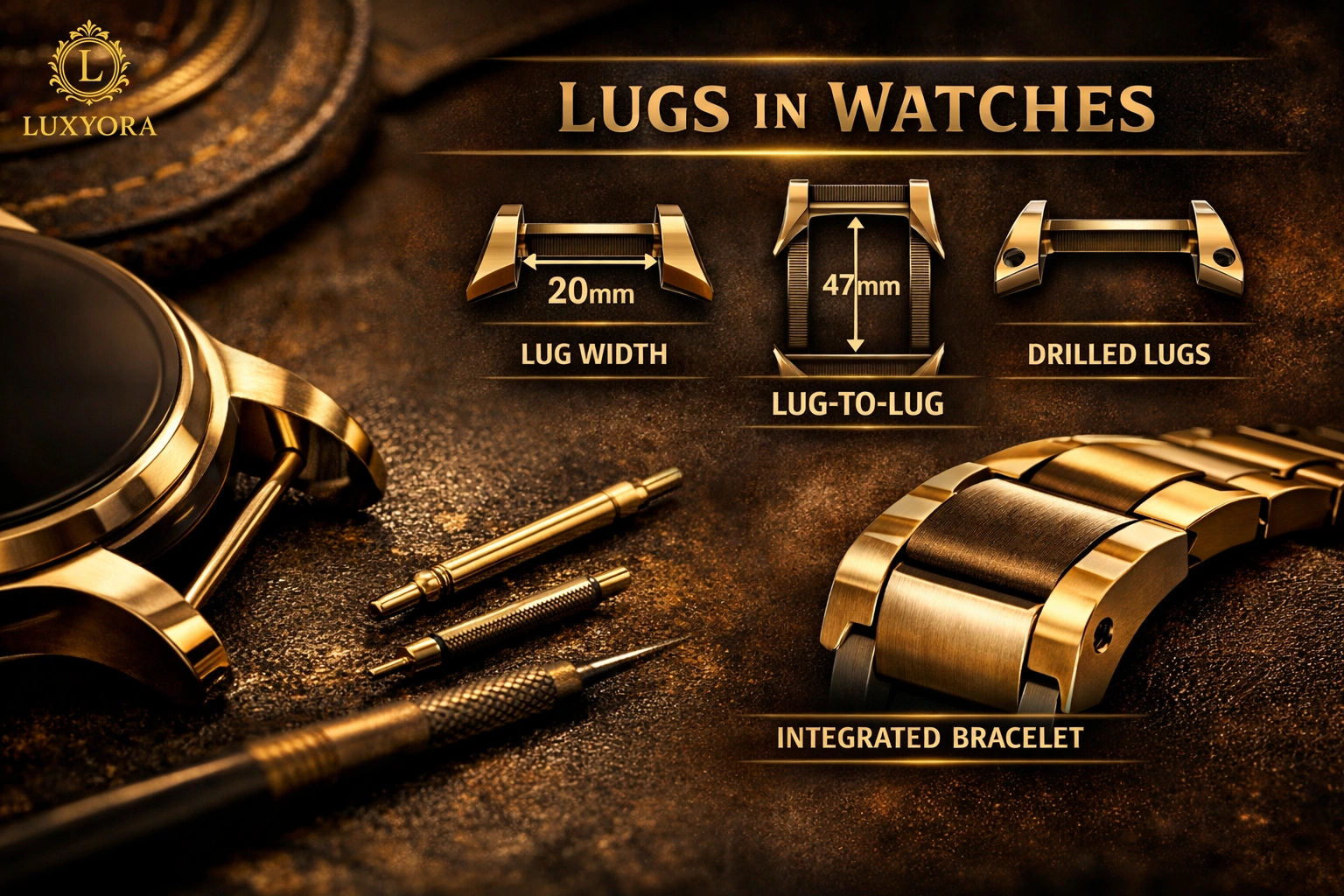
Lug width is the distance between the inside faces of the lugs on one side of the case. It determines what strap/bracelet width fits (e.g., 18mm, 20mm, 22mm). If you buy straps, the lug width is your “correct size.”
Pro tip: Lug width is typically measured in millimeters and is often an even number (18/20/22), though some watches use odd sizes.
B) Lug-to-lug (case length on wrist)
Lug-to-lug is the distance from the outer tip of the top lugs to the outer tip of the bottom lugs. It is often the most practical predictor of how large a watch wears, because it’s effectively the watch’s footprint along the wrist.
Watch media frequently emphasizes lug-to-lug alongside diameter and thickness when explaining fit and proportions.
Rule of thumb (not a law):
If the lug tips extend beyond the flat top of your wrist, the watch may feel unstable or visually “overhanging.” This idea appears frequently in discussions of fit and proportionality.
3) Lug design: where engineering meets style
Lugs aren’t just attachment points; they’re part of the case architecture. Watchmakers use lug geometry to control comfort and visual character:
Common lug characteristics that change the feel
- Downturned lugs: curve down to wrap the wrist (often improves comfort on smaller wrists).
- Long/straight lugscan make a watch appear larger because they increase the footprint.
- Short/compact lugs: help a watch wear smaller and more centered.
- Thickness and bevels: influence how “sharp,” “toolish,” or “dressy” a case looks.
Many educational lug guides map these choices to real-world wear-and-strap matching.
Signature lug forms (style keywords collectors use)
- Lyre / twisted lugs: a sculpted, twisting form strongly associated with Omega’s design language in modern sports watches.
- Hooded (shrouded) lugs: partially hidden under the case, giving a sleek, integrated look and a more “vintage” design flavor.
- Integrated lug concepts: designs that visually merge the case into the bracelet/strap are often sporty, but can reduce strap interchangeability.
4) Lugs and strap culture: why enthusiasts obsess over them
The modern watch scene has a strong “strap-switching” culture, and lugs are the gateway. Two practical features matter a lot:
A) Quick-release spring bars
Quick-release spring bars include a tiny built-in lever that lets straps be changed without tools, reducing the risk of scratching lugs during removal.
B) Drilled lugs
Some tool watches use drilled lugs (holes visible on the outside of the lug), which makes it easier to push the spring bar out, making them popular with field and dive-watch users. This is often discussed as a practical feature for frequent strap changes.
5) Lugs in manufacturing and finishing
From an industry perspective, lugs also entail manufacturing complexity and finishing costs. Crisp edges, symmetrical bevels, and consistent brushing/polishing across lug surfaces separate mediocre casework from excellent casework, especially on luxury watches where hand-finishing expectations are higher.
Watchmakers and industry commentators regularly point out that lug chamfers, flatness, and consistent case lines are central to perceived quality and refinishing standards.
6) Integrated bracelet watches: when “lugs” disappear (kind of)
In true integrated bracelet designs, the case may not have conventional lugs at all; the case effectively becomes part of the bracelet’s first link(s). This changes both the look and the ownership experience:
- Cleaner, continuous design line
- Often, less universal strap compatibility
- More reliance on brand-specific bracelet parts and fit systems
This is a key point in debates and definitions in modern watch design
7) Practical checklist: how to evaluate lugs before buying a watch
When a brand (or seller) posts specs, use this lug-focused checklist:
- Confirm lug width (strap size in mm).
- Look up lug-to-lug to estimate real wrist fit.
- Check lug curvature (downturned vs straight).
- Decide how much you care about strap swapping (integrated designs may limit options).
- If you’re rough on watches, consider quick-release straps and/or drilled lugs for safer changes.
References
- Schmidt, R. (2018). The Wristwatch Handbook: A Comprehensive Guide to Mechanical Wristwatches. Acc Art Books
- Stone, G., & Pulvirent, S. (2020). The Watch: Thoroughly Revised. Abrams.
- Delugs. (2022, May 26). New and improved quick release spring bars. (Delugs)
- Ethos Watches. (2025, July 31). Watch lugs and their role in ensuring well-fitted… (Ethos Watches)
- Fratello. (2024, June 4). Back to basics: How to read and use a watch’s spec sheet. (fratellowatches.com)
- Hodinkee. (2021, September 9). Watch specs: What they mean, why they matter. (Hodinkee)
- Hodinkee. (2022, February 18). A watch with an integrated bracelet is a highly specific thing. (Hodinkee)
- Hodinkee. (2024, February 20). The plea for proportionality. (Hodinkee)
- Monochrome Watches. (2018, April 25). Omega Seamaster Diver 300M Master Chronometer (hands-on). (Monochrome Watches)
- Nixon. (n.d.). What is watch lug width and how to measure it. (Nixon US)
- NOMOS Glashütte. (n.d.). The lug-to-lug measurement (glossary). (NOMOS Glashütte)
- The Watch Company. (2022, June 8). Understanding and measuring watch lugs: A thorough guide. (The Watch Company)
- Time+Tide Watches. (2024, July 22). Why lug-to-lug is the most important measurement. (Time+Tide Watches)
- Wristler. (2025, July 14). Watch lug styles explained: Fit, comfort & buying tips. (Wristler)
- Quill & Pad. (2021, December 25). The superficial value in refinishing/refurbishing Rolexes: A watchmaker’s rant (reprise). (Quill & Pad)
-