Watch Hands : What are Watch Hands
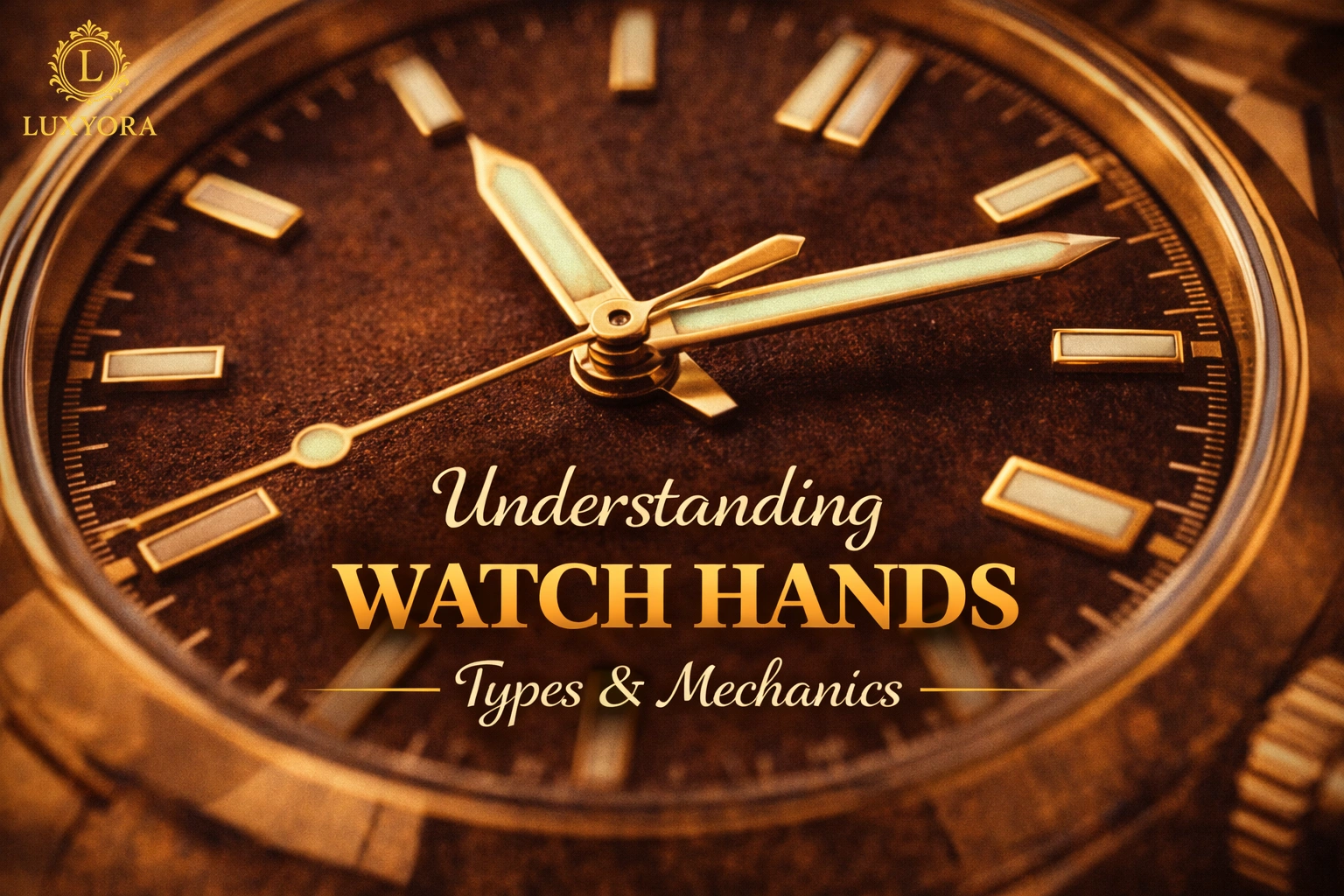
In watchmaking, hands are the moving indicators mounted on the movement’s hand stack (typically the hour, minute, and seconds) that display time against the dial’s markers and scales. They look simple, but the watch hands are a highly engineered interface between movement mechanics and human readability. Their shape, length, mass, finish, and luminous treatment influence everything from instant legibility to power efficiency and even perceived luxury.
A watch can have a beautifully finished dial, but if the hands are poorly proportioned, low-contrast, or misaligned, the watch will feel “off” every time you check the time. This is why hands are considered a key element of dial furniture and a strong signal of design competence and manufacturing quality.
1) What Watch Hands Do (Beyond “Pointing at Numbers”)
A. Deliver quick, accurate time reading
The primary purpose is to indicate time, but good hands do it with minimal cognitive effort. This depends on:
- Contrast (hands vs dial)
- Hierarchy (minute hand easy to distinguish from the hour hand)
- Length accuracy (minute hand reaching minute track, seconds hand reaching seconds hash marks)
Dive-watch guidance tied to ISO expectations emphasizes that hands, especially the minute hand, must be easily distinguishable in low light for safe elapsed-time reading.
B. Enable complication reading
Many watches add hands for:
- GMT/dual time
- Chronograph seconds
- Power reserve
- Retrograde displays
- Central date hands (pointer-date)
As complexity increases, hands must maintain a clear visual hierarchy to prevent clutter.
C. Communicate identity and category
Hand style instantly signals a watch’s “genre”:
- Sword hands often suggest pilot/tool-watch legibility
- Dauphine hands are strongly associated with dressy elegance
- Cathedral hands evoke vintage pilot or field style
This is a major topic in modern watch education guides.
2) How Hands Attach and Move (Key Industry Terms)
Watch hands are friction-fitted onto specific parts of the motion work:
- The hour hand mounts to the hour wheel (hollow, rotating once every 12 hours).
- The minute hand mounts to the cannon pinion, which rotates once per hour and is designed with controlled friction so it can be driven by the train, yet still allows hand-setting without forcing the entire gear train.
- The seconds hand mounts to the seconds pinion (often the fourth wheel axis in many architectures).
Why this matters: If cannon pinion friction is too tight, the setting feels stiff and can cause wear; too loose, and the minute hand can drift or lag.
3) Core Hand Types (Rich Keywords and Visual Vocabulary)
Here are widely used hand styles you’ll see in product descriptions and collector discussions:
Baton hands
Straight, simple, modern. Common to minimalist and sport-luxury designs.
Dauphine hands
Faceted, tapering, “diamond-like” hands that catch light and feel refined are often seen on dress watches.
Sword hands
Broad, angular hands built for visibility; widely used in pilot and dive watches because they can carry generous lume.
Alpha hands
Classic tapered profile with a wider base; common on vintage-inspired pieces.
Leaf/Feuille hands
Curved, leaf-like hands are frequently used in elegant dress watches to create a softer look and smoother proportions.
Cathedral hands
Segmented, often “stained-glass” inspired shapes associated with vintage pilot/field styles; typically designed for bold legibility.
Syringe hands
Needle/syringe-like profile popular in the field and in military-inspired watches; precise and highly legible.
Modern guides provide visual breakdowns and naming conventions for these hand styles and their typical use cases
4) Lume on Hands: Low-Light Readability and Safety
On sports watches and especially dive watches, luminous hands aren’t optional decoration; they are functional. ISO-related summaries commonly stress:
- Clear legibility at close viewing distance in darkness
- A running indicator (often a luminous seconds hand) to show the watch is operating
- High distinction of the minute hand for timing.
Modern watch hands often use photoluminescent pigments (commonly marketed under names such as Super-LumiNova). Application quality matters: uneven lume can look sloppy and perform inconsistently.
5) Materials and Finishing: Why Hands Signal “Luxury.”
Hands are typically made from metal (often brass or steel), then finished with:
- Polishing (mirror finishes)
- Brushing (tool-watch aesthetic)
- Plating (gold tone, rhodium tone)
- Heat bluing (traditional deep-blue finish on steel hands)
Because hands sit beneath the crystal and constantly reflect light, finishing errors are easy to spot. High-end watch books often highlight the importance of component finishing (including hands) in collectors’ evaluation of craftsmanship.
6) Proportion Rules: How Experts Judge Hands Quickly
A strong handset usually follows these “invisible rules”:
- The minute hand reaches the minute track
If it falls short, reading minutes becomes less precise. - The hour hand reaches the hour indices
A watch that is too long looks crowded; one that is too short reduces clarity. - The second hand reaches the seconds markers
Especially important on chronographs and precise sports watches. - Hands are distinguishable at a glance
Dive watch standards and guidelines emphasize this, especially the hour-versus-minute distinction. - Weight and balance are appropriate
Overly heavy hands can reduce amplitude and affect timekeeping stability, an engineering concern, not just a style issue.
7) Common Problems (And What They Mean)
- Hand misalignment: the minute hand not pointing exactly at the markers could indicate assembly issues or impact.
- Hand rub: touching the crystal/dial with your hands can stop the watch or cause scratches.
- Lume aging mismatch: hands glow differently than the markers, indicating replacement or uneven application.
- Loose cannon pinion behavior: minute hand “slips” or doesn’t advance smoothly.
Conclusion
In horology, hands are more than indicators; they’re a precision-designed system that merges mechanics (cannon pinion, hour wheel, friction fit) with human factors (legibility, hierarchy, contrast) and aesthetics (shape language, finishing, lume). Understanding hand types, dauphine, baton, sword, cathedral, leaf, and how hands interact with the motion work helps readers evaluate watches more intelligently and speak confidently about this essential industry term
References
Baldassarre, T. (2025, November 20). Watch hands: A guide to the 14 most popular styles.
Brunner, G. L. (2019). The Watch Book – Compendium. teNeues.
Horopedia. (n.d.). Cannon-pinion. Retrieved February 5, 2026.
International Organization for Standardization. (2018). ISO 6425:2018—Horology—Divers’ watches [Standard].
Oracle Time. (2024, July 5). Every style of watch hands explained.
Stone, G., & Pulvirent, S. (2018). The watch, thoroughly revised: The art and craft of watchmaking. Abrams.
The 1916 Company. (2021, February 23). What is a dive watch? (ISO 6425 definition & meaning).
Time+Tide Watches. (2024, September 9). Every part of a watch movement, from screw to pinion (cannon pinion and hand-setting friction).
Time+Tide Watches. (2025, January 5). The definitive watch hand style guide (watch education).
WatchGecko. (2025, May 27). Watch hands explained: A guide to popular styles.