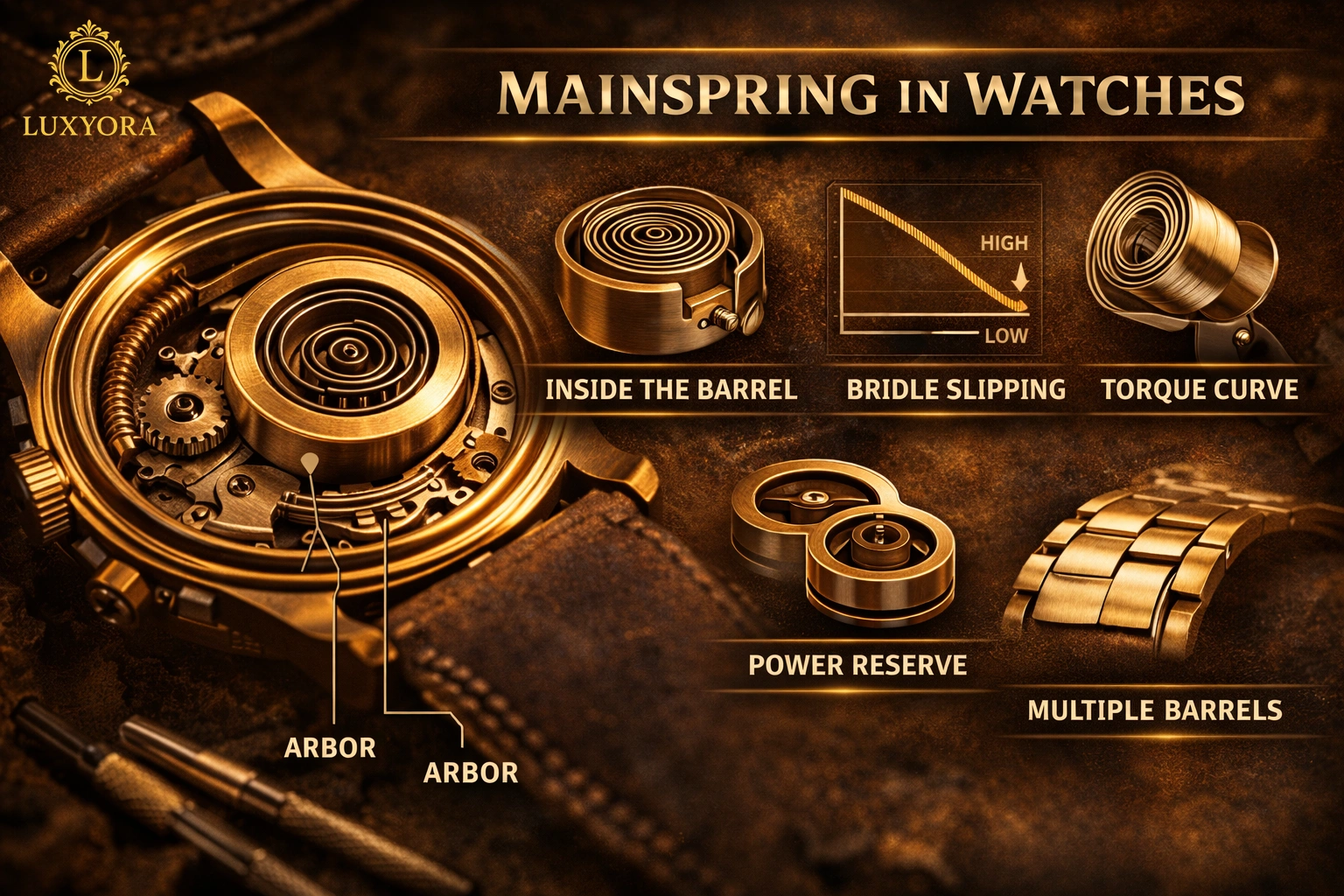
Mainspring : What is Mainspring
In mechanical horology, the mainspring is the heart of a watch’s energy system, the component that stores and releases the power that ultimately drives the gear train, escapement, and hands. If the balance wheel is the “heartbeat,” the mainspring is the fuel tank (or battery) that keeps the movement alive.
Understanding how a mainspring works its materials, geometry, torque behavior, and interaction with the barrel gives watch enthusiasts and professionals a deeper grasp of power reserve, accuracy, and long-term reliability.
1) What is a mainspring?
A mainspring is a long, thin strip of metal formed into a spiral coil. When you wind a watch (manually via the crown or automatically via the rotor), you tighten that coil and store potential energy. As the spring unwinds, it releases energy gradually, turning the barrel and driving the wheel train.
In most wristwatches, the mainspring lives inside a cylindrical housing called the barrel. The barrel isn’t just a container; it’s a functional transmission component with teeth around its outer edge that mesh with the movement’s gears.
2) The mainspring barrel system: arbor, barrel, and “going barrel” logic
A modern watch typically uses a going barrel arrangement:
- The inner end of the mainspring attaches to the arbor (a shaft connected to the winding mechanism).
- The outer end attaches to the barrel wall (or a bridle system, in automatics).
- When you wind, you turn the arbor and tighten the spring.
- When the watch runs, the mainspring’s force turns the barrel, and the barrel’s teeth deliver power to the gear train.
This design matters because it allows the watch to keep running while being wound, a key advantage over simpler spring arrangements used in some non-watch mechanisms.
3) Torque, isochronism, and why a mainspring affects accuracy
A watch’s timekeeping depends heavily on how consistently power is delivered to the regulating organ. The mainspring does not deliver perfectly constant torque across its entire unwind cycle. Torque tends to be weaker when the spring is nearly unwound and can become less stable near the extremes of wind as well, so movements are often designed to operate best in a more stable “middle” range.
This is why you’ll see watchmakers and technical writers talk about:
- Torque curve: how force changes over the reserve
- Amplitude: balance wheel swing affected by torque stability
- Isochronism: the ideal of consistent timekeeping regardless of wind state
The mainspring is central to all of it.
4) Power reserve: how mainsprings define runtime
Power reserve is how long a watch runs after a full wind. It’s closely tied to mainspring length, thickness, alloy behavior, and barrel dimensions.
How brands extend power reserve
- A larger barrel and longer spring (more stored energy), but this can increase torque variation if not managed carefully.
- Multiple barrels:
- Series coupling can increase power reserve and potentially improve torque consistency by using smaller springs that deliver more consistent torque.
- Multi-barrel systems are common in long-reserve watches (e.g., multi-day calibers).
- Optimized mainspring sizing inside the barrel (engineering the spring dimensions to shape the torque curve).
5) Automatic watches: the slipping bridle and the “no overwinding” concept
A common beginner question is: “Can I overwind an automatic watch?” In general, automatics are designed not to overwind because they use a slipping bridle system.
Instead of being rigidly hooked at the outer end, many automatic mainsprings have a sliding bridle that presses against the barrel wall. When the spring reaches full wind, it begins to slip along the barrel wall, controlled by specialized braking grease that prevents damaging over-tension while still allowing the rotor to continue winding.
This slipping system is a practical blend of engineering and lubrication science: the grease must allow controlled slip while maintaining enough friction to transmit power effectively.
6) Mainspring materials: from steel to modern alloys like Nivaflex
Historically, mainsprings were made of steel, but modern watchmaking relies heavily on specialized alloys commonly grouped under the Nivaflex family, selected for elasticity, corrosion resistance, and stability.
For example, horological sources describe Nivaflex as a complex cobalt-based alloy used primarily for mainsprings, valued for performance characteristics relevant to precision watchmaking.
Why alloys matter (industry keywords):
- Anti-magnetic behavior (helps stability in modern life)
- Corrosion resistance (humidity and age)
- High tensile strength (thin springs storing significant energy)
- Better fatigue performance (longer service life)
7) Manufacturing and quality: why a “simple spring” is hard to perfect
While it looks humble, the mainspring is a high-stress engineered part. Manufacturing challenges include:
- Precise thickness tolerances (tiny changes affect torque and reserve)
- Heat treatment and surface finishing
- Consistency at scale (especially for high-volume calibers)
- Lubrication strategy (particularly for slipping bridle automatics)
Watchmaking content that looks “from the bench” often highlights the precision and process control required for mainsprings, which determine much of the user experience, reserve length, winding feel, stability, and reliability.
8) Servicing and safety: mainsprings store serious energy
From a practical watch-repair standpoint, mainsprings must be handled carefully. Even a small wristwatch spring stores enough energy to cause damage to parts or injury if released uncontrollably. This is why professionals use mainspring winders and follow controlled procedures for letting down power and reinstalling springs.
9) Why the mainspring remains a core “innovation zone.”
Even though the mainspring is centuries-old technology, it remains an area of ongoing refinement: controlling the torque curve, increasing reserve, improving alloys, and enhancing efficiency through barrel engineering. Recent technical commentary continues to focus on barrel architecture and spring dimensions as among the most direct routes to improved real-world performance.
References
Schmidt, R. (2018). The Wristwatch Handbook: A Comprehensive Guide to Mechanical Wristwatches. ACC Art Books.
Stone, G., & Pulvirent, S. (2020). The Watch: Thoroughly Revised. Abrams.
Beyond the Dial. (2022, February 1). How watches work, episode 3: Movements as torque… (BEYOND THE DIAL)
Chrono24. (2020, May 22). A watch’s energy source: The mainspring. (Chrono24)
Ciechanowski, B. (2022, May 4). Mechanical watch. (ciechanow.ski)
Esslinger. (2019, December 24). How to wind a mainspring with the Bergeon mainspring winders. (Esslinger Watchmaker Supplies Blog)
Forster, J. (2020, January 6). In-depth: Consider the mainspring. Hodinkee. (Hodinkee)
Hamilton Jewelers. (2018).
Understanding what power reserve means. (Hamilton Jewelers)
Oak & Oscar. (2023a, February 3). From the bench: Mainspring mechanics. (Oak & Oscar)
Oak & Oscar. (2023b, January 9). From the bench: The truth about “overwinding”. (Oak & Oscar)
SJX (Watches by SJX). (2024, March 8). Explained: Barrels, mainsprings, and the trade-off… (SJX Watches)
SJX (Watches by SJX). (2025, November 7). In-depth: Balancing mainspring dimensions inside the barrel. (SJX Watches)
Swisswatches Magazine. (2026, January 8). The most important watch anniversaries of 2026. (Swisswatches Magazine)
The 1916 Company. (2020, November 13). Days to spare: The world of long power reserves. (The 1916 Company)
The Naked Watchmaker. (2026). Making: Mainsprings (at Générale Ressorts). (The Naked Watchmaker)
Wikipedia. (2026). Nivaflex. (Wikipedia)