Vintage Reissue Luxury Watches | Luxyora
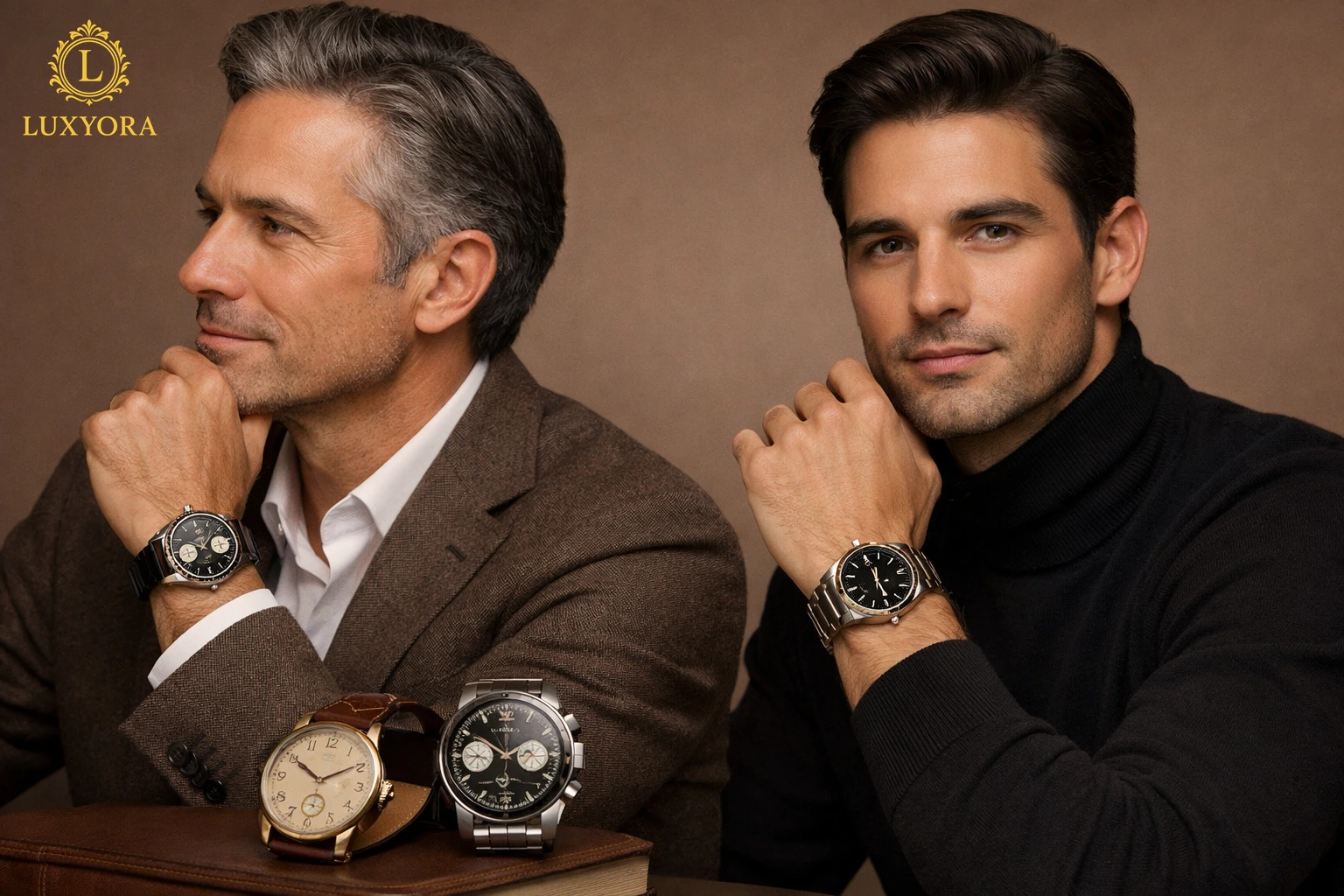
There’s something truly captivating about a watch that seems to have stepped out of a past era yet feels perfectly at home today. That’s the special charm of vintage reissue luxury watches: they do more than bring back an old design; they reopen a mood, a proportion, and a way of making beauty useful once again. In recent years, archive-inspired models have returned in a big way, not as mere museum pieces but as sophisticated modern creations influenced by history and crafted with today’s precision. Throughout the industry, the love for heritage-inspired watch design has grown, fueled by consumers’ increasing appreciation for authenticity, tactile quality, and craftsmanship that can be admired up close and felt on the wrist.
What makes this movement so captivating is how it beautifully blends style, engineering, and cultural longing. Collectors truly appreciate the warmth of mid-century dial typography, the subtlety of smaller case proportions, the elegance of stepped bezels, sector dials, box-shaped crystals, brushed steel, gilt accents, and the charming curves of domed profiles. At the same time, they also look for modern reliability better water resistance, durable alloys, anti-magnetic performance, improved shock protection, tighter manufacturing standards, and more stable luminous compounds than the delicate or radioactive materials of the past. This isn’t just about nostalgia; it’s a design philosophy where the old becomes a thoughtful blueprint for relevance.
Why Vintage Reissue Luxury Watches Matter Now
The return of archive-inspired watchmaking is not an accident. It reflects a broader luxury shift away from excess for its own sake and toward meaning, provenance, and considered design. In a market saturated with novelty, reissues offer an emotional shorthand. They suggest continuity. They imply that a design survived because it deserved to. That matters in luxury, where permanence is often more seductive than trend.
There is also a practical beauty to the category. Many historical watches were designed with unusual clarity because they came from eras when legibility, utility, and compact wearability were non-negotiable. The best reissues preserve these virtues. Slim bezels create expansive dials. Pencil or syringe hands read cleanly. Arabic numerals or applied markers are often more balanced than many modern alternatives. Cases in the 36 to 39 millimeter range sit elegantly on a wide range of wrists, a feature that has become increasingly desirable after years dominated by oversized sports watches. Contemporary commentary on watch design has noted that vintage-inspired pieces continue to resonate precisely because they combine romance with highly evolved usability.
And then there is the cultural angle. Mechanical watches today are rarely essential tools in the old sense. Their value lies in ritual, identity, and object quality. That reality makes history a powerful design asset. When a watch draws from an archive, it taps into a language that people already trust: restrained proportions, balanced symmetry, tactile finishes, and visible references to aviation, diving, travel, dress, or motorsport heritage. These codes feel grounded. They carry a narrative weight that many new-from-scratch designs struggle to build overnight.
The Difference Between a Reissue, a Revival, and Vintage-Inspired Design
For anyone writing or shopping in this space, precision matters. Not every old-looking watch is a true reissue.
Reissue
A reissue typically attempts a faithful return of a historically specific reference. That may mean similar dimensions, dial layout, hand shapes, bezel architecture, movement format, or even re-created manufacturing details. Some of the strongest examples in recent years have gone so far as to digitally scan the original movement architecture or case geometry to preserve historical fidelity while updating select technical elements for durability and serviceability.
Revival
A revival tends to be broader. It brings back a historic line, family, or design code without recreating a single original piece detail by detail. It may borrow the silhouette, proportions, or naming tradition, then reinterpret the rest.
Vintage-Inspired Model
A vintage-inspired watch uses the visual vocabulary of the past without claiming to reproduce a precise historical reference. It may include faux-aged lume, domed crystals, old-style typography, or retro color palettes, but its architecture is often entirely contemporary. Industry commentary has pointed out that this category can range from deeply thoughtful to overly sentimental, depending on whether the design evokes the past or merely imitates its surface.
For SEO and editorial clarity, vintage reissue luxury watches, archive-inspired watches, heritage watch design, retro-inspired timepieces, and modern reissue watches are related but not interchangeable terms. The nuance is part of the appeal.
The Archive as Design Laboratory
The most intelligent archive-inspired models do not treat old catalogues like costume departments. They treat them like technical and aesthetic laboratories. That is where the category becomes truly interesting.
A historical dial, for example, may reveal how negative space once played a larger role in readability. A 1940s or 1950s case can show how lugs were sculpted to create visual finesse rather than blunt mass. An older chronograph may demonstrate how sub-dial spacing once felt more graceful because it was dictated by movement geometry rather than marketing preference. Reissue design succeeds when these lessons are absorbed rather than merely copied.
This is also where material knowledge comes into play. A vintage watch might have used plexiglass, radium-based lume, plated brass hands, or thin stamped components because those were the best available solutions at the time. A modern reissue can visually honor those features while improving them: sapphire can be shaped to resemble box acrylic; luminous compounds can echo aged tritium tones without its instability; stainless steel finishing can alternate between satin and mirror polish with far sharper transitions than older industrial tooling allowed; and advanced alloys can preserve crisp bevels longer in daily wear. Even chemically stable movement finishes have been used in modern heritage-minded calibers to echo older warmth while improving longevity.
That balance is the whole game. Too much historical purity, and the watch risks becoming inconvenient or fragile. Too much modernization, and the archive reference loses its emotional voltage.
Craftsmanship Insight: Why Reissues Often Look Better Up Close
One of the quiet pleasures of today’s best archive-inspired watches is that they frequently outperform their ancestors in pure execution, even while appearing older at first glance.
Dial Furniture and Surface Depth
Vintage dials were often beautiful because of proportion, but not always because of manufacturing precision. Today, dial makers can achieve finer printing tolerances, more consistent lacquer surfaces, sharper applied indices, and more nuanced texturing. A matte dial can be velvety rather than chalky. A brushed finish can catch light with more discipline. Recessed registers can be cleaner. Even the seemingly simple act of recreating old fonts or scales now benefits from digital restoration and higher-resolution tooling.
Case Finishing and Geometry
Older watches often had softer transitions after polishing, aging, and servicing. A modern reissue can recreate the silhouette while presenting it at its architectural best: crisp chamfers, more exact brushing grain, cleaner lug undersides, and more controlled bezel knurling. That means the watch can feel more luxurious than the original while still carrying the same spirit.
Crystals, Lume, and Color Temperature
A detail many casual buyers overlook is color temperature. The finest reissues are careful about how warm or cool the dial appears. Cream-toned lume, gilt printing, silvered chapter rings, eggshell surfaces, charcoal sub-dials, and warm black lacquer can be calibrated to suggest age without tipping into parody. The same goes for crystals. A box sapphire that distorts at the edge like old acrylic can dramatically affect the emotional read of a watch. It is a tiny engineering decision with major stylistic consequences. Commentary on faux patina shows just how much debate surrounds this one choice alone, which proves how sophisticated the audience has become.
Why Collectors Are Drawn to Smaller Proportions Again
Case size is one of the clearest signs of the archive return. For years, larger diameters signaled presence. Now, many enthusiasts are rediscovering the visual confidence of compact watches. Vintage-inspired reissues have helped drive that shift by reminding wearers that elegance often comes from proportion, not scale.
A smaller watch can be worn more easily under a cuff, feel more balanced on the wrist, and look more intentional in both formal and everyday settings. It also tends to let the details breathe. A 37 millimeter case with a wide dial opening, slim bezel, and gently curved lugs can have far more character than a bulkier watch chasing size for its own sake. This renewed interest in classic sizing is not merely nostalgic. It reflects a more mature idea of luxury: one rooted in comfort, discretion, and refinement rather than visual volume.
The Tension Between Authenticity and Performance
No discussion of vintage reissue luxury watches is complete without addressing a central tension: how far should a modern remake go in preserving the original?
Collectors often want authenticity in visible details, but they also expect convenience. Few people want moisture anxiety, weak lume, or a movement too delicate for everyday life. So the strongest archive-inspired models tend to modernize invisibly. They improve gaskets, metallurgy, shock resistance, magnetic resilience, and serviceability while leaving the emotional architecture intact.
This is why many of the most respected recent revivals are not direct facsimiles. They are edited. Dimensions may be adjusted slightly for present-day wear. Movements may be re-engineered or resumed in production through contemporary methods. Case construction may be strengthened. Crystals may shift from acrylic to sapphire. Yet if the watch still preserves the line, mood, and historical honesty of the original, enthusiasts usually accept the compromise. Some of the most celebrated recent heritage releases have drawn praise precisely because they managed to feel “vintage, made today,” which is arguably the ideal description of the genre.
Why Archive-Inspired Models Perform So Well in Luxury Storytelling
From an editorial and SEO standpoint, archive-inspired models have a unique strength because they deliver across multiple search intentions simultaneously. They serve readers looking for:
- heritage watch design
- vintage reissue luxury watches
- retro-inspired luxury timepieces
- smaller case luxury watches
- handcrafted dial and case finishing
- historically accurate watch reissues
- collector-focused modern mechanical watches
That breadth matters because the category bridges style content, collector education, craftsmanship analysis, and buying intent. A reader may arrive for aesthetics, then stay for movement history, finishing insight, or historical context. In content strategy terms, it is a rich intersection of desirability and expertise.
It also helps that reissues come with built-in narrative tension. Is the watch a faithful recreation or a creative reinterpretation? Does it use archival cues responsibly? Does it honor old functionality or market it? Those questions create the kind of layered editorial conversation that modern luxury readers enjoy. They do not want generic praise. They want discernment.
The Future of Vintage Reissue Luxury Watches
The archive wave is not likely to disappear soon, but it will become more demanding. Consumers are becoming sharper. They can spot lazy retro styling. They know when a beige lume plot is doing too much. They understand that heritage should be more than a marketing adjective.
That means the future belongs to reissues with intellectual rigor. Expect more attention to historically correct case profiles, more sophisticated dial restoration, more nuanced finishing, and a stronger emphasis on the original purpose of a design rather than its superficial styling cues alone. We are also likely to see more movement-level revivals, where the mechanism itself becomes part of the historical comeback story rather than merely the shell around it. Recent examples of resumed or archive-derived caliber storytelling suggest that this movement is already underway.
There is, however, a bigger truth underneath the trend. Archive-inspired watches return because they answer a deeply modern desire: to own something with memory without compromising. Something storied, but still sharp. Something composed enough to feel timeless, yet alive enough to feel now.
Buying Perspective: What to Look for in an Archive-Inspired Watch
For readers and collectors evaluating this category, a few markers separate a meaningful reissue from a merely retro object.
Proportion Before Hype
First, look at the diameter, thickness, lug length, bezel width, and dial opening. Archive-inspired beauty usually lives in proportion.
Finishing That Rewards Closer Inspection
Check the edge transitions, brushing consistency, handset quality, printed scales, and crystal shape. Reissues should feel thoughtful under magnification, not just attractive in campaign photography.
Historical Honesty
The best pieces know what they are reviving and why. They preserve a specific visual grammar rather than scattering random nostalgic signals.
Modern Utility in the Right Places
Better seals, more durable materials, stable lume, and dependable movement architecture are not betrayals of history. They are the reason a reissue can actually be worn and loved now.
Conclusion: The Luxury of Returning Well
Vintage reissue luxury watches are flourishing because they offer a rare kind of sophistication. They do not scream innovation, yet they often reveal it in subtler ways: in crystal engineering, in caliber reconstruction, in improved finishing tolerances, in nuanced historical editing. They transform archival memory into present-tense elegance.
And that is the real seduction. Not that they look old, but that they make the past feel expertly dressed for today.
Luxyora Philosophy: True luxury does not chase time; it converses with it. The finest objects return not to repeat history, but to prove that beauty with memory is beauty with depth.
References:
Fratello Watches. (2023, September 4). Retro styling in watches: Cool or a little disingenuous? (Fratello Watches)
Fratello Watches. (2024, June 13). Why do watch brands keep looking backward for good design? (Fratello Watches)
Hodinkee. (2020, January 7). Introducing the Speedmaster Caliber 321 in stainless steel. (Hodinkee)
Hodinkee. (2022, May 12). A deep dive on the modern Type XX. (Hodinkee)
Hodinkee. (2025, November 6). Introducing the Tribute to Compax – inspired by Nina Rindt and powered by vintage movements. (Hodinkee)
Fratello Watches. (2025, November 18). Introducing the new Planet Ocean, freshly revamped for its 20th anniversary. (Fratello Watches)