Chronograph : What is Chronograph
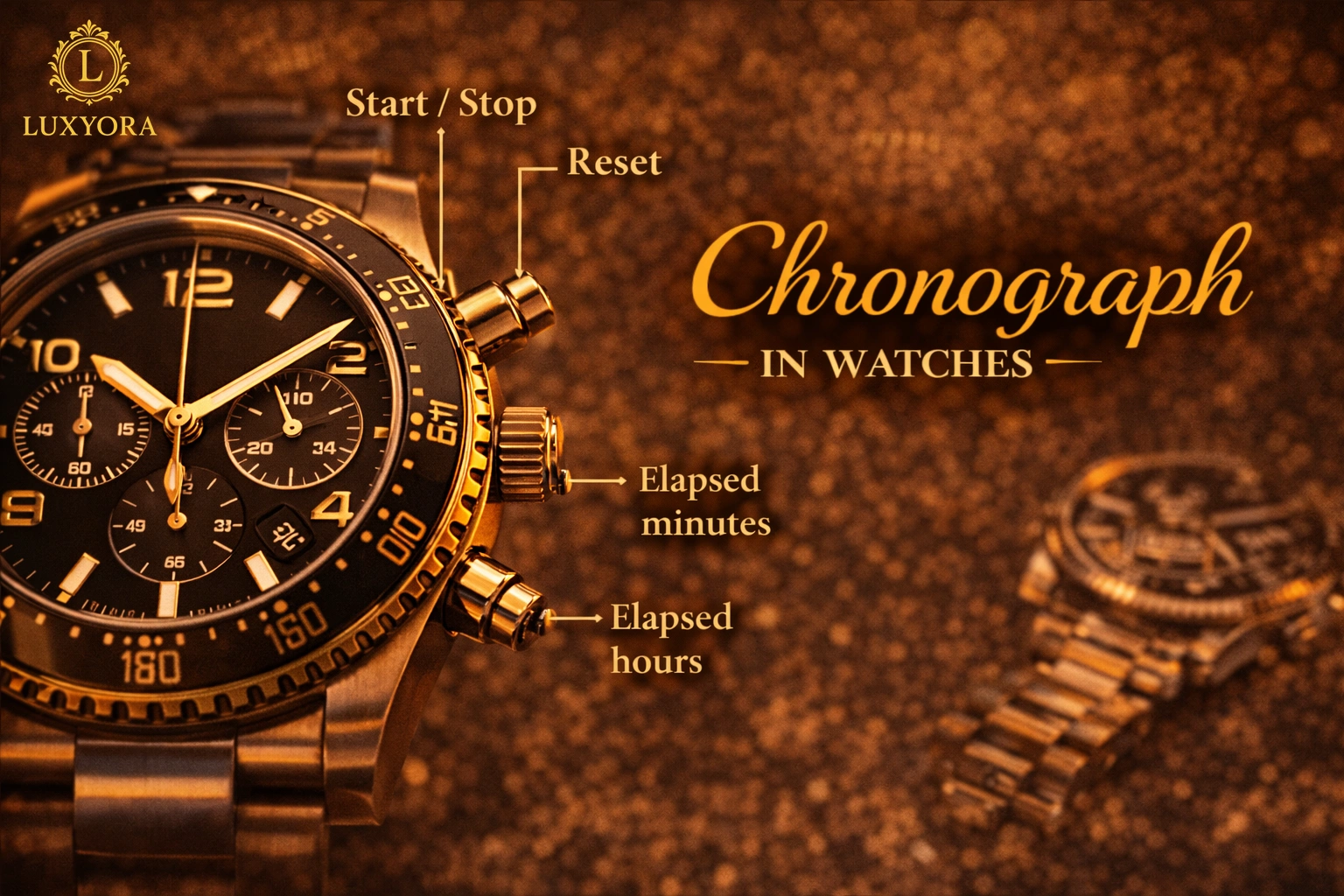
In watchmaking, a chronograph is a watch fitted with an additional timing function that works like a stopwatch, allowing you to start, stop, and reset an elapsed-time measurement while the watch continues to display standard time. Industry references describe it as a watch complication operated via pushers (typically at 2 o’clock and 4 o’clock) to measure continuous or interrupted intervals.
Chronographs remain one of the most popular complications because they blend mechanical drama (levers, clutches, column wheels) with real utility: timing workouts, cooking, parking, race laps, flight legs, or any event where “how long did that take?” matters.
What Makes a Watch a Chronograph?
A chronograph watch usually includes:
- Two pushers:
- Start/Stop (often at 2 o’clock)
- Reset (often at 4 o’clock)
- A central chronograph seconds hand (often the large hand sweeping around the dial)
- One or more sub-dials (registers) to count elapsed minutes and/or hours.
A key point for learners: the chronograph’s “seconds” hand is usually not the same as the running seconds used for normal timekeeping. Many chronographs place normal seconds on a small sub-dial (“small seconds”) while the large central hand is reserved for timing events.
How a Chronograph Works Inside
A mechanical chronograph adds a dedicated mechanism that can be engaged or disengaged from the watch’s going train. When you press the pusher, a sequence of levers and switching parts engages the chronograph, allowing it to receive power and drive the timing hands. TAG Heuer’s technical explainer frames this as a coordinated system of gears, wheels, and levers that measure intervals when activated.
From an “industry term” perspective, the most important internal concepts are:
The switching system: Column wheel vs cam (cam-and-shuttle)
- Column wheel chronograph: uses a rotating “castle-like” wheel to coordinate start/stop/reset commands; often praised for smooth pusher feel and crisp mechanical choreography.
- Cam (or cam-and-shuttle) chronograph: uses a cam system to route commands; often considered robust and cost-effective in many architectures.
The clutch: Horizontal (lateral) vs vertical
The clutch couples power to the chronograph train.
- Horizontal (lateral) clutch: engages via lateral gear meshing; it can be visually satisfying (you can often see the mechanism), but it can create a slight “jump” when the chronograph seconds hand starts, depending on execution.
- Vertical clutch: engages through friction coupling (often compared to an automotive clutch), frequently associated with smoother starts and better suitability for running the chronograph continuously in some designs.
- A recent technical explainer focused on how the vertical clutch acts as the mechanical link between the going train and the chronograph mechanism, and why its design offers different pros/cons compared with horizontal clutches.
Integrated vs Modular Chronograph Movements
Another important “caliber-level” distinction is how the chronograph is built:
- Integrated chronograph: the chronograph is designed as part of the base movement architecture from the start.
- Modular chronograph: a time-only base movement drives a chronograph module mounted on top.
Manufacturing-level writing by Vaucher describes chronograph construction and contrasts system organization (column wheel vs. cam) and construction approaches (integrated vs. add-on/module).
For buyers, this matters because it can influence thickness, pusher feel, service approach, and sometimes the layout of sub-dials.
Chronograph Scales: Tachymeter, Telemeter, Pulsometer
Many chronographs become even more functional through printed or engraved scales:
- Tachymeter: calculates speed over a known distance (common on racing chronographs)
- Telemeter: estimates the distance to an event you can see and hear (e.g., lightning and thunder)
These are commonly explained in chronograph usage guides alongside pushers and sub-dials.
These scales are why chronographs have such strong ties to motorsport, aviation, and tool-watch culture.
Major Types of Chronographs You’ll Hear in the Industry
Standard (simple) chronograph
Start/stop/reset timing with basic elapsed readouts. This is the “everyday chronograph” most people mean.
Flyback chronograph
A flyback lets you reset and restart timing with a single action (useful when timing consecutive intervals without stopping first). A mainstream explainer highlights flyback and rattrapante as notable advanced variations beyond simple chronographs.
Rattrapante (split-seconds) chronograph
A rattrapante (split-seconds) has two superimposed seconds hands; one can be stopped to record an intermediate time while the other continues, then it “catches up” (rattrape) to rejoin. Hodinkee’s explainer introduces this as a chronograph variant designed to time two events that start together but end at different moments.
These terms are “industry signals”: when you see them in a watch description, they usually indicate higher mechanical complexity and price.
Why Chronographs Matter in Today’s Watch Market
Chronographs are popular because they combine:
- Story and heritage (motorsport timing, pilot navigation, space-era tool watches)
- Mechanical engagement (pushers, clutch engagement, reset-to-zero action)
- Everyday utility (timing tasks without a phone)
Modern media discussions still compare chronograph architectures in real products, such as cam-and-shuttle with horizontal clutch vs column wheel with vertical clutch, because these engineering choices shape tactile feel, smoothness, and perception of refinement.
Practical Tips for Using a Chronograph Correctly
- Start: press the top pusher (commonly 2 o’clock).
- Stop: press the same pusher again to freeze the measurement.
- Reset: press the bottom pusher (commonly 4 o’clock) only after stopping.
- If your watch has a tachymeter/telemeter, learn the scale logic so that those rings are there to be used.
References
Brunner, G. L. (2023). The Watch Book: Compendium – Revised Edition. teNeues. (Offline reference)
Ethos Watches. (2023, May 31). What a chronograph is, and all the different types (mechanism & variations). (Ethos Watches)
GMT Publishing. (2023). The Millennium Watch Book: Chronographs. GMT Publishing. (Offline reference) (Europa Star)
Hodinkee. (2018, July 18). Split-seconds chronographs explained (rattrapante). (Hodinkee)
Hodinkee. (2026, January 15). Hands-On: Comparing modern chronograph systems (cam-and-shuttle/horizontal clutch vs column wheel/vertical clutch). (Hodinkee)
TAG Heuer. (2023, September 26). Timing is everything: The inner workings of a chronograph. (TAG Heuer Official Magazine)
TAG Heuer. (n.d.). FAQ: What is a chronograph? (Accessed 2026). (faq.tagheuer.com)
Chrono24. (2018, September 20). What is a chronograph and how does it work? (chrono24.in)
Chrono24. (2020, January 30). What are flyback and rattrapante chronographs? (chrono24.in)
Vaucher Manufacture Fleurier. (2022). Integrated chronograph: The charm and usefulness of the column wheel (systems and construction types). (Vaucher Manufacture Fleurier)
Watches by SJX. (2024, September 20). Explained: The vertical clutch of a chronograph. (SJX Watches)
Schmidt, R. (2019). The Wristwatch Handbook: A Comprehensive Guide to Mechanical Wristwatches. ACC Art Books. (Offline reference)