Crystal in Watches : What is Crystal in Watches
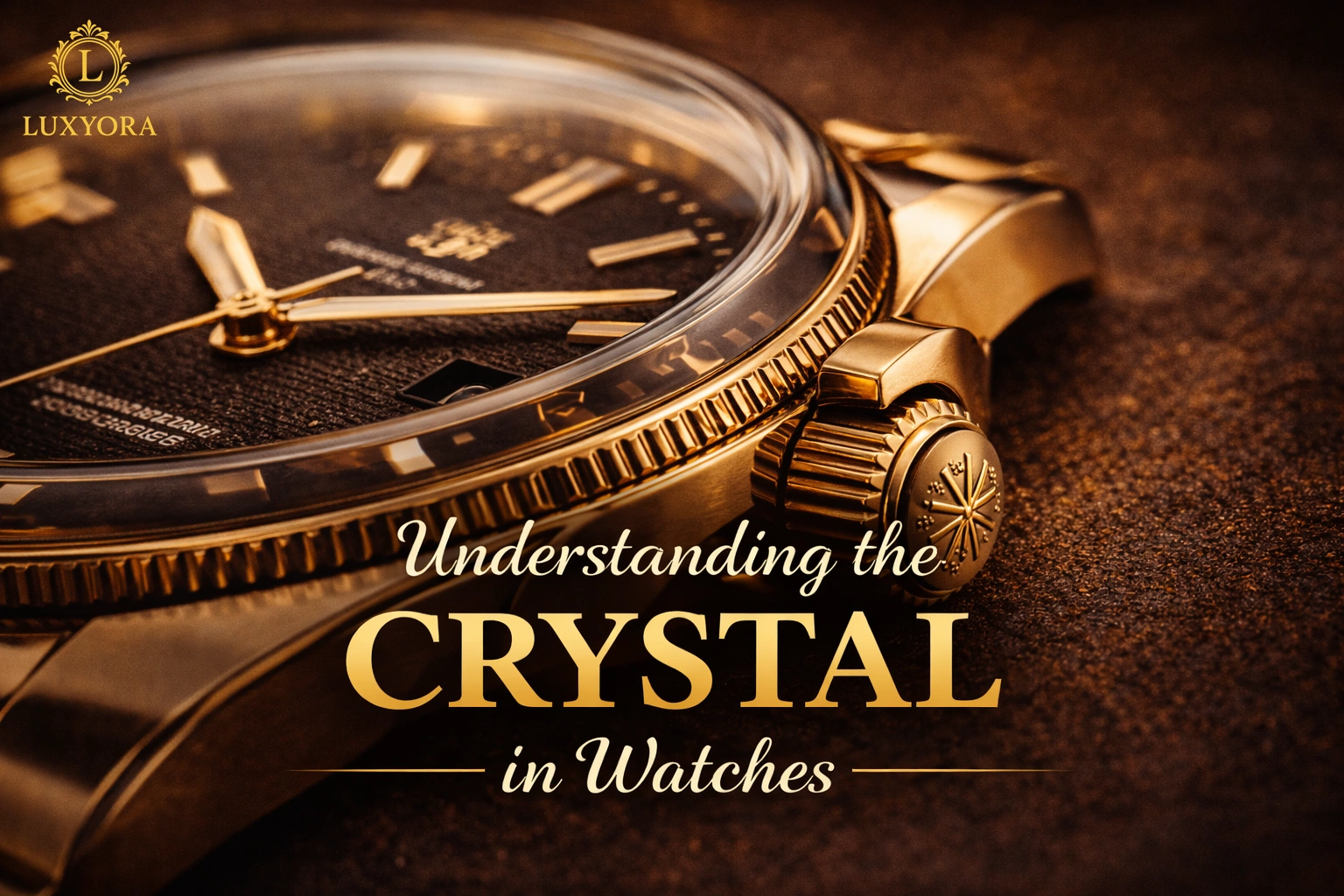
In watchmaking, the crystal is the transparent cover fitted over the dial (and sometimes also on the caseback) that protects the movement and dial while allowing a clear view of the time. Although it appears to be “just the glass,” the crystal is a critical performance component that influences scratch resistance, shatter resistance, water resistance, reliability, glare control, and optical clarity.
From sapphire crystal to mineral glass and acrylic (Hesalite/plexi), crystal choice is one of the most important decisions in case design, especially for sports watches and dive watches.
This article explains the term “crystal” in an educational, industry-aligned way and helps readers understand how to evaluate a watch crystal like a professional.
What a Watch Crystal Does
A watch crystal has four primary jobs:
- Protection: It shields the dial, hands, and movement from impacts, dust, sweat, salt, and moisture.
- Visibility: It provides a clear view of the time and dial details.
- Sealing support: Together with gaskets, it contributes to the watch’s ability to maintain water resistance.
- Optics and aesthetics: Crystal shape and coatings affect reflections, distortions, and “feel” (vintage warmth vs modern sharpness).
Rolex describes modern watch crystals as highly durable sapphire and notes the use of anti-reflective coating (including on the Cyclops lens area for date readability).
The Three Main Crystal Materials (With Industry Keywords)
A) Sapphire crystal (synthetic sapphire/corundum)
Sapphire crystal is made from synthetic corundum (aluminum oxide). It is prized for its high scratch resistance. In gemological terms, sapphire (corundum) ranks 9 on the Mohs hardness scale, which explains why it resists everyday scratches far better than most materials.
Strengths (keywords):
- Scratch resistance
- Premium clarity and crisp look
- Common for luxury watches and many modern tool watches
- Often used for display casebacks (sapphire exhibition backs), because it can be engineered to maintain sealing while offering visibility.
Trade-off:
- Sapphire is more prone to shattering or chipping from sharp impacts than acrylic (which tends to deform rather than crack). This is why some brands and use-cases still prefer acrylic.
B) Mineral crystal (hardened mineral glass)
Mineral crystal is a form of hardened glass used widely in affordable and mid-range watches. It typically offers a good balance of impact resistance and cost, but scratches more easily than sapphire.
Many online educational sources describe mineral glass as typically around Mohs 5–6, well below sapphire’s 9.
Strengths (keywords):
- Cost-effective
- Generally decent impact resistance
- Easy to mass-produce and replace
Trade-off:
- More likely to show scratches from sand, grit, and daily wear compared with sapphire.
C) Acrylic crystal (plexiglass / Hesalite / PMMA)
Acrylic crystals are plastic-based and are known by names like plexiglass and Hesalite (a term popularized by Omega). Acrylic watch crystals are commonly made from PMMA (polymethyl methacrylate).
Strengths (keywords):
- Excellent shatter resistance (often cracks less catastrophically than glass)
- Light weight
- Warm, vintage optical look
- Scratches can often be polished out, restoring clarity
Trade-off:
- Acrylic scratches more easily than mineral or sapphire, so it needs occasional polishing and careful handling.
A comprehensive technical overview of crystal types notes that acrylic/plexiglass, mineral, hardened mineral treatments, and sapphire each fall at different points on the scratch-vs-impact spectrum.
Crystal Shapes and Profiles (Why Shape Matters)
Crystal geometry changes both aesthetics and performance:
- Flat crystal: Modern, clean look; often minimizes distortion.
- Domed crystal: Common on diver and vintage-inspired watches; can improve viewing angles and style, but may introduce edge distortion depending on thickness and curvature.
- Boxed crystal (boxed sapphire / boxed acrylic): A vintage “tall” profile with crisp side walls; popular for retro designs.
- Beveled or edge-treated sapphire: Improves visual integration with the bezel and case.
Crystal shape also affects how reflections behave, especially when combined with coatings.
Anti-Reflective Coating (AR): The Science Behind Better Legibility
Anti-reflective (AR) coating is a thin-film treatment applied to crystals to reduce glare and improve dial visibility under bright light. Scientifically, AR coatings work via thin-film interference, reducing reflected light intensity through destructive interference.
Common AR configurations
- Inner AR (underside only): Reduces reflections while protecting the coating from scratches.
- Double-sided AR (both sides): Strongest glare reduction, but the outer coating can show wear or scratches over time.
Rolex explicitly references anti-reflective treatment on sapphire in its case/cyclops discussion, highlighting the brand’s emphasis on readability.
Special Crystal Features You’ll Hear in the Watch Industry
Cyclops lens (date magnifier)
A Cyclops is a magnifying lens over the date window, often integrated into sapphire (sometimes described as milled or formed as part of the crystal design, depending on brand approach). Rolex discusses the Cyclops and its optical purpose: improving date legibility.
Display (exhibition) caseback crystals
Many mechanical watches include a sapphire crystal on the caseback to reveal the movement. Rolex describes using sapphire for transparent casebacks while preserving waterproofness.
Hardened mineral variants (e.g., brand proprietary names)
Some brands use proprietary hardened mineral glass. For example, Seiko is well known for “Hardlex” in certain lines, often described as a hardened mineral compound positioned between standard mineral and sapphire in terms of price-to-performance.
How to Choose the Right Crystal (Practical Guidance)
Choose sapphire crystal if:
- You want maximum scratch resistance
- You prefer a crisp, modern look
- You value resale and “premium spec” perception
Choose a mineral crystal if:
- You want a balanced, affordable daily watch
- You prioritize impact tolerance with reasonable clarity
- You’re okay with occasional scratches or replacement
Choose acrylic/Hesalite if:
- You want classic vintage aesthetics
- You prefer shatter resistance for certain rugged scenarios
- You don’t mind periodic polishing
A useful way to remember the trade-off is: harder = more scratch-resistant, but not necessarily more impact-resistant. Watch education sources emphasize that scratch hardness and impact toughness are different properties.
Crystal Care, Maintenance, and Replacement
Best practices (easy wins):
- Rinse the watch after exposure to saltwater or sweat (if the watch is water resistant and the crown is secured).
- Avoid wiping dust/grit with a dry cloth, as this can dislodge particles and spread them across the crystal.
- Use microfiber and gentle cleaning solutions for fingerprints.
When to service:
- Deep chips, cracks, or edge damage
- Persistent fogging/condensation (this is urgent)
- AR coating wear that affects readability
Crystals are replaceable components, but replacing them on high-end watches often requires proper gaskets, proper torque, and pressure testing to preserve water resistance.
Conclusion
The crystal is a core watchmaking component that merges materials science, optics, and case engineering. Understanding sapphire, mineral, and acrylic (Hesalite) materials, as well as AR coatings and crystal shapes, provides a strong foundation for evaluating durability, legibility, and overall quality. Whether you’re buying a dress watch, a diver, or a vintage-inspired chronograph, crystal choice is never cosmetic alone; it’s one of the most functional “industry terms” in horology.
References
Brunner, G. L. (2019). The Watch Book – Compendium. teNeues.
GIA. (n.d.). Sapphire gemstone. Gemological Institute of America. Retrieved February 5, 2026, from the GIA website. (GIA)
International Organization for Standardization. (2018). ISO 6425:2018—Horology—Divers’ watches [Standard]. (Rolex)
Monochrome Watches. (2024, December 9). Technical perspective: A comprehensive guide to watch crystals (plexiglass, mineral, sapphire)—history, pros and cons. (Monochrome Watches)
Rolex. (n.d.). Oyster case – Watchmaking features (sapphire crystal and anti-reflective coating). Retrieved February 5, 2026, from the Rolex website. (Rolex)
Rolex. (n.d.). Transparent case back – Watchmaking features (sapphire crystal caseback). Retrieved February 5, 2026, from the Rolex website. (Rolex)
Stone, G., & Pulvirent, S. (2018). The watch, thoroughly revised: The art and craft of watchmaking. Abrams.
Time+Tide Watches. (2024, July 6). How scratch-resistant is your watch? Hardness scale watch education. (Time+Tide Watches)
Xie, X., et al. (2022). Femtosecond laser processing technology for anti-reflection surfaces [Review]. Micromachines. (PMC)
Zhang, X., et al. (2020). A comparative study of adhesion evaluation methods on anti-reflective coatings (thin-film interference mechanism discussion). Coatings, 10(10). (MDPI)