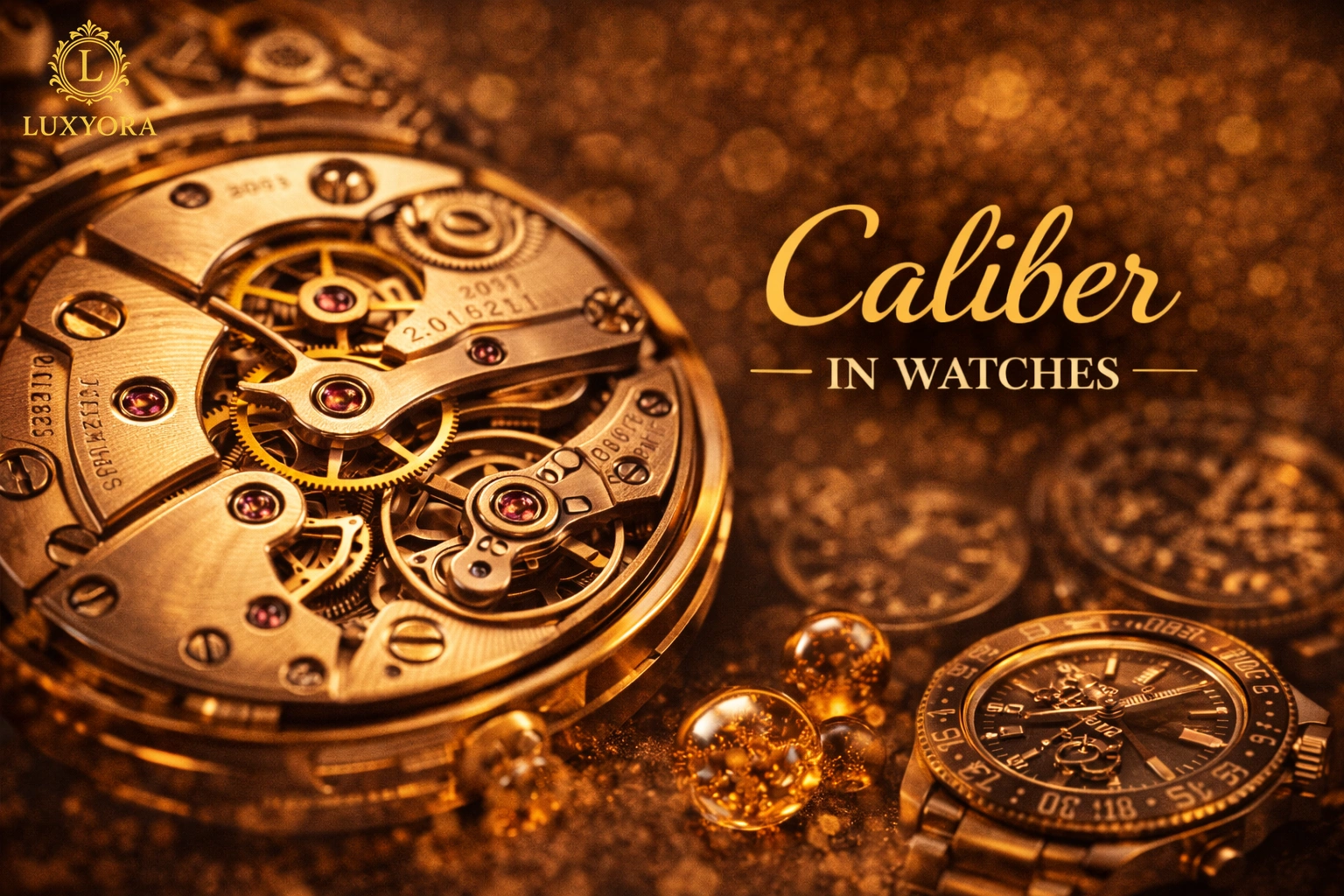
Caliber : What is Caliber
In the watch industry, caliber (also spelled calibre) is a foundational term, but it’s often misunderstood. Many people assume it simply means “movement.” In practice, a caliber is the specific model, design, and technical specification of a movement, usually identified by a name or reference number (for example, “Caliber B01,” “Calibre 3235,” or “ETA 2824-2”). In other words, while movement is the general mechanism that makes a watch run, caliber refers to the exact movement variant, including its blueprint, layout, dimensions, and features.
This distinction is important because “caliber” is how brands, watchmakers, collectors, and service centers communicate what’s inside a watch: the engine architecture, the performance profile, and often the value proposition.
1) Definition: Caliber vs Movement (And Why the Industry Uses Both Terms)
A watch movement is the internal mechanism that powers timekeeping (mechanical, automatic, quartz, etc.). A caliber is a specific movement model with defined specifications, size, frequency, jewel count, complications, and construction details, typically tracked by a unique identification system.
Quick clarity
- Movement (generic): mechanical movement, quartz movement, automatic movement
- Caliber (specific): the exact “model number” of that movement, like an engine code in cars.
Because so much of a watch’s identity and cost is tied to what’s inside, “caliber” became a central industry term for cataloging, marketing, and servicing.
2) What Information a Caliber Typically Describes
A caliber is not just a label. It usually implies a whole technical profile, such as:
A. Dimensions
- Movement diameter (often in millimeters; historically also in lignes)
- Thickness, which influences case design and comfort
B. Performance specifications
- Frequency/beat rate (e.g., 28,800 vibrations per hour)
- Power reserve (how long the watch runs off-wrist when fully wound)
- Winding system details (automatic rotor vs manual-wind)
C. Construction and quality indicators
- Jewel count (synthetic rubies used to reduce friction at key points)
- Escapement and regulating organ choices
- Materials and manufacturing approach (varies widely by brand tier)
D. Complications (functions beyond telling time)
A caliber may include or support:
- date/day-date, GMT, chronograph, moonphase
- power reserve indicator, perpetual calendar, etc.
This is why watch listings often proudly include the caliber name; it’s shorthand for engineering complexity and capability.
3) In-House, Manufacture, and “Based On”: How Caliber Talk Gets Complicated
One reason caliber terminology can feel confusing is that the industry uses overlapping terms such as in-house, manufacture, outsourced, supplied, ébauche, and modified.
In-house movement (in-house caliber)
In the watchmaking industry, an “in-house” movement is often described as a caliber designed, developed, and manufactured under one roof. The brand controls the full process and components.
The reality: a spectrum
Industry commentary also highlights that truly in-house production can require replicating an enormous supply chain, which is why many brands operate in the middle: they may design a caliber but source certain components or manufacturing steps externally.
What you’ll commonly see
- “Manufacture caliber”: suggests brand-driven design/production
- “Based on ETA/Sellita” / “derived from”: indicates a caliber built from a known architecture with modifications
- “Exclusive to brand”: can mean customized versions from a partner
For a buyer, the takeaway is simple: a caliber name is meaningful, but the backstory matters, who designed it, who made it, and what was changed.
4) Why Caliber Matters to Buyers, Collectors, and Watchmakers
A. Value and pricing
Movement development is expensive. Watches that use widely supplied calibers can be excellent, but “in-house” or highly engineered calibers often carry higher prices due to R&D and manufacturing investment.
B. Serviceability and long-term ownership
Knowing the caliber helps with:
- correct servicing procedures
- parts sourcing
- expected service intervals (varies by maker)
- resale clarity (collectors like specifics)
C. Performance expectations
A caliber’s architecture often predicts its strengths:
- thin dress calibers prioritize elegance
- tool-watch calibers prioritize shock resistance and robustness
- chronograph calibers differ massively in complexity and feel
D. Transparency and authenticity
Caliber naming is also tied to consumer trust: it lets you verify what you’re paying for. Many watch educators emphasize understanding movements as a way to understand the entire watch.
5) Caliber and Certification: Chronometer Standards and Testing
Some calibers are designed to meet higher accuracy standards and may be submitted for independent testing.
COSC / Chronometer
COSC is the Swiss testing body that certifies movements as chronometers in accordance with ISO 3159.
ISO itself describes ISO 3159 as the standard defining “chronometer,” including test programs and minimum requirements.
Why does this connect to caliber?
Chronometer certification is typically applied to movements (calibers) rather than just the watch model name. When a brand says “chronometer,” it’s pointing to a tested performance level of the caliber (or the movement inside the watch), not merely the external design.
2026 direction: stricter standards coming
Business reporting has described COSC’s plan for a stricter “Super-COSC” standard expected in September 2026, reflecting a push for more demanding real-world performance assurances.
6) How to Read Caliber Information Like a Pro
When you see a caliber listed, try to gather (or infer) these points:
- Type: quartz / manual mechanical/automatic mechanical
- Frequency: higher isn’t automatically better, but it signals design intent
- Power reserve: useful if you rotate watches
- Complications: what functions are integrated
- Origin story: in-house, supplied, modified, exclusive
- Certification: COSC / other testing if applicable
Practical tip: If a listing only says “automatic movement” with no caliber name, it may be withholding useful detail. If it lists a caliber, you can research known traits, service history, and reputation.
Conclusion
In watches, caliber is the term that turns “movement” into a precise identity. It’s the watch world’s way of saying: not just what powers the watch, but exactly which design, which specification, and which engineering choices. From in-house movement debates to chronometer certification and even future tightening of performance standards, caliber knowledge helps consumers assess quality, pricing, and long-term ownership with greater confidence.
References
Brunner, G. L. (2023). The Watch Book: Compendium – Revised Edition. teNeues. (Offline reference)
Contrôle Officiel Suisse des Chronomètres (COSC). (n.d.). Certified chronometer. (Wikipedia)
Ethos Watches. (2024, July 31). What are in-house movements and should you care? (Ethos Watches)
Ethos Watches. (n.d.). Calibre (watch guide glossary). (Ethos Watches).European Commission? (Not applicable.)
Financial Times. (2025, September 5). Swiss watch certifier unveils stricter “Super-COSC” standard (to debut September 2026). (Financial Times)
Fratello Watches. (2022, June 1). What is an in-house movement and does it matter to you? (Fratello Watches)
International Organization for Standardization. (n.d.). Wrist-chronometers with spring balance oscillator (ISO 3159). (ISO)
Longines. (n.d.). What is a chronometer watch? (COSC/ISO 3159 overview). (Longines)
Monochrome Watches. (Not used.)
Schmidt, R. (2019). The Wristwatch Handbook: A Comprehensive Guide to Mechanical Wristwatches. ACC Art Books. (Offline reference)
Teddy Baldassarre. (2025, May 8). Watch movements: A comprehensive guide and FAQ. (Teddy Baldassarre)
The 1916 Company. (2025, December 8). The status of in-house movements vs. supplied, in 2025. (The 1916 Company)
Watches of Switzerland. (n.d.). The Calibre A-Z of luxury timepiece terminology (includes movement measurement context, such as lignes). (watches-of-switzerland.co.uk)