How Often Should You Service a Watch? | Luxyora
A luxury watch is equal parts accessory and engine. From the outside, it’s all polish and poise: steel catching light, a dial that feels like a tiny gallery. Inside, it’s a hardworking micro-world of gears, oils, gaskets, and tolerances so precise they make “delicate” look glamorous. And like anything beautifully engineered, a watch doesn’t just need love; it needs maintenance.
So, how often should you service a watch? The chic answer is: often enough that it never has to beg. The real answer depends on what you wear, how you wear it, and what’s under the hood.
The modern baseline: what “often” really means
For many quality mechanical watches, a full service is commonly thought of in multi-year cycles rather than yearly appointments. In fact, several major brands now recommend longer intervals than the old-school “every 3-5 years” rule of thumb, thanks to improved oils, materials, and manufacturing processes.
As a useful style-meets-sense baseline:
- Mechanical/automatic watches: plan on a full service every ~5-10 years, depending on brand guidance and how demanding your lifestyle is.
- Quartz watches: servicing is less about lubrication and more about battery, seals, and water resistance, but it still matters, especially if you wear it often or expose it to moisture.
The important part isn’t the number; it’s staying ahead of wear.
Every luxury watch has its own rhythm, and its movement quietly determines how it should be cared for over the years. Discover the guide in Watch Movements Explained: Quartz vs Automatic vs Mechanical.
Do: use mild soap and a soft brush only when appropriate
Think of service intervals like skincare: what works for one person (or one watch) might not be ideal for another.
Some brands explicitly recommend longer service windows. For example, Rolex recommends servicing a Rolex approximately every 10 years, depending on the model and real-world use. Patek Philippe notes that both quartz and mechanical watches should be serviced every 8 to 10 years through an official service center or authorized retailer. Omega, in its user manuals, states that watches should be serviced every 5 to 8 years, depending on conditions of use.
Then you have brands like IWC emphasizing that service timing is influenced by your individual wearing habits, environment, and activity level; basically, your watch has a lifestyle too.
Translation: there isn’t one universal calendar reminder. There’s a smart range, and then there’s your actual reality.
The biggest factor: how you live in your watch
Two identical watches can need service at different times if the owners live differently. Ask yourself:
- Do you wear it daily? Daily wear means more constant motion, more exposure to sweat, cosmetics, impacts, and temperature swings.
- Do you swim, travel, or live in humidity? Water resistance relies on gaskets that age. Moisture risk increases with time and exposure.
- Do you work around magnets or electronics? Magnetism can affect mechanical timekeeping.
- Do you wear it for high-impact activities? Weight training, racket sports, and anything with repeated shock can accelerate problems.
If your watch lives a gentler life in the office, at dinners, or on weekend city strolls, it can often go longer between full services. If it lives a sporty, ocean-air, constant-travel life, you may want shorter intervals and more frequent checkups.
Knowing when to service your watch is important, but understanding how to care for it every day is what truly preserves its value. Explore Care, Maintenance & Longevity in Watches: The Luxury Owner’s Guide.
Full service vs. checkup: not everything needs the “spa day”
Watch care has levels:
A checkup (sometimes called an inspection) can include:
- accuracy/timing assessment
- water-resistance testing (for water-capable watches)
- visual inspection of crown, pushers, seals, bracelet/strap
A full service usually includes:
- complete movement disassembly
- cleaning
- lubrication
- replacement of worn parts as needed
- reassembly and regulation
- final testing, often including water resistance where applicable
If you’re wearing a water-resistant watch as a true swim companion, annual or periodic water-resistance checks can be a smart move because water damage is the kind of drama you don’t want.
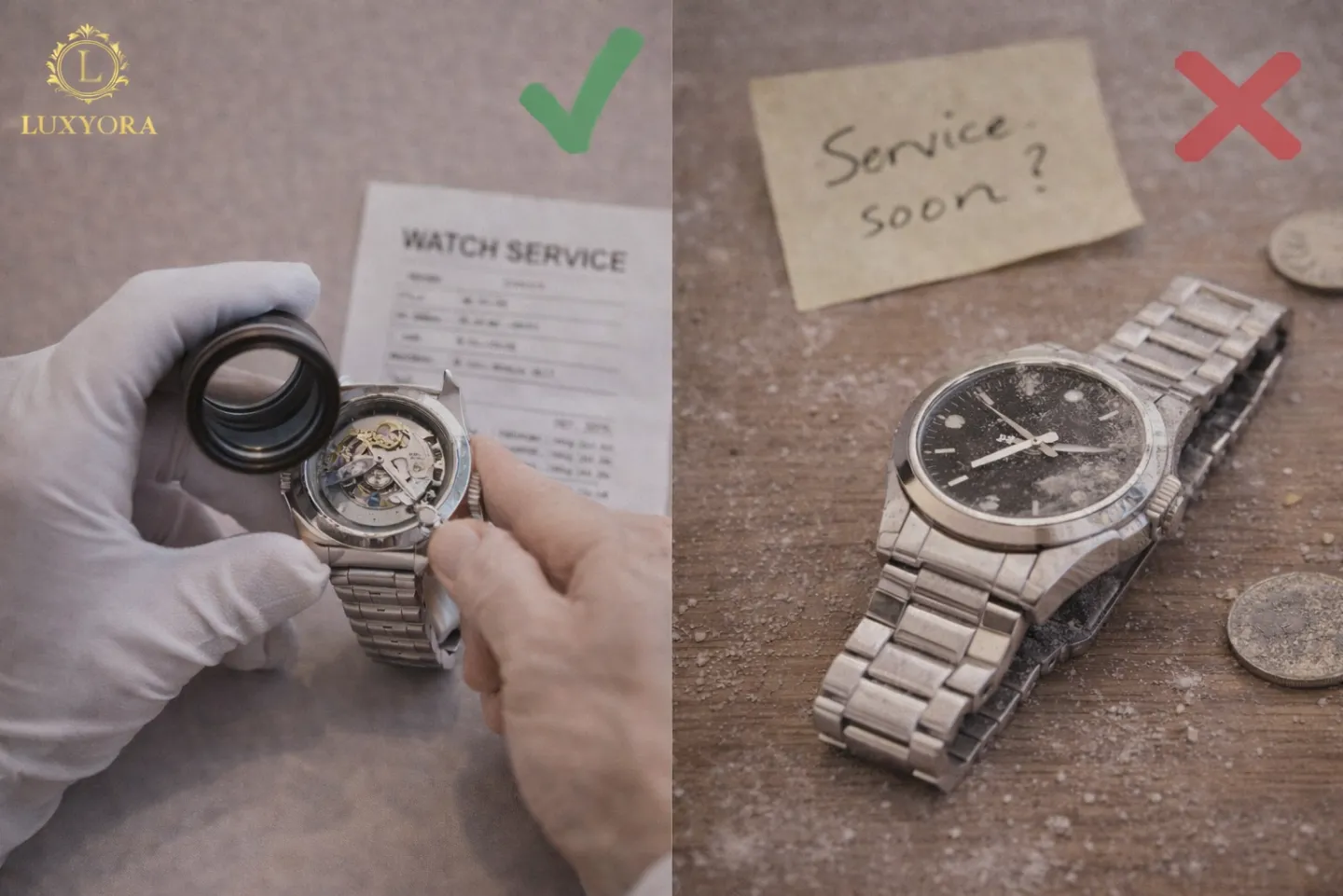
Don’t wait for a breakdown: the warning signs
A watch rarely fails out of nowhere. It hints. Quietly. Then loudly. The most useful “service now” signs:
- Accuracy changes: it starts gaining/losing noticeably more time than usual
- Power reserve drops: it stops sooner than it used to when off-wrist
- Crown feels rough or loose: winding/setting isn’t smooth
- Moisture/fogging: any condensation under the crystal is a red alert
- Odd sounds: rattling or unusually loud rotor noise
- Chronograph or complications misbehave: sticky pushers, misaligned hands, date not switching cleanly
If you notice any of the above, the timeline becomes “as soon as you can,” not “sometime this year.”
Quartz watches: the low-maintenance myth
Quartz watches are wonderfully practical, but “low maintenance” isn’t “no maintenance.”
- Replace batteries promptly. A depleted battery left too long can risk leakage damage.
- If the case is opened for a battery change, seals may be disturbed; water resistance may need to be tested, especially if the watch is used around water.
- Keep the exterior clean; grime still builds up around casebacks and bracelets.
Quartz can last brilliantly for years with simple, timely care.
Where your service matters (especially for luxury pieces)
In luxury, servicing isn’t just functional; it’s value protection.
Brand service centers / authorized service can preserve:
- warranty considerations
- access to correct parts
- brand-standard testing procedures
- documentation that supports future resale
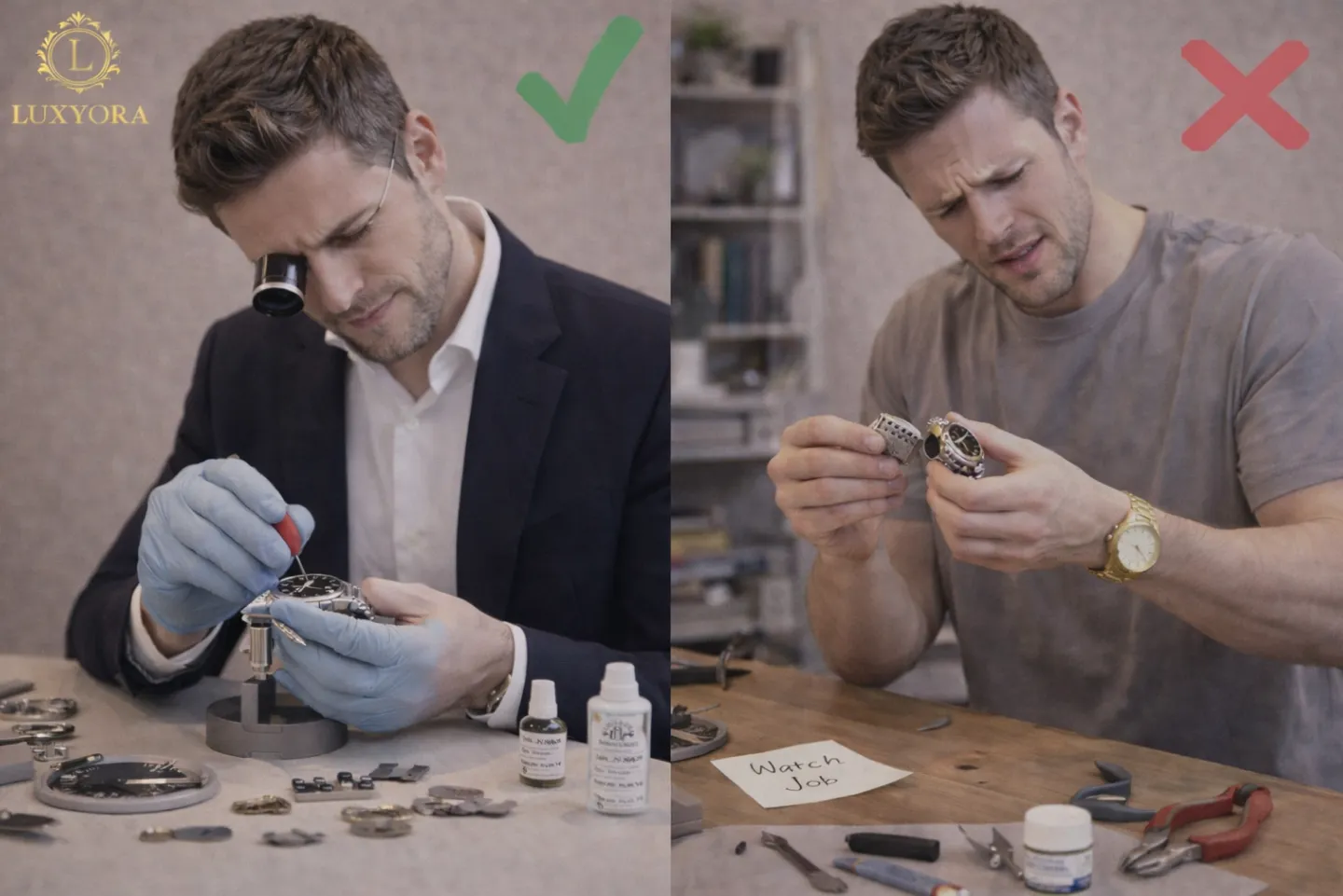
Independent specialists can be excellent too, especially for vintage pieces or collectors who want a specific restoration philosophy, but you want someone qualified, reputable, and experienced with your movement type.
The point is to avoid “mystery servicing,” where shortcuts cost you later.
A practical schedule you can actually live with
If you want a clean, easy framework:
- Mechanical/automatic (daily wearer): consider a checkup every couple of years, full service roughly within 5-8 years, or per brand guidance
- Mechanical/automatic (occasional wear): full service roughly within 8-10 years, assuming performance stays stable
- Any watch used in water: periodic water-resistance checks are smart, and sooner after any case opening
- Quartz: battery changes as needed, with seals/water resistance considered especially for water-capable models
This keeps you proactive without turning watch ownership into a full-time job.
If you want your watch to perform as beautifully years from now as it does today, a few overlooked maintenance habits can make all the difference. Discover more in Watch Maintenance Tips to Extend Lifespan.
Luxyora Philosophy: Servicing isn’t about fixing what’s broken; it’s about protecting what’s beautiful before it ever has to struggle. The most luxurious watches are the ones that quietly keep their promise, year after year.
References:
- Omega SA. (n.d.). User manual 217.32.42.21.01.001 [PDF]. OMEGA.
- Patek Philippe SA. (n.d.). Watch care recommendations. Patek Philippe.
- Rolex SA. (n.d.). Caring for your Rolex: Frequently asked questions. Rolex.
- IWC Schaffhausen. (n.d.). FAQ: Services. IWC Schaffhausen.
- Schmidt, R. (2019). The wristwatch handbook: A comprehensive guide to mechanical wristwatches. ACC Art Books.
- Stone, G., & Pulvirent, S. (2018). The watch, thoroughly revised: The art and craft of watchmaking. Abrams.