Rotor : What is Rotor | Luxyora
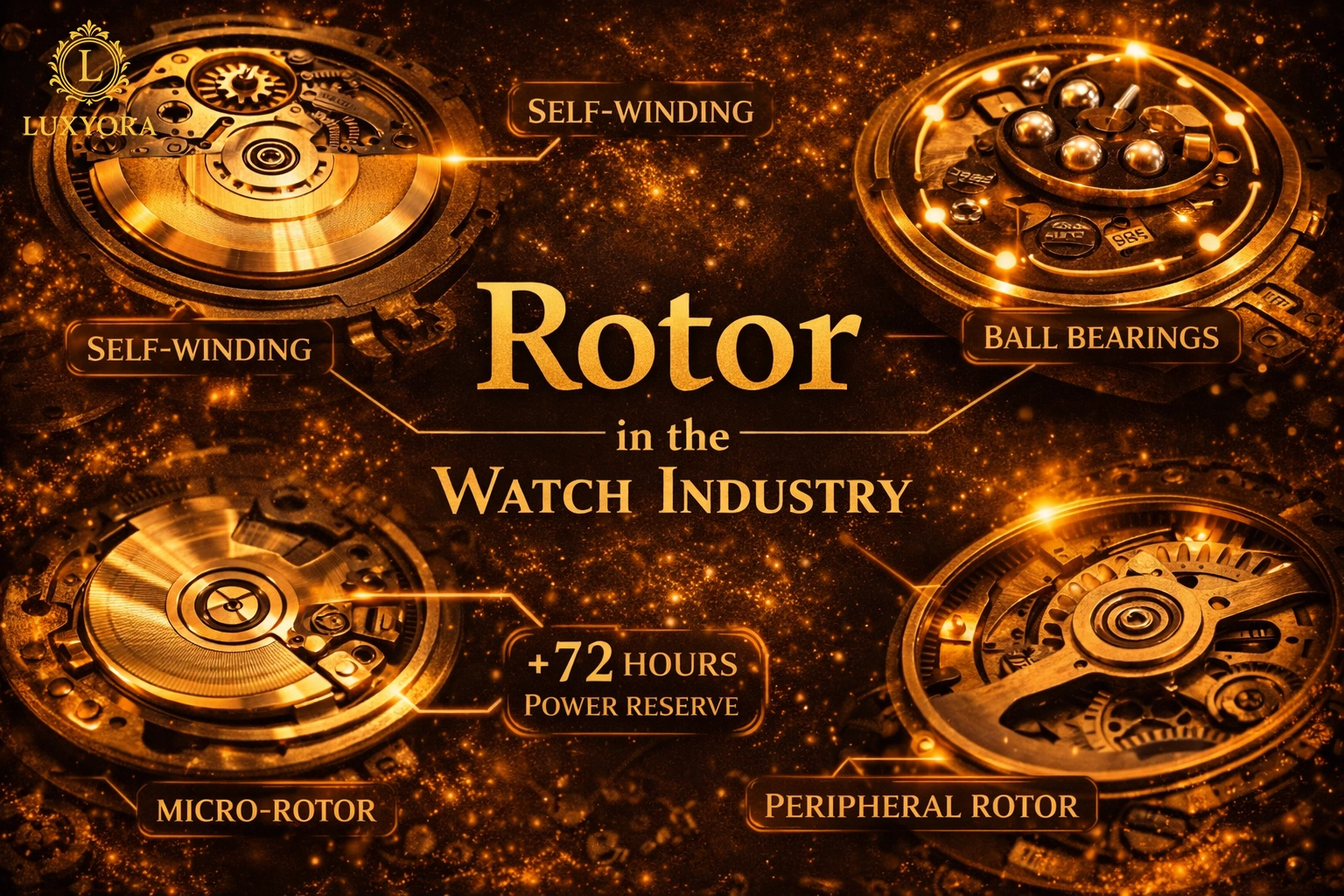
In the watch industry, a rotor (also called an oscillating weight or winding mass) is the semicircular or otherwise weighted component in an automatic mechanical movement that converts wrist motion into stored energy. As the wearer moves, the rotor swings, driving the automatic winding system that winds the mainspring inside the barrel. This is the defining difference between an automatic (self-winding) watch and a purely manual-winding watch.
In practical terms, the rotor is the “charger” of a mechanical watch, quietly topping up the power reserve while you go about your day.
Why Rotors Matter: Core Benefits for Wearers and Brands
Rotors remain a cornerstone of modern watchmaking because they deliver a blend of engineering utility and user convenience:
- Everyday convenience: reduced need for daily crown winding when worn regularly.
- Stable power delivery: consistent mainspring tension supports a more stable rate behavior.
- Tool-watch practicality: ideal for daily wearers who prefer “grab-and-go” mechanical watches.
Design storytelling: many brands decorate rotors with Geneva stripes, perlage, engraving, brand crests, or openworked designs to signal craftsmanship and identity.
How a Rotor Works: Step-by-Step (The Automatic Winding System)
A rotor does not wind the mainspring directly by brute force. Instead, it is part of a system designed to capture motion efficiently while preventing overwinding.
1) Motion creates rotation
Wrist movement causes the rotor to rotate around its pivot point. The rotor is intentionally weighted at the perimeter to increase moment of inertia, so small wrist movements can still generate useful energy.
2) Gearing converts rotation into winding
The rotor drives a set of gears and clutches that translate rotor rotation into barrel winding. Modern systems are designed so the rotor can turn freely without “locking up” the movement.
3) A slipping bridle prevents overwinding
When the mainspring reaches full tension, a slipping mechanism (often a bridle on the mainspring) allows controlled slip to prevent damage.
4) Energy is stored in the mainspring (power reserve)
The stored energy is released gradually to power the gear train and escapement. The power reserve is the duration the movement runs after being fully wound and not worn.
Unidirectional vs Bidirectional Rotors: Two Key Architectures
A major industry distinction is whether the rotor winds in one direction or both:
Unidirectional winding
- The winding mechanism captures energy only when the rotor turns in one direction.
- In the other direction, the rotor may “freewheel.”
- Some unidirectional systems can feel very smooth (or sometimes more “spinnable”) depending on design.
Bidirectional winding
- The system captures energy regardless of rotor direction.
- This can improve real-world winding efficiency by harvesting more motion.
Neither is universally “better.” Brands choose based on efficiency targets, thickness constraints, desired rotor feel, and reliability history.
Rotor Support Systems: Axle vs Ball Bearings
Because a rotor is a moving mass, its support and friction characteristics directly impact durability.
Axle (bushing/pivot)
A traditional rotor can rotate on an axle/pivot arrangement. This can be robust, but long-term wear and lubrication quality matter.
Ball bearing rotor
Modern engineering often uses ball bearings to reduce friction and improve stability. Watch educational sources note that bearings can be made from steel, and some modern designs experiment with ceramic bearings to reduce wear.
From a historical engineering perspective, ball-bearing solutions helped reduce wear and improve winding smoothness; modern discussions often note that bearing approaches reduce friction and increase longevity.
Industry keyword cluster: ball bearing rotor, rotor axle, rotor wobble, rotor rub, wear and tear, winding efficiency.
Rotor Designs You’ll Hear About: Central, Micro, and Peripheral
Not all rotors sit in the same place. Design choice affects movement thickness, aesthetic visibility, and winding performance.
1) Central (full-size) rotor
This is the classic rotor most people picture: a large semicircular mass mounted above the movement. It’s typically very effective and widely used.
Pros: strong winding potential, straightforward design
Trade-off: can cover movement finishing and increase thickness
2) Micro-rotor
A micro-rotor is a smaller rotor integrated into the movement rather than sitting on top. The key motivation is thinness: micro-rotors can help create slimmer automatic calibres while still offering self-winding convenience.
Pros: thinner movement, better view of bridges, and finishing
Trade-off: a smaller rotor may require denser material or careful engineering to maintain winding efficiency.
3) Peripheral rotor
A peripheral rotor runs around the outer edge of the movement like a ring rather than in the center. Media frequently highlight two key benefits: full movement visibility and potentially strong inertia due to thelarge diameter. Practical implementations often rely on rolling systems and bearings; detailed industry commentary notes the complexity required to make these designs durable and reliable.
Pros: unobstructed view, potentially efficient due to large diameter
Trade-off: higher complexity, tight tolerances, potentially costlier service
Rotor Materials: Why Weight (and Density) Matters
Rotors must be heavy enough to wind effectively. That’s why many rotors use dense metals or combine materials:
- Brass is common in base components
- Denser metals (often used in weighted segments) increase inertia within a smaller footprint, which is particularly relevant for micro-rotors.
In premium watches, rotors also serve as a stage for brand finishing, including openworking, engraving, gold-toned coatings, and skeletonized shapes, to balance aesthetics and mass.
Common Rotor-Related Issues (And What They Mean)
Understanding rotor terminology helps readers interpret service notes and buying considerations:
- Rotor rub/rotor scrape: rotor contacting the caseback due to wear, shock, or tolerances.
- Noisy rotor: some movements produce audible rotor spin; not always a defect, but can indicate bearing wear in extreme cases.
- Winding inefficiency: the watch doesn’t build power reserve during wear; could relate to reverser wheels, rotor bearings, or lubrication.
- Shock impacts: the heavy rotor mass can stress the support system, making robust bearing/pivot engineering critical.
Why the Rotor Is a Big Deal in Modern Collecting
Since 2018, enthusiast culture has increasingly valued “visible mechanics,” and the rotor is often the most prominent moving part visible through a sapphire caseback. Brands leverage this by:
- decorating rotors as signature elements,
- using micro/peripheral rotors for thinness and visual drama,
- and emphasizing durability and engineering choices like bearings and winding direction.
In short, the rotor sits at the intersection of mechanical utility, movement architecture, and luxury storytelling, making it one of the most important industry terms to understand if you’re learning modern horology.
References
Ethos Watches. (2025, February 15). What is a micro rotor? (Ethos Watches)
Italian Watch Spotter. (2021, July 15). What drives an automatic watch? Type and functioning of the oscillating weight. (Il mio sito WordPress)
LIV Watches. (2019, November 27). The ultimate guide to automatic watch movements. (LIV Swiss Watches)
Longines. (n.d.). What is an automatic watch and how does it work? (Longines)
(Note: This page is used for technical definitions; the publication date is not clearly shown on the source page.)
Monochrome Watches. (2022, February 7). Just Because – For the love of micro-rotor in watchmaking. (Monochrome Watches)
Monochrome Watches. (2024, June 11). A comprehensive history of the automatic watch (technical perspective). (Monochrome Watches)
Revolution. (2025, May 29). A guide to the automatic winding system. (Revolution Watch)
Stone, G., & Pulvirent, S. (2018). The watch, thoroughly revised: The art and craft of watchmaking. Harry N. Abrams. (ABRAMS)
SwissKubik. (2026, January 28). The differences between unidirectional and bidirectional watch winders. (SwissKubik)
WatchTime India. (2022, January 11). Peripheral rotor: A smart solution. (WatchTime)
Kaplan, B. B. (2022). Horology: An illustrated primer on the history, philosophy, and science of time, with an overview of the wristwatch and the watch industry. Schiffer Publishing. (Booktopia)
Brunner, G. L. (2023). The watch book: Compendium (Revised ed.). teNeues. (Bookswagon)
Rotate Watches. (2023, August 30). Unveiling the magic: A brief history of automatic watches. (Rotate Watch Kits)