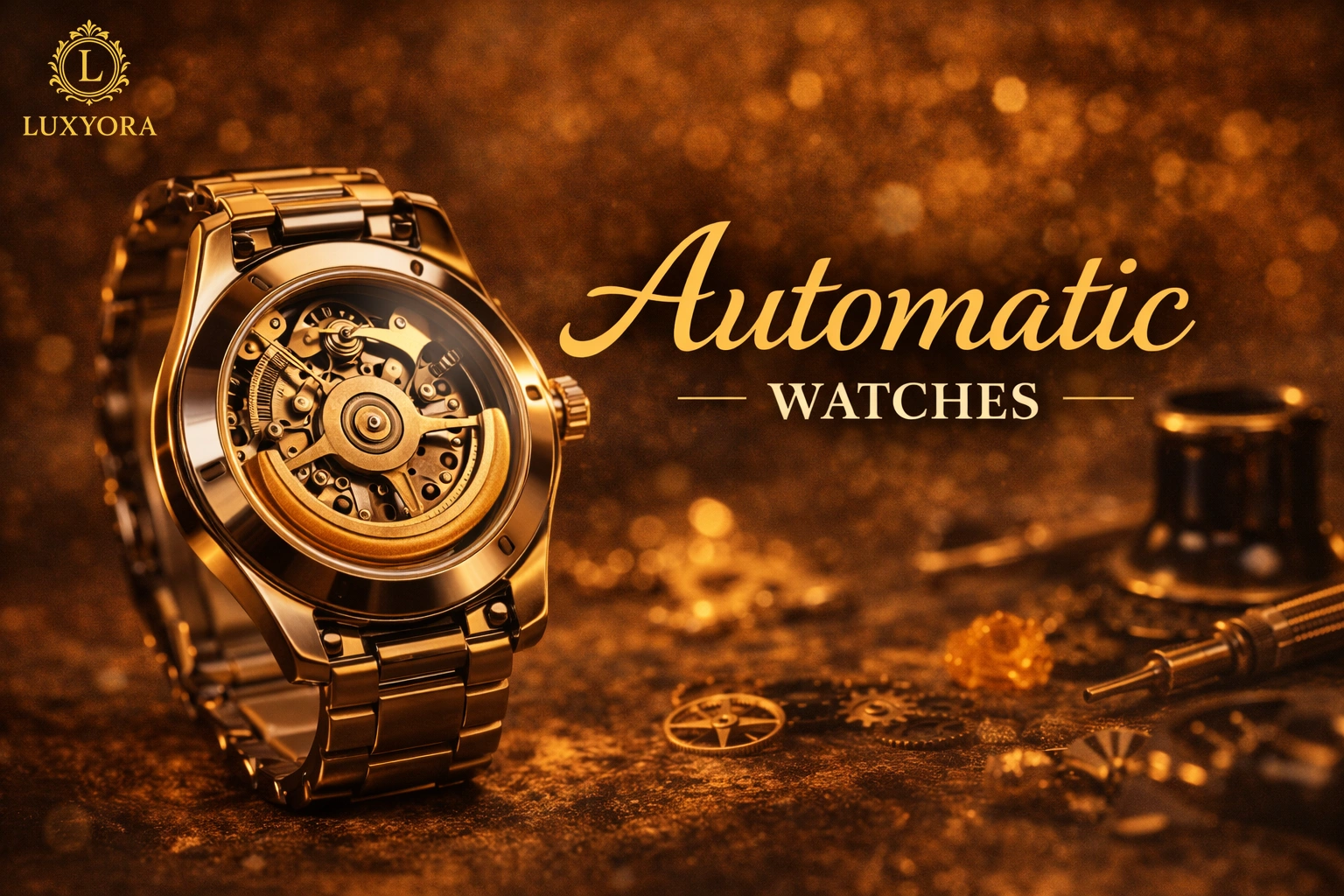
Automatic Watch : What is Automatic Watch
In watchmaking, the term “Automatic” refers to a self-winding mechanical watch, a timepiece that stores energy in a mainspring and winds itself through the natural motion of the wearer’s wrist. Instead of relying on a battery (as in a quartz watch), an automatic watch uses a precisely engineered system of gears, springs, an escapement, and an oscillating balance to keep time. The defining feature is the rotor (also called the oscillating weight), which rotates as you move and transfers energy to wind the mainspring automatically.
Automatic watches sit at the heart of the luxury and enthusiast market because they blend mechanical craftsmanship, heritage, and engineering performance, and because the “machine on your wrist” experience is deeply appealing in a world dominated by digital devices.
1) Definition: What Is an Automatic Watch?
An automatic watch (self-winding watch) is a mechanical watch where the wearer’s motion powers a rotating mass (rotor) that winds the mainspring. If worn regularly, it can run continuously without manual winding, although most can also be wound by turning the crown.
Keywords to know
- Self-winding/automatic: winds from motion
- Mechanical movement: energy from a spring, not a battery
- Rotor: a rotating weight that powers the winding
- Mainspring: stores energy (the “fuel”)
- Power reserve: how long it runs when fully wound
2) How an Automatic Watch Works (Step-by-Step)
Even though brands may differ in architecture and finishing, most automatic movements follow the same energy path:
A. Energy creation: the rotor winds the mainspring
As your wrist moves, the rotor swings, engaging a winding system that tightens the mainspring. This “automatic winding” is the signature function that distinguishes an automatic watch from a manually wound mechanical watch.
B. Energy storage: the mainspring barrel
The wound mainspring sits in a barrel. As it unwinds, it gradually releases torque to drive the motion.
C. Energy transmission: the gear train
A series of gears (the going train) transmits power from the barrel through wheels that ultimately drive the hands.
D. Regulation: escapement + balance wheel (“the heartbeat”)
Timekeeping in a mechanical watch is controlled by the escapement interacting with the balance wheel, which oscillates at a steady frequency (often 3-5 Hz, depending on the design). The escapement releases the gear train in controlled steps, creating the familiar ticking and keeping time consistent. Modern developments in escapement design and materials continue to improve efficiency and stability.
3) Automatic vs Manual vs Quartz: Practical Differences
Automatic vs Manual-wind
- Automatic: winds itself with wrist motion; usually also hand-wind capable.
- Manual: must be wound by the crown periodically.
Automatic vs Quartz
- Automatic: powered by a mainspring and regulated mechanically; admired for craftsmanship and engineering.
- Quartz: battery-powered and typically more accurate day-to-day, but not purely mechanical.
Industry insight: Many enthusiasts choose automatic watches for emotional and mechanical appeal even when they already own a quartz watch that’s more “set-and-forget.”
4) Winding System Designs: Central Rotors, Micro-rotors, and More
Automatic winding can be executed in different ways, and these choices affect thickness, aesthetics, and sometimes efficiency:
- Central rotor: the most common design; a semicircular rotor sits over the movement.
- Micro-rotor: a smaller rotor integrated into the movement plane, often enabling thinner watches; used by several high-end makers.
- Peripheral rotor: rotor runs around the edge of the movement, preserving a clear view of the mechanism while enabling winding.
These variations are part of why the term “automatic” is not just functional; it’s also a design language in modern watchmaking.
5) Accuracy, Chronometers, and Certifications You’ll See (COSC, METAS)
“ Automatic” does not necessarily mean “chronometer,” but many automatic watches are tested to performance standards.
COSC (Swiss chronometer certification)
COSC certifies movements that meet chronometer criteria; brands often cite the well-known daily rate tolerance range (commonly referenced as –4/+6 seconds/day) in consumer-facing explanations. COSC also describes chronometer certification as evidence of precision-focused development and testing.
METAS Master Chronometer
The METAS Master Chronometer certification is positioned as a stringent set of tests applied to complete watches and is open to brands whose watches are “Swiss Made” and already have a chronometer-certified movement. Industry reports and summaries indicate that Master Chronometer testing extends beyond basic accuracy, including evaluations such as magnetic-field resistance and performance under additional conditions.
What’s coming next
Watch certification is evolving. A major business report noted COSC’s plan for a stricter “Super-COSC” standard, with tighter tolerances and broader performance tests, scheduled to debut in September 2026. This reflects growing demand for real-world reliability and modern stress testing.
6) Ownership Essentials: Power Reserve, Wear Patterns, and Watch Winders
Even though automatics wind themselves, they don’t create energy out of nothing; they need motion. Key owner concepts:
- Power reserve: Often 38-80+ hours depending on movement design; if you don’t wear it, it stops once the reserve is depleted.
- Daily wear: Regular wear typically keeps it topped up.
- Manual winding: Many automatics can be hand-wound for a quick start.
- Watch winders: Useful for multi-watch owners, but not required; they’re mainly a convenience tool.
7) Why “Automatic” Is a Premium Term in the Watch Industry
“Automatic” is more than a power source; it’s a shorthand for:
- mechanical complexity
- craftsmanship and finishing
- heritage engineering
- serviceable longevity
- The romance of a self-powered machine
Many modern watch books and brand references frame mechanical watches as objects where technology, artistry, and identity converge, helping explain why automatic movements remain culturally and commercially important.
References
Brunner, G. L. (2023). The Watch Book: Compendium – Revised Edition. teNeues. (Google Books)
Certina. (n.d.). COSC certification: COSC certified chronometer. (certina.com)
COSC. (n.d.). Certified chronometer. Contrôle Officiel Suisse des Chronomètres. (cosc.swiss)
Financial Times. (2025, September 5). Swiss watch certifier unveils stricter “Super-COSC” standard. (Financial Times)
FHS (Federation of the Swiss Watch Industry). (2025, November 6). Master Chronometer celebrates its tenth anniversary. (fhs.swiss)
Foulkes, N. (2019). Time Tamed. Simon & Schuster UK. (Simon & Schuster India)
Hodinkee. (2020, August 21). In-depth: The modern watch escapement, and how it got that way. (Hodinkee)
Longines. (2026). What is an automatic watch & how does it work? (Longines)
METAS. (2025, April 17). Certification MASTER CHRONOMETER. Swiss Federal Institute of Metrology. (metas.ch)
Revolution Watch. (2025, May 29). A guide to the automatic winding system. (Revolution Watch)
Think Rogers. (2020, April 15). Everything you wanted to know about watch movements. (thinkrogers.com)
Watch Affinity. (n.d.). Watch movement types explained. (watchaffinity.co.uk)
GQ (2019). It’s what’s inside that counts: The beautiful complexity of a Swiss automatic movement. (GQ)