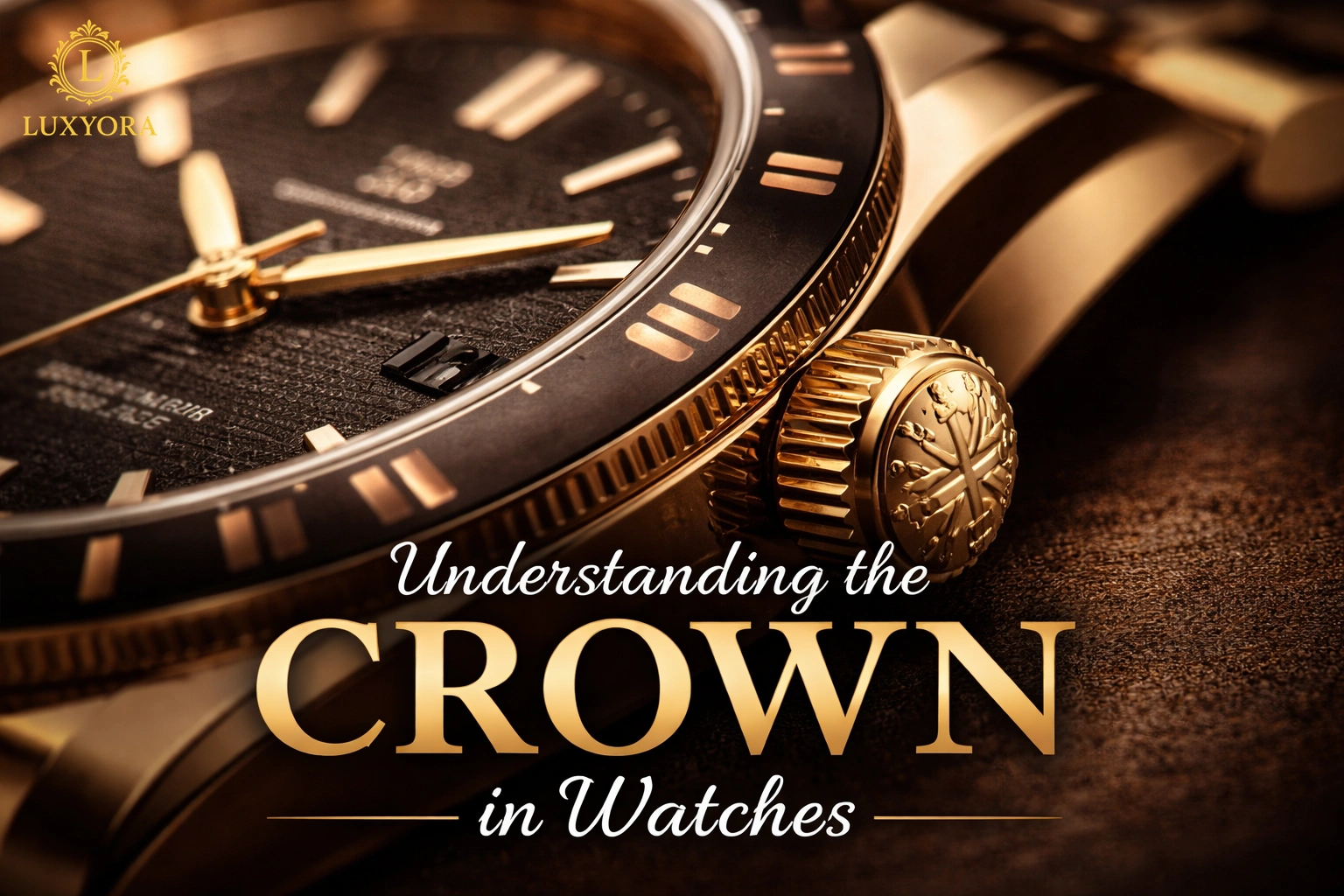
Crown in Watches : What is Crown in Watches
In watchmaking, the crown is the external control you grip to wind the movement, set the time, and often adjust complications (date, GMT hand, rotating inner bezel, etc.). It looks simple, but the crown is one of the most engineering-dense parts of a wristwatch because it sits at a critical boundary: the inside of the case must remain sealed, while the user must still be able to interact with the movement daily.
This guide explains what a crown is, how it works, the major crown types (including screw-down crowns), why it matters for water resistance, and how to use and maintain it correctly so you understand this core industry term like a watch professional.
1. What a Watch Crown Does (Core Functions)
A. Winding the movement
B. Setting the time
Pulling the crown outward typically engages the time-setting mechanism. Many modern watches also support:
- Hacking seconds (the seconds hand stops when the crown is pulled) for precise synchronisation.
C. Adjusting complications
Depending on the movement, crown positions may control:
- Quickset date (common on many calibres)
- GMT / traveller functions
- Day/date
- Internal rotating bezel (common on some dive and aviation watches)
These functions are enabled by the movement’s keyless works, the internal mechanism that translates crown positions and rotations into winding or setting actions.
2. The Anatomy of a Crown (Key Parts You Should Know)
A crown is not just the knob on the outside. A complete crown system includes:
- Crown body (the part you touch)
- Crown tube (a metal tube fixed into the case; often threaded on screw-down designs)
- Winding stem (a shaft connecting the crown to the movement)
- Gaskets / O-rings (seals that help prevent water, dust, and sweat from entering the case)
This is why crown design is deeply tied to case engineering and waterproofness.
3. Crown Types Explained (Industry Vocabulary)
1. Push-pull crown (standard crown)
A push-pull crown relies on internal gaskets and friction. It “pushes in” to the normal position and “pulls out” to the setting positions. You’ll find it on many dresses and everyday watches.
Pros: quick to operate, simpler construction.
Considerations: generally not as robust for repeated underwater exposure as a screw-down solution (design and gasket quality still matter).
2. Screw-down crown (Screw-lock crown)
A screw-down crown threads into the case tube, compressing gaskets to improve sealing. Many manufacturers explicitly instruct users to unlock (unscrew) before setting, then lock (screw down) after setting. Seiko’s instructions show the basic lock/unlock method and emphasise securing the crown after operation.
Why it’s used: It’s a practical solution for higher water-resistance watches, especially dive watches, because it helps protect the crown system from accidental pulls and enhances sealing reliability when properly tightened.
Important user rule: A screw-down crown only helps if it is actually screwed down.
3. Protected crowns and crown guards
Many sports watches feature crown guards protrusions in the case that shield the crown from impacts. This reduces the chance of bending the stem or unseating seals.
4. Specialised sealing systems (brand terminology)
Some brands name their crown sealing systems. Rolex, for example, describes the Triplock winding crown as a triple-sealed system introduced in 1970 to create multiple sealed zones for waterproofness.
Rolex also discusses its broader approach to waterproofness “behind the crown,” highlighting crown sealing as central to case integrity.
4. Why the Crown Matters for Water Resistance
If a watch leaks, one of the most common entry points is the crown/stem interface, because it’s a moving, user-operated part.
Standards context (Dive watches)
For dive watches, ISO 6425:2018 is the international standard specifying requirements and test methods for divers’ watches.
While the standard covers many features and tests, the big takeaway is that professional “diver’s” watches are evaluated under demanding conditions where crown sealing and secure operation matter.
A watch may be marketed as “water resistant,” but certification and compliance are different, and ISO itself does not “certify” products; brands and labs handle certification claims.
5. How to Use a Screw-Down Crown Correctly (Practical Steps)
Most screw-down crown instructions follow the same logic:
- Unscrew (counterclockwise) until the crown releases.
- Operate the crown (wind / set time/set date).
- Push in, then screw down (clockwise) while applying gentle inward pressure until it stops.
Citizens’ manuals explicitly show “unlock/lock” behaviour and emphasise securing the crown after use.
Common mistakes to avoid
- Forcing the threads: Cross-threading can damage the crown tube and compromise water resistance.
- Setting time/date underwater: Always operate the crown when the watch is dry and clean.
- Leaving it unscrewed: This defeats the sealing benefit and can allow moisture intrusion.
6. Crown Maintenance and Service: What Professionals Look For
Because the crown interacts with seals and threads, it’s a wear item over a watch’s life.
What gets replaced during service
Watch servicing commonly includes replacing gaskets and seals, including those in the crown and tube, then pressure-testing the watch.
Symptoms of crown problems
- Crown feels “gritty,” wobbly, or doesn’t screw down smoothly
- Time/date setting feels inconsistent
- Condensation under the crystal (urgent stop using and service immediately)
A well-maintained crown system protects the movement from humidity, sweat salts, dust, and shocks, which is why experienced collectors treat crown feel and sealing as quality signals, not just convenience.
7. Why the Crown Is Also a Branding and Design Element
Beyond mechanics, the crown is a strong visual and tactile identity cue:
- Signed crowns (logo engraving)
- Oversized “onion” crowns (vintage pilot style)
- Recessed crowns (sleeker profile)
- Unique grip textures for better usability with gloves
Modern watch books and brand histories often highlight crown design as part of the broader evolution of rugged wristwatch cases and user interaction. For example, The Watch, Thoroughly Revised (2018) frames watch components and case architecture as central to collecting and appreciation.
Conclusion
In watch-industry language, the crown is far more than a knob: it is the control interface to the movement, a major factor in water resistance, and a frequent determinant of durability and user experience. Understanding crown types, especially the screw-down crown, crown tube, and gasket sealing, helps you evaluate a watch’s real-world robustness, operate it correctly, and maintain it like an informed owner.
References
Bremont. (2019, June 14). All part of the service.
Citizen Watch Co. (n.d.). Instruction manual (Cal. H800): How to use a screw down crown and screw down push button [PDF]. Retrieved February 5, 2026, from Citizen Watch Global website. (CITIZEN WATCH Global Network)
Fratello Watches. (2022, May 30). The dry facts about the ISO 6425 divers’ watch standard. (fratellowatches.com)
International Organization for Standardization. (2018). ISO 6425:2018—Horology—Divers’ watches [Standard]. (Iteh Standards)
Rolex. (n.d.-a). Triplock: Cases—Watchmaking features. Retrieved February 5, 2026, from Rolex website. (Rolex)
Rolex. (n.d.-b). Behind the crown: Mastering waterproofness. Retrieved February 5, 2026, from Rolex website. (Rolex)
Seiko Watch Corporation. (n.d.). Screw down crown (operating instructions). Retrieved February 5, 2026, from Seiko Watches website. (Seiko Watch Corporation)
Stone, G., & Pulvirent, S. (2018). The watch, thoroughly revised: The art and craft of watchmaking. Abrams. (ABRAMS)
WIRED. (2018, December 21). Inside Rolex’s gruelling, top-secret dive watch testing facility. (WIRED)