Fixed Bezel : What is Fixed Bezel in Watches | Luxyora
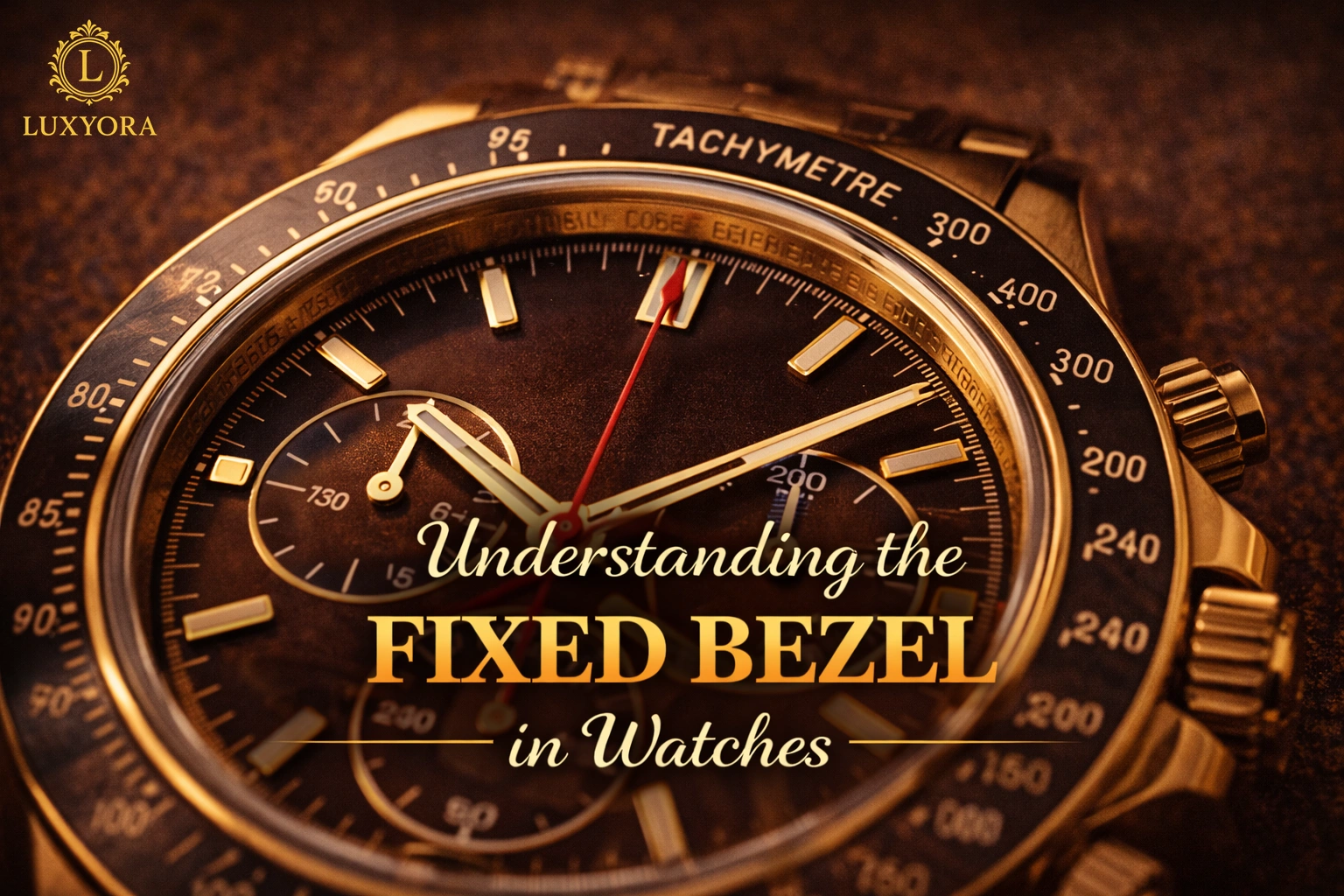
In watchmaking, a fixed bezel is the non-rotating ring that sits atop (or forms the upper edge of) the watch case, framing the crystal and dial. Unlike a diver’s elapsed-time bezel or a GMT timing bezel, a fixed bezel does not turn. Its role is primarily to secure and protect the crystal opening, while also serving as a permanent reference surface for scales (such as a tachymeter, telemeter, or pulsometer) and for aesthetic signatures, including fluted, smooth, engraved, ceramic, or gem-set designs.
In simple terms:
- A rotating bezel is used to adjust (you move it).
- A fixed bezel is designed for reading (it remains stationary).
This article explains what a fixed bezel is, where it’s used, how it differs from rotating bezels, common bezel scales and materials, and how to evaluate one like an informed buyer or industry professional.
1) What a Fixed Bezel Does
A fixed bezel has three core jobs:
A. Structural protection
The bezel is part of the case architecture that helps protect the crystal edge and supports the watch’s front opening. Fixed bezels are often described as providing a stable, reliable frame that doesn’t introduce moving parts at the top of the case.
B. A permanent reference for measurement scales
Many fixed bezels carry engraved or printed scales that must remain aligned with the dial and hands. The best-known example is the tachymeter bezel on chronographs, which is used to measure speed from elapsed time and a fixed distance. Rolex describes the Daytona bezel’s tachymetric scale as a speed-reading tool based on elapsed time.
C. Design identity
A fixed bezel strongly defines a watch’s “look.” Think of:
- Smooth, polished bezels (dress watches)
- Fluted bezels (classic luxury styling)
- Ceramic fixed bezels (sport-luxury durability)
- Gem-set bezels (high jewelry)
Because it’s always visible, the bezel is one of the biggest “identity” components on the exterior of a watch.
2) Fixed Bezel vs Rotating Bezel: The Practical Difference
Rotating bezels
Rotating bezels are used for interactive timing, elapsed time, countdown, or multi-timezone tracking because you can align a marker with a hand and read results as time passes.
For diving watches, rotating bezels are especially important because they provide a clear elapsed-time controller. Diving watch guidance commonly explains that dive bezels are unidirectional as a safety feature (if bumped, they can only shorten remaining time, not extend it).
ISO 6425:2018 requires a diving time indicator (often a rotating bezel, but it may also be a digital or other solution) and notes that it must be protected against inadvertent handling.
Fixed bezels
Fixed bezels do not rotate and are commonly used when:
- The bezel is mainly protective/aesthetic, or
- The bezel holds a scale that must stay permanently aligned
As one reviews the education guide notes, fixed bezels are common on chronographs and dress watches, where the function is to read the scale rather than adjust it.
3) Common Types of Fixed Bezels (Industry Keywords)
1) Smooth fixed bezel
A clean, minimal bezel is frequently used in classic and dress watches. It emphasizes the dial and keeps the silhouette refined.
2) Fixed tachymeter bezel
A hallmark of chronographs. The tachymeter scale is typically calibrated so that when you time an event over a known distance (e.g., 1 km or 1 mile), it converts elapsed seconds to average speed per hour. Rolex’s Daytona description explicitly highlights the tachymetric bezel and its purpose for measuring average speed.
Why it’s fixed: If a tachymeter bezel rotated, the scale would no longer be reliably aligned with the chronograph hand’s readings, so keeping it fixed preserves accuracy of interpretation.
3) Fixed the telemeter bezel
A telemeter scale helps estimate the distance to an event you can see and hear (e.g., lightning and thunder). It is traditionally used on chronographs and can appear on either the dial or bezel.
4) Fixed pulsometer bezel
Often found on medical-themed chronographs, a pulsometer scale can estimate heart rate from the number of beats counted.
5) Decorative fixed bezel styles
- Fluted bezel (signature luxury aesthetic)
- Coin-edge / knurled bezel (texture and grip styling)
Gem-set bezel (high jewelry execution)
4) Fixed Bezel Materials and Finishes
Fixed bezels are available in many materials, often selected for a balance of a luxury feel, scratch resistance, and long-term appearance.
Stainless steel
Durable and easy to refinish, but polished steel can show hairline scratches more quickly.
Aluminum bezel inserts
Lightweight and historically common on sports watches, but they can fade or scratch. Vintage-collectors sometimes care deeply about bezel originality and type (for example, Speedmaster bezel variations are actively discussed in enthusiast media).
Ceramic bezels
Ceramic is popular for its high scratch resistance and color stability, offering a premium look over time. (Ceramic can still chip under certain impacts, so “scratch-proof” isn’t the same as “unbreakable.”)
Sapphire or mineral inserts
Less common than ceramic, but used in some designs for depth and glossy visual effects.
Engraving vs printing
Fixed bezels may have:
- Engraved numerals (often filled with lacquer/paint)
- Printed scales
Engraving tends to look more premium and can improve the longevity of markings.
5) Why Fixed Bezels Are Popular (Advantages)
A. Reliability and simplicity
No moving mechanism means fewer parts to loosen, misalign, or collect grit. Many brands use fixed bezels to keep the case architecture robust and straightforward.
B. Better for permanent scales
Tachymeter, pulsometer, and telemeter scales work best when the reference never shifts, another reason fixed bezels are common on chronographs.
C. Strong design identity
A fixed bezel is like a picture frame: it can make a watch look larger or smaller, sportier or dressier, vintage or futuristic.
6) Limitations of Fixed Bezels (What They Can’t Do)
A fixed bezel cannot replace the practical timing functions of a rotating bezel. For example:
- It is not ideal for elapsed dive timing, where a unidirectional rotating bezel is the classic solution.
- It cannot be adjusted for quick “set-and-read” timing tasks (countdown, second timezone tracking via bezel rotation).
So a fixed-bezel watch is often chosen for chronograph measurement, daily wear, simplicity, or pure aesthetics, rather than interactive timing.
7) How to Evaluate a Fixed Bezel Like an Expert
When assessing a watch with a fixed bezel, check:
1. Alignment
- The tachymeter “60” should align logically with the dial’s 12 o’clock position.
- Engraved markers should be centered and evenly spaced.
2. Finish quality
- Clean transitions between brushed and polished surfaces.
- Crisp engraving edges; paint fill is neat and consistent.
3. Material suitability for use
- If you’re hard on watches, ceramic may stay looking new longer than polished steel.
- If you like vintage charm, aluminum’s aging can be part of the appeal.
4. Legibility
- A scale is only useful if it’s easy to read quickly. Rolex emphasizes legibility as a key value of the Daytona’s bezel scale.
Conclusion
A fixed bezel is the non-rotating bezel design that frames the watch face, supports case protection, and often carries permanent measurement scales. It is especially significant in chronographs, where the bezel may feature a tachymeter that must remain fixed for consistent reading, and in dress or everyday watches where simplicity and design clarity matter. Understanding fixed bezels helps you read watch specs more confidently, compare sport vs dress intent, and evaluate craftsmanship in one of the most visible parts of a watch.
References
Brunner, G. L. (2019). The Watch Book – Compendium. teNeues.
Fratello Watches. (2022, May 30). The dry facts about the ISO 6425 divers’ watch standard. (fratellowatches.com)
International Organization for Standardization. (2018). ISO 6425:2018—Horology—Divers’ watches [Standard]. (Iteh Standards)
Kapoor Watch Co. (2024, December 10). Types of watch bezels: Function & design explained. (kapoorwatch.com)
Rolex. (n.d.). Cosmograph Daytona: High-performance chronograph (tachymetric bezel description). Retrieved February 5, 2026. (Rolex)
Stone, G., & Pulvirent, S. (2018). The watch, thoroughly revised: The art and craft of watchmaking. Abrams.
WatchGecko. (2023, December 4). Understanding the different types of watch bezels. (WatchGecko)
Wikipedia contributors. (n.d.). Diving watch (elapsed time controller and unidirectional bezel explanation). Retrieved February 5, 2026. (Wikipedia)
Wristler. (2026, January 22). Watch bezel functions explained: Dive, GMT & tachymeter (fixed bezel section). (Wristler)
Reservoir. (2023). The essential edge: A guide to bezels on luxury watches. (Reservoir Watch)