How to Spot a Fake Designer Handbag | Luxyora
Buying a designer handbag should feel like stepping into your most confident self, with clean lines, perfect leather, and hardware that catches the light like jewelry, not like playing a high-stakes guessing game with your savings.
Counterfeits have gotten very good. Some are obvious (wonky logos, plastic-y “leather,” stitching that looks like it sprinted). Others are “superfakes” designed to pass a glance and fool an excited buyer who wants the dream bag moment. The trick is learning to slow down and read the details the way a seasoned authenticator would: not one single clue, but a pattern of truth.
This guide is designed to help you spot red flags without turning your life into a forensic lab. It’s consumer-first, practical, and rooted in real authentication practices used across the resale industry.
First: Know What You’re Up Against
Counterfeit trade is not small-time. Global estimates place counterfeit and pirated goods at a significant share of world imports, and the ecosystem keeps evolving from materials to packaging to digital paperwork. That’s why your best defense is a checklist mindset: verify the seller, verify the bag, verify the story.
Also important: authenticity is rarely proven by a single feature. A convincing serial number can exist on a fake. A dust bag can be fake. Even documentation can be fake. Authenticity is the sum of the details.
The Golden Rule: Start With the Seller, Not the Stitching
Before you zoom into hardware engraving, zoom out to the big picture.
1) Price that’s “too good” usually is
If the deal makes your heart race, pause. Genuine luxury bags hold value, especially in iconic styles and colors. Extreme discounts without a clear reason (such as heavy wear, missing parts, or serious damage) should prompt caution.
2) Seller transparency is a tell
A trustworthy seller can answer basic questions calmly:
- Where was it purchased?
- Do they have proof of purchase?
- Can they provide clear photos in natural light?
- Are they comfortable with third-party authentication?
If the tone turns defensive or evasive, treat that as data.
3) Beware of “authentication included” without credibility
A certificate only matters if it’s from a recognized, accountable, authenticator or platform with a real process behind it. Random “certificates” printed at home-level design quality are not proof of anything other than paper.
Your Hands and Eyes: The High-Impact Physical Checks
Now let’s get into the bag itself. You’re looking for precision, consistency, and quality that feels intentional.
4) Material quality: luxury feels unmistakable
Authentic leather typically has depth grain, softness, and resilience. It shouldn’t feel overly stiff like plastic or strangely spongy. Canvas should feel tightly woven and substantial. If it feels flimsy, coated in a cheap shine, or smells harshly chemical, that’s a red flag.
5) Stitching: look for discipline, not perfection theatre
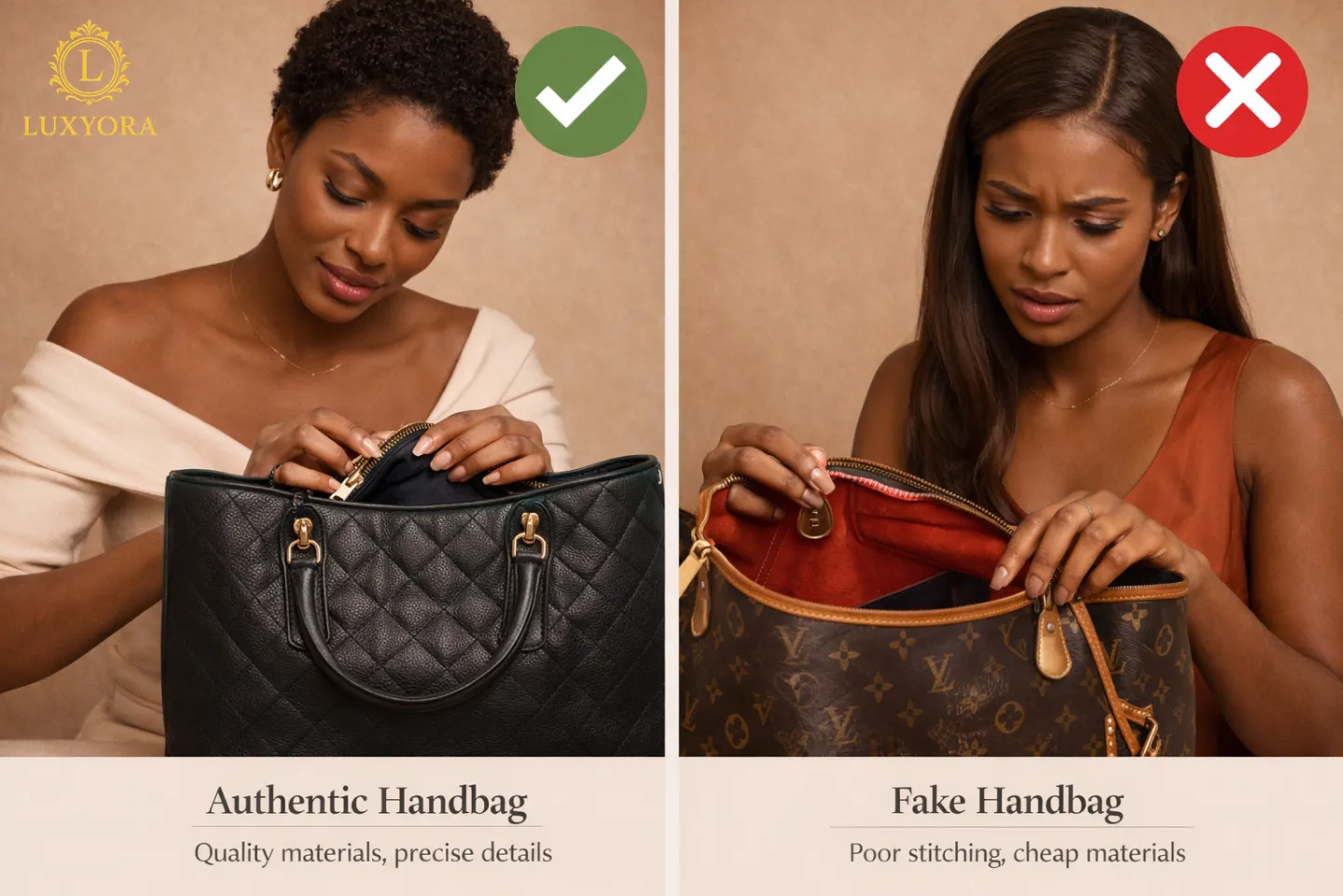
Luxury stitching is consistent: evenly spaced, straight, with no loose threads or rushed corners. Counterfeits often struggle at stress points, handle bases, corners, zipper ends, where the bag needs reinforcement and craftsmanship shows.
6) Edge paint and glazing: the detail fakes forget
On many designer bags, edges are finished with careful glazing. On fakes, edge paint can look thick, uneven, bubbly, or already cracking. Run your eyes along every edge like you’re reading a sentence. Does it flow smoothly?
7) Structure and symmetry: the bag should “sit” correctly
Even relaxed silhouettes have balance. Common counterfeit tells:
- One handle is higher than the other
- Uneven panels
- Sagging that doesn’t match the style
- A base that warps oddly
If the bag looks tired when it’s supposed to look sculpted, question it.
Logos, Stamps, and Typography: Where Counterfeits Get Cocky
8) Logo placement and font: small differences matter
Luxury brands are obsessive about typography. On counterfeits, letters may be too thick, too thin, too close together, or slightly misaligned. Look at:
- spacing between letters
- crispness of embossing
- placement consistency
If the stamp looks shallow, messy, or off-center, it’s not a good sign.
9) Heat stamps and interior markings: pressure and clarity are everything
Interior stamps (brand name, “Made in…,” material stamping) should look clean and confident, like they were pressed by someone who has done it 10,000 times. Fakes often look either too faint or too aggressively deep, as if trying to “prove” authenticity.
Hardware: The Luxury “Weight Test”
Hardware is one of the easiest ways to sense quality fast.
10) Weight and finish: authentic hardware has presence
Authentic hardware usually feels substantial, not hollow. Finishes are consistent, old tone that doesn’t look brassy, plating that doesn’t chip instantly, and engraving that’s crisp rather than fuzzy.
11) Engraving: clean, centered, legible
Check zipper pulls, clasps, locks, feet, and rings. Engraving should be:
- sharp, not blurry
- evenly placed
- consistent in font and depth
If engraving looks “printed” or shallow, like it could rub off, be suspicious.
12) Zippers: smooth glide, premium components
Many luxury bags use specific zipper makers or brand-specific zipper details. A zipper that catches, feels gritty, or looks cheaply painted is a classic giveaway of counterfeit.
The Serial Number Trap: Useful, But Not a Verdict
13) Serial numbers, date codes, chips, and tags can be faked
Yes, you should check that the codes exist and match the format expected for that brand and era. But do not stop there. Counterfeiters copy codes, replicate fonts, and even mimic placements.
Think of a serial number as one puzzle piece, not the whole picture.
14) Lining and interior construction should match the model
Counterfeits often get interiors wrong:
- incorrect lining fabric
- wrong pocket shape
- mismatched stitching color
- sloppy seams inside
Compare the interior layout to verified images of the exact style and size.
Before judging a handbag by its appearance alone, take a closer look at the interior craftsmanship explored in A Guide to Handbag Lining Materials: What to Look For.
Packaging and “Extras”: The Easiest Thing to Fake
15) Dust bags, boxes, ribbons, booklets - treat them as accessories, not proof
Packaging changes across seasons and regions. Counterfeit packaging is everywhere. Real packaging can be missing; fake packaging can look convincing. Don’t let a pretty box distract you from the bag itself.
The Smartest Move: Authenticate Like a Grown-Up
If you’re spending real money, act like it.
16) Use reputable resale platforms with documented authentication processes
Major resale platforms describe multi-step authentication approaches that involve human expertise supported by tools such as micro-imaging, data comparisons, and risk scoring. Buying through systems like this reduces your exposure.
17) Consider third-party authentication for high-value purchases
Independent authentication services and AI-assisted tools exist specifically because counterfeiting is complex. If you’re buying a high-ticket piece, paying for authentication is part of the cost of ownership, like insuring fine jewelry.
18) Keep your own “provenance file”
If you do buy an authentic bag, keep:
- proof of purchase
- emails/receipts
- photos of the bag when received
- authentication results (if any)
This protects you if you ever resells and makes your luxury feel calmer, not stressful.
Quick “Red Flag” Summary You Can Screenshot Mentally
- Price is far below market with no logical reason
- Seller won’t provide clear photos or provenance
- Chemical smell, cheap feel, overly glossy leather
- Uneven stitching at corners/handles
- Thick, messy edge paint
- Logo font spacing looks off
- Hardware feels light, engraving looks blurry
- Zipper catches or looks cheaply finished
- Serial number looks “right,” but everything else feels wrong
If three or more of these show up? Walk away. Another bag will come.
Luxyora Philosophy: Luxury is peace of mind you can hold in your hand, so choose proof over pressure, and craftsmanship over hype.
References:
- Entrupy. (2019, April 25). Authenticating the authentication. Entrupy.(Click Here)
- Entrupy. (2020). State of the Fake 2020 report. Entrupy.(Click Here)
- European Union Intellectual Property Office. (2021). Anti-counterfeiting technology guide. EUIPO Observatory.(Click Here)
- OECD. (n.d.). Counterfeit and pirated goods. Organisation for Economic Co-operation and Development.(Click Here)
- OECD. (n.d.). Trends in trade in counterfeit and pirated goods. OECD iLibrary.(Click Here)
- OECD & EUIPO. (2025). Mapping global trade in fakes 2025 (PDF).(Click Here)
- The RealReal. (n.d.). Luxury authentication & counterfeit prevention.(Click Here)
- Vestiaire Collective. (n.d.). Trusted pre-loved luxury authentication standards.(Click Here)
- Zimmermann, R. (2023). Methods to authenticate luxury products: Identifying key features and most recognized deficits. SN Computer Science, 4, 1–18.(Click Here)
- Fashionphile. (n.d.). How we look at authentication.(Click Here)
- Reuters. (2024, July 9). Deja-vu? In Olympics push, France ramps up war on fakes. Reuters.(Click Here)