Clasp : What is Clasp in Watches
In the watch world, a clasp is the closure mechanism that secures a watch to the wrist, either on a metal bracelet or on certain leather/rubber straps fitted with a deployant (deployment) clasp. It may look like a simple fastening, but in modern horology, the clasp is a high-impact “industry term” because it directly affects three things owners notice every day:
- Security (does the watch stay on your wrist?)
- Comfort and fit (does it pinch, slide, or allow swelling?)
- Perceived quality (does it feel precise, solid, and refined?)
Watch media and brand education increasingly treat clasps as a design and engineering feature rather than an afterthought, highlighting how different clasp architectures (tang, folding, butterfly, diver’s extension, micro-adjust) create very different user experiences.
1. What a Watch Clasp Does (Beyond “Closing the Band”)
A clasp is designed to:
- Join the two ends of a bracelet/strap securely around the wrist
- Provide adjustability (micro-adjust holes, tool-free extension systems, sliding mechanisms)
- Add safety redundancy (locks, double pushers, flip-locks) on tool watches
- Improve strap longevity (deployant clasps reduce creasing and stress on leather)
- Support specialty use cases like diving via extension systems (for wetsuits)
For dive watches and other “tool” categories, standards/testing discussions also emphasize that some tests may be performed on the watch head only, but if a bracelet cannot be removed, the complete watch is tested, underscoring that bracelet + clasp can be part of real-world qualification contexts.
2. The Main Types of Watch Clasps (Industry Vocabulary)
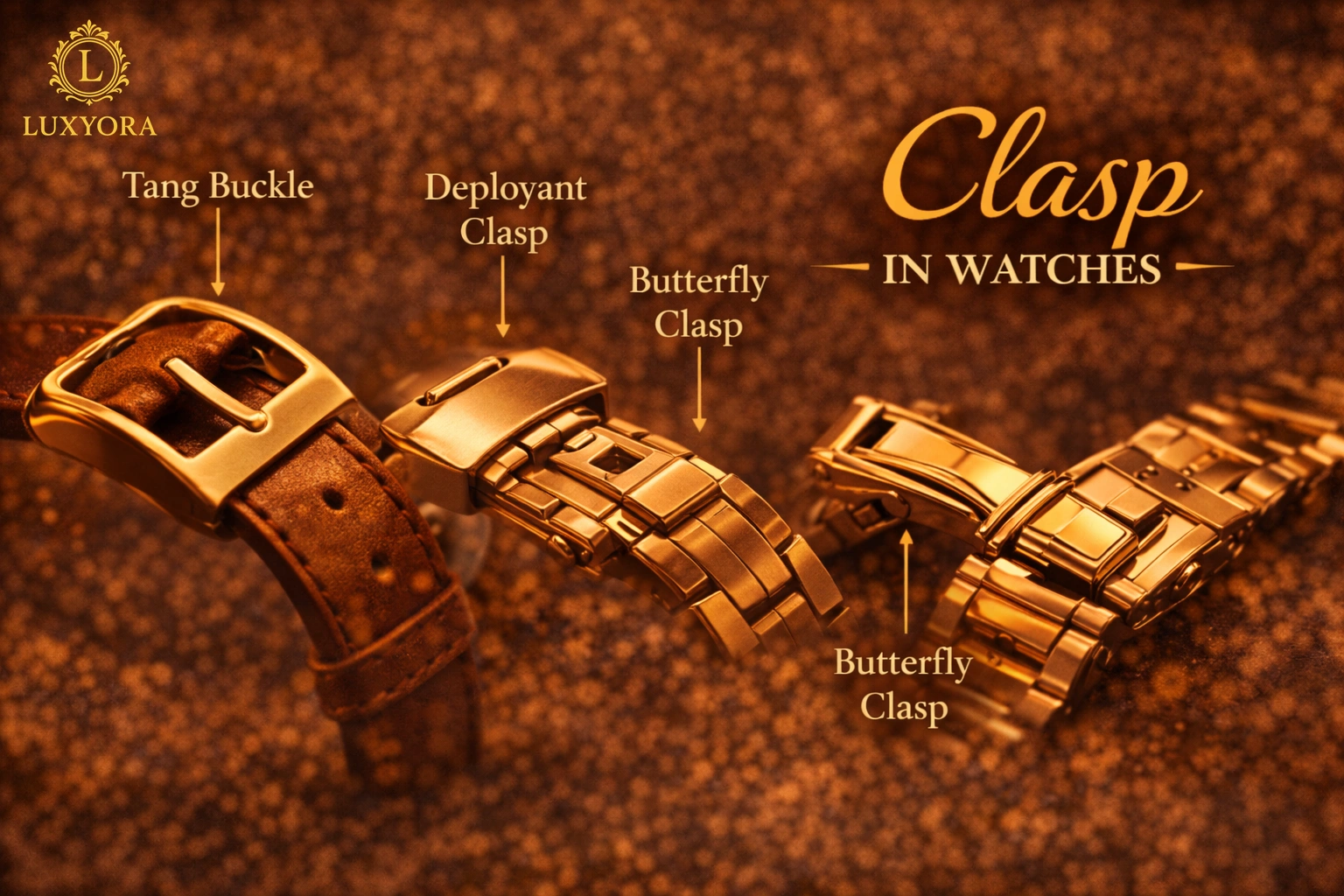
A) Tang / Pin / Ardillon Buckle (strap buckle)
This is the classic “belt buckle” closure used on leather, fabric, and rubber straps. It’s simple, lightweight, easy to repair, and highly secure when properly sized. Modern guides list it as the most common strap closure and the baseline from which deployant systems evolved.
Best for: traditional dress watches, casual straps, affordability, and simplicity
Watch keywords: tang buckle, pin buckle, ardillon buckle
B) Deployant (Deployment) Clasp
A deployant clasp folds open on hinges and then closes around the wrist. It’s widely used on leather and rubber straps, and on many bracelets. The key benefit is that it reduces bending stress on leather and often feels more “luxurious” in daily use.
Common sub-types include:
- Single-fold deployant
- Double-fold deployant
- Push-button deployant (two side buttons release the clasp)
Best for: premium leather straps, frequent wear, quick on/off
Watch keywords: deployant, folding clasp, push-button clasp
C) Butterfly Clasp (Double Deployant / “Hidden” clasp)
A butterfly clasp folds from two sides and closes into a central piece, creating a very clean, uninterrupted bracelet look. Many guides describe it as one of the most “invisible” and aesthetic bracelet closures.
Best for: dressy bracelets, integrated-bracelet aesthetics
Trade-off: sometimes less forgiving for on-the-fly fit changes than sport-focused clasps
Watch keywords: butterfly clasp, double deployant, hidden clasp
D) Fold-over Safety Clasp (Sport / Diver style)
These are common on sports and dive watches: a folding clasp, often combined with a flip-lock safety latch, to prevent accidental opening. Many consumer guides highlight the safety catch as the defining feature for rugged use.
Best for: sports watches, dive watches, active daily use
Watch keywords: safety clasp, flip-lock, fold-over clasp
E) Diver’s Extension Clasp
A diver’s clasp often includes an extension to allow the watch to fit over a wetsuit. In practice, many brands also combine diver extension with micro-adjust features for fine-tuning.
Best for: diving, water sports, thick sleeves
Watch keywords: diver extension, wetsuit extension
F) Micro-Adjustment and Tool-Free Comfort Systems
This is one of the biggest clasp trends of the 2018-2026 era: quick adjustability that lets the bracelet expand or contract during the day as your wrist size changes with heat, activity, or hydration.
A widely cited brand example is the Rolex Glidelock, described by Rolex as a tool-free extension system that allows incremental adjustment (up to about 15-20 mm depending on configuration) without tools. Enthusiast and retailer commentary often frames this kind of engineering as a major leap in day-to-day wear comfort.
Other brands also adopt “comfort adjust” concepts; for example, Fratello discusses Omega’s clasp options and the appeal of toolless adaptability throughout the day.
Best for: everyday comfort, hot climates, travel, active wear
Watch keywords: micro-adjust, on-the-fly adjustment, comfort extension, Glidelock
3. Materials and Build Quality: Why Clasps Feel “Cheap” or “Premium.”
Clasp quality is largely felt through:
- Precision tolerances: tight closure with minimal rattle
- Machined vs stamped construction: modern premium clasps increasingly use more complex machining and refined internal mechanisms (Everest Bands, 2026).
- Button action and detents: pushers should feel crisp, not spongy
- Finishing: brushing/polishing should match the bracelet and resist sharp edges
- Corrosion resistance: especially for dive clasps exposed to saltwater
In other words, the clasp is a miniature mechanical component inside the watch.
4. Fit Engineering: Micro-Adjust, Half-Links, and “Why It Never Feels Perfect.”
A clasp is part of a larger sizing system that may include:
- removable links/screws or pins
- half links (finer sizing increments)
- micro-adjust holes inside the clasp
- tool-free extension racks or sliding mechanisms
This matters because even a high-end bracelet can feel wrong if you can’t land in the “sweet spot” between too tight and too loose. Brands increasingly treat clasp adjustability as a competitive advantage because it creates immediate real-world satisfaction.
5. Choosing the Right Clasp: A Practical Buyer Guide
If you want classic simplicity, choose a tang buckle.
If you want leather longevity and a premium feel, choose a deployant.
If you want the cleanest bracelet look, choose a butterfly clasp.
If you want maximum security, choose a fold-over safety clasp.
If you care about daily comfort, prioritize micro-adjustment or a tool-free extension.
Conclusion
In watch industry language, a clasp is not merely a closure; it’s a wearable engineering system that determines how secure, comfortable, and refined a watch feels. From the timeless tang buckle to modern micro-adjust technology like Glidelock, clasps are a major differentiator in the watch market, and learning clasp vocabulary helps you buy smarter and enjoy your watch more.
References