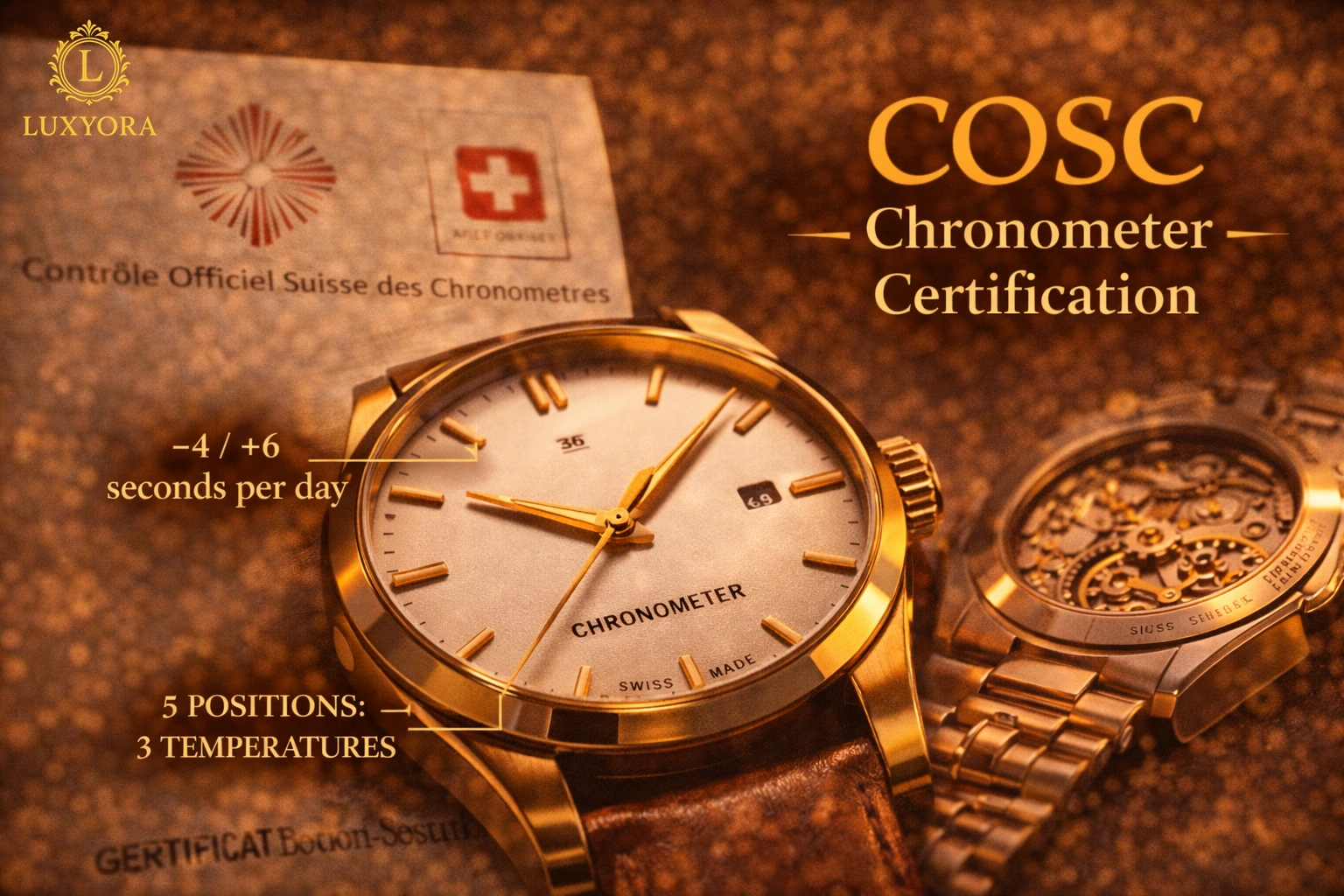
COSC Chronometer Certification : What is COSC Chronometer Certification
In the watch industry, COSC Chronometer Certification is one of the most recognized independent accuracy credentials for Swiss watchmaking. COSC stands for Contrôle Officiel Suisse des Chronomètres, the Swiss body that tests and certifies watch movements (and in some cases “watch heads”) that meet chronometer requirements. A watch that passes can legally be marketed as a “chronometer”, a term that signals above-average precision and consistent rate performance under controlled testing conditions.
Even in an era of brand-run standards (such as METAS Master Chronometer) and advanced materials, COSC remains a key industry benchmark because it provides third-party, standardized testing and is widely referenced by collectors, retailers, and service centers when discussing performance, quality, and value.
1. What Does COSC “Chronometer” Mean?
A chronometer in wristwatch terms is defined by a standardized test program and minimum requirements commonly tied to ISO’s chronometer framework for wrist-chronometers. COSC certification is the most widely recognized real-world application of that framework in Swiss watchmaking.
Key industry keywords
- Chronometer (precision designation)
- COSC certificate (independent proof of testing)
- Average daily rate
- Positions & temperatures testing
- Consistency/rate stability
- Cased vs uncased testing
2. What Exactly Does COSC Test?
Movement-first testing (the common model)
Traditionally, COSC testing is performed on the movement (uncased), not the fully assembled watch. This is why you’ll often see chronometer certification described as a movement certification rather than a “whole watch” certification.
How long is the test?
COSC’s own description highlights 12 to 20 days of testing, along with frequent checks/handling and multiple elimination criteria, underscoring that it’s not a single quick measurement but a multi-day evaluation process.
Positions and temperatures
Many educational explainers summarize the classic COSC framework as testing over 15 daysacross five positions at three temperatures, with daily measurements.
Why positions matter: mechanical movements behave differently when oriented crown-up, dial-up, etc., due to gravity’s effects on the balance assembly and friction points.
Why temperatures matter: lubricants and materials respond to temperature changes, which can influence the rate.
3. The Headline Accuracy Figure: The Famous “-4 / +6 Seconds per Day”
In consumer language, COSC is often summarized by its most-quoted headline: a certified chronometer movement must keep time within a limited daily rate deviation (commonly cited as –4 to +6 seconds/day in many mechanical chronometer contexts).
Important nuance: COSC is not only about “one number.” It also emphasizes consistency across conditions, the extent to which the rate varies by position, day-to-day stability, and whether it remains within acceptable criteria throughout the full test program. Many detailed COSC explainers break down multiple rate criteria beyond the headline daily rate, as consistency is a major factor in chronometric performance.
4. What You Actually Get When a Watch Is COSC-Certified
When a brand submits movements that pass, COSC issues a chronometer certificate identifying the tested movement. In the market, this creates three practical outcomes:
- A regulated movement at the factory level (the brand has adjusted it to meet stricter performance goals).
- Independent verification that it passed a recognized test protocol.
- A credible quality signal used in resale listings, retail education, and enthusiast comparisons.
From a collector’s viewpoint, chronometer certification can be especially meaningful when comparing watches that otherwise look similar on paper.
5. COSC vs METAS (and Other Modern Standards)
COSC: movement-focused (often uncased)
COSC is historically known for certifying the movement before it is cased.
METAS Master Chronometer: watch-focused (fully assembled) and COSC-based
METAS certification is structured differently: it is a broader functional certification applied to the complete watch and explicitly requires a chronometer-qualified basis aligned with ISO 3159. METAS documentation states that eligibility requires a “chronometer” movement per ISO 3159 and completion of additional test cycles.
A practical way to remember it:
- COSC answers: Is this movement chronometer-grade under the COSC/ISO-style program?
- METAS answers: Does the fully assembled watch meet broader real-world performance criteria (e.g., magnetism and power reserve requirements) when built on a chronometer base?
6. What COSC Does Not Guarantee (Real-World Limitations)
COSC certification is valuable, but it’s not a promise of perfection forever. Real-world performance depends on:
- how the watch is worn (positions, motion, temperature exposure)
- shock events (drops/impacts)
- magnetism exposure
- service condition and lubrication age
A COSC movement that hasn’t been serviced for a long time may drift outside chronometer-like performance, while a well-regulated non-COSC movement can sometimes perform impressively in daily wear. This is why many watch books emphasize that mechanical accuracy is a blend of design, adjustment, and ongoing maintenance, not just a single certification badge.
7. The Next Step: “Super-COSC” and the 2026 Push Toward Real-World Testing
A major recent development is COSC’s announced plan for “Super-COSC”, positioned as a stricter, modernized certification intended to better reflect contemporary expectations. Reporting describes Super-COSC as debuting in September 2026, with tighter tolerances and new test dimensions (including testing the entire watch and additional checks on magnetism-related performance and power reserve).
This matters because the market has been moving toward “whole watch” assurance (not just uncased movement performance). Super-COSC signals that COSC intends to remain relevant alongside brand standards and newer third-party certifications.
8. How to Use COSC Knowledge When Buying a Watch
When you see “COSC Certified Chronometer” on a watch listing, use it intelligently:
- Treat it as independent evidence that the movement met a recognized performance program.
- Ask whether the brand publishes additional accuracy targets (some brands go beyond COSC).
- If you care about modern anti-magnetism and whole-watch validation, compare COSC to broader programs like METAS.
- Remember maintenance: long-term accuracy depends on service intervals and real-world use.
References
Brunner, G. L. (2023). The Watch Book: Compendium – Revised Edition. teNeues. (Offline reference)
Contrôle Officiel Suisse des Chronomètres (COSC). (n.d.). COSC certification process (site content accessed 2026). (cosc.swiss)
Financial Times. (2025, September 5). Swiss watch certifier unveils stricter “Super-COSC” standard (launch planned for September 2026). (Financial Times)
International Organization for Standardization. (n.d.). ISO 3159:2009 — Timekeeping instruments: Wrist-chronometers with spring balance oscillator (standard overview page accessed 2026). (ISO)
METAS (Swiss Federal Institute of Metrology). (2025, April 17). Certification MASTER CHRONOMETER (program overview; ISO 3159 chronometer basis). (metas.ch)
Monochrome Watches. (2025, May 28). Interview: COSC CEO Andreas Wyss on challenges and upcoming Super-COSC (testing overview and context). (Monochrome Watches)
Schmidt, R. (2019). The Wristwatch Handbook: A Comprehensive Guide to Mechanical Wristwatches. ACC Art Books. (Offline reference)
Time+Tide Watches. (2025). Everything you need to know about COSC (criteria and explanations). (Time+Tide Watches)
The Watch Company. (2020, July 24). What is COSC? A complete guide to the chronometer certification (positions/temperatures summary). (thewatchcompany.com)