Sandalwood : What is Sandalwood | Luxyora
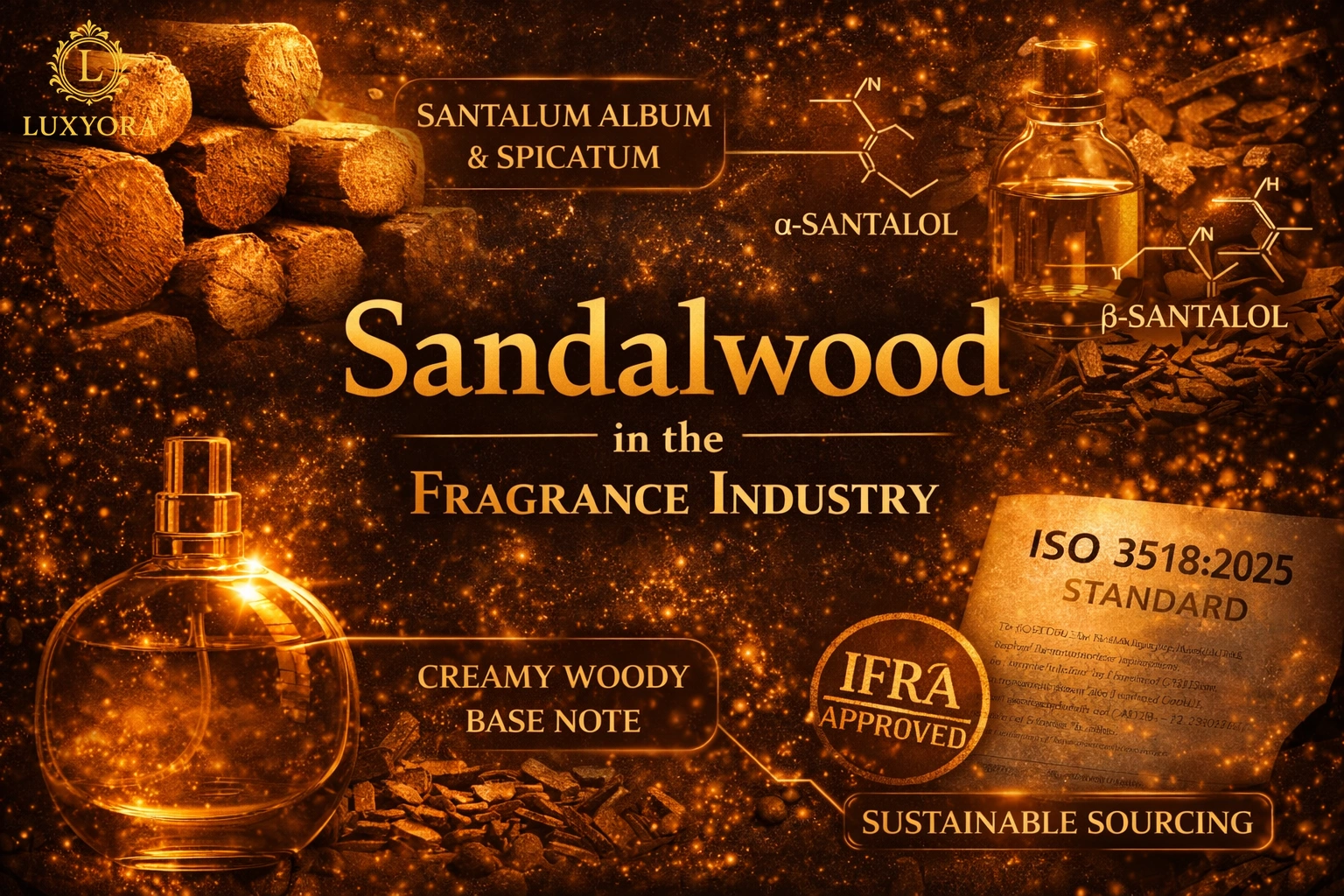
In the fragrance industry, sandalwood refers to an olfactory family and raw-material tradition centered on the warm, smooth scent of the genus Santalum, most notably Indian sandalwood (Santalum album) and Australian sandalwood (Santalum spicatum). In perfumery, sandalwood is prized as a creamy, woody base note with a soft, milky, balsamic character and strong tenacity (long-lasting presence on skin and fabric).
Unlike many bright top notes that evaporate quickly, sandalwood typically functions as a base note anchor, helping a fragrance feel rounded, luxurious, and persistent. It is used across categories, fine fragrance, personal care, and home fragrance, and is often described using keywords such as woody, creamy, lactonic, smooth, balsamic, and fixative.
Why Sandalwood Is So Valuable: Olfactory Role and “Fixative Power”
1) A signature “creamy wood” profile
Sandalwood’s fame comes from its ability to smell:
- Soft and milky rather than sharp or dry
- Warm and enveloping rather than smoky
- Elegant and comforting rather than aggressive
Perfumery ingredient explainers consistently note that sandalwood imparts a “round” woodiness that blends readily with florals, ambers, musks, and spices.
2) Fixative function in compositions
In the perfume industry, sandalwood often functions as a fixative or base modifier; it can slow the evaporation of more volatile materials, thereby improving the perceived longevity and diffusion profile of a perfume over time.
The Chemistry Behind the Scent: Santalols and the “Santalum Signature”
Sandalwood’s aroma is closely linked to naturally occurring constituents, especially α-santalol and β-santalol, which are widely discussed as key contributors to the recognizable sandalwood character.
Because chemical composition affects odor quality and performance, the industry relies on quality specifications for sandalwood oil. A major benchmark is ISO 3518, which specifies the characteristics of the essential oil of Santalum albumto support quality assessment in trade and manufacturing.
Industry keyword cluster: sandalwood essential oil, α-santalol, β-santalol, santalols, creamy woody note, base note, tenacity, fixation, Santalum album, Santalum spicatum, ISO 3518.
Natural Sandalwood Materials: Species, Geography, and What Perfumers Choose
Indian sandalwood (Santalum album)
Often treated as a “reference” material in perfumery storytelling, frequently associated with a rich, creamy profile and a long cultural history of use. Modern supply is shaped by cultivation, regulations, and conservation pressures; therefore, perfumers and brands also rely on alternative sandalwood sources and modern production approaches.
Australian sandalwood (Santalum spicatum)
Australian sandalwood is widely used in today’s fragrance market, including luxury applications. However, debates on sustainability and conservation remain active; reports have documented declines in wild populations and the pressures of harvesting, alongside claims of sustainable management in certain areas.
Why this matters to the fragrance industry: sandalwood is not merely a note; it is also a supply chain and sustainability issue. For modern brands, ingredient transparency, ethical sourcing, and credibility in conservation increasingly influence product positioning and consumer trust.
Sandalwood in Perfume Structure: Where It Sits and What It Pairs With
Sandalwood as a base note
Sandalwood most commonly appears in the base because it has a relatively slow evaporation rate and supports long wear.
Classic and modern pairing families
Sandalwood is frequently used to build (or soften) these popular accord styles:
- Floral-woody: jasmine, rose, tuberose + sandalwood for creamy depth
- Amber / oriental: resins, vanilla, spices + sandalwood for warmth and polish
- Woody-musky: clean musks + sandalwood for a smooth “skin scent” effect
- Oud-style blends: oud, saffron, rose + sandalwood for luxury and diffusion control
Sandalwood Beyond Alcohol Perfume: Attars, Oils, and Cultural Fragrance Forms
In South Asian fragrance traditions, sandalwood has long been used not only for its scent but also as a functional basein attars (perfume oils). Modern coverage of attars notes that sandalwood oil can help control diffusion and extend the life of other materials in an oil format, an important educational lens for readers learning how sandalwood behaves across product types.
Safety, Standards, and Compliance: What Brands Must Consider
ISO quality specification
ISO 3518:2025 provides updated standardization guidance on the quality characteristics of Santalum album essential oil relevant for companies purchasing, testing, and formulating with natural sandalwood oil.
IFRA standards and use-level limits
In consumer products, the use of fragrance ingredients is often guided by the IFRA Standards, which set restrictions and provide guidance based on safety assessments and are mandatory for IFRA members.
Practical industry documentation frequently includes IFRA Certificates of Conformity that specify maximum use levels by product category for specific sandalwood materials (e.g., certificates for sandalwood oils can list category-based limits).
Allergen awareness
Public ingredient databases indicate that sandalwood oil may be relevant in the context of allergen/sensitization for susceptible individuals, underscoring the need for careful management of dosage, labeling, and testing.
(Important note for readers: regulation and compliance can vary by region and product type; brands typically work with suppliers, safety assessors, and category-based standards to ensure compliant use.)
Sustainability and the “Modern Sandalwood Problem”
From 2018 to 2026, the most important shift in sandalwood isn’t just how it smells, it’s how it is sourced and protected.
Key industry realities include:
- Pressure on wild resources and debates about regeneration and harvest levels
- Growth of plantations and managed supply, particularly for commercial continuity
- Innovation toward sandalwood-like ingredients, including sustainability-driven approaches to producing santalol-rich materials
- Scientific work on biosynthesis and sustainable production, reflecting how valuable santalols are to perfumery and how seriously supply constraints are taken
How to Explain Sandalwood to Consumers (Retail & Content Tip)
If you’re writing product copy or educating customers, a strong sandalwood description usually includes:
- Scent identity: creamy, smooth, milky wood
- Performance: long-lasting base note, “anchoring” effect
- Style cues: warm, soft luxury; often paired with florals, amber, musks
- Sourcing story: Indian vs Australian sandalwood; sustainable sourcing emphasis
- Modern relevance: beloved in both classic perfumery and modern “skin scent” trends
References
Arunkumar, A. N., Joshi, G., Warrier, R. R., & Karaba, N. N. (Eds.). (2022). Indian sandalwood: A compendium. Springer Nature. (Amazon)
AvenaLab. (2024). Sandalwood essential oil IFRA certificate of conformity (COC) (PDF). (Avena Lab)
Firmenich SA. (2020, May 1). Sustainable production of a sandalwood oil-like ingredient. Perfumer & Flavorist. (Perfumer & Flavorist)
Iberchem. (2022, October 11). Sandalwood in perfumery. (Iberchem)
International Fragrance Association. (2023, July 5). Notification of the 51st amendment to the IFRA standards. (IFRA)
International Fragrance Association. (n.d.). IFRA standards documentation. (IFRA)
International Organization for Standardization. (2025). ISO 3518:2025—Essential oil of sandalwood (Santalum album L.) (Standard). (ISO)
National Center for Biotechnology Information. (n.d.). Sandalwood oil (PubChem compound summary). PubChem. (PubChem)
The Guardian. (2024, October 27). From Aesop to Estée Lauder, Australian sandalwood is coveted worldwide for its aroma. But experts say it’s at risk. (The Guardian)
Turin, L., & Sanchez, T. (2018). Perfumes: The guide 2018. Perfüümista OÜ. (Amazon)
Vogue. (2023, April 3). Attar, the millennia-old fragrance tradition, is poised for a major comeback. (Vogue)
Yan, X., et al. (2024). Biological properties of sandalwood oil and microbial biosynthesis strategies (Review). PMC. (PMC)