Rotating Bezel : What is Rotating Bezel
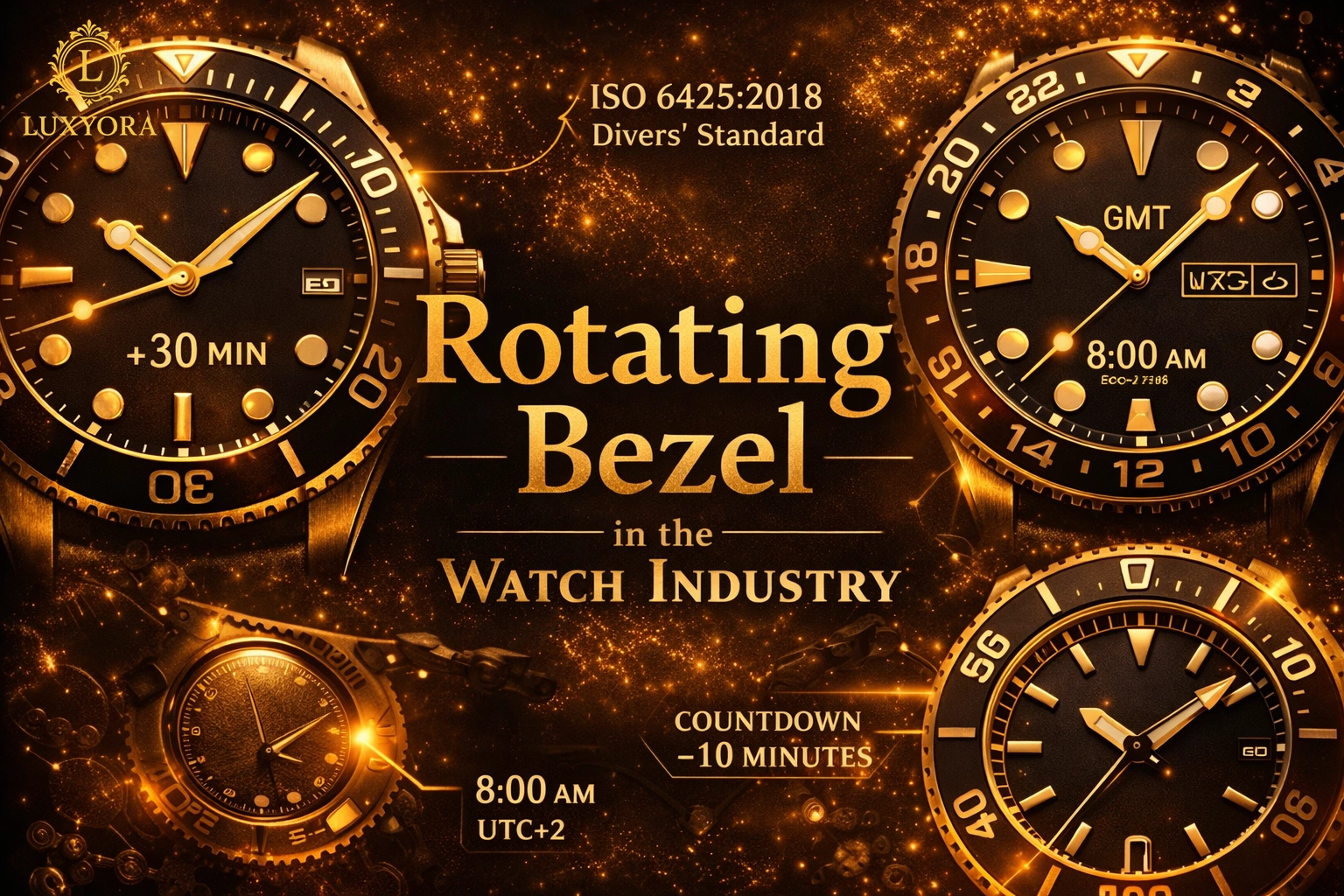
A rotating bezel is a movable ring fitted around a watch crystal that can be turned to align markings (scales, triangles, numerals, or indices) with the watch hands. In industry terms, it’s a functional timing interface, a simple, mechanical “calculator” that helps the wearer measure elapsed time, time remaining, or additional time zones without using pushers or digital menus.
While some bezels are purely decorative or fixed (e.g., many tachymeter bezels), a rotating bezel is designed for hands-on utility, especially in dive watches, GMT/travel watches, and certain military/aviation tool watches.
Why Rotating Bezels Matter: The “Tool Watch” Advantage
Rotating bezels remain popular because they offer:
- Instant readability: you can “set and glance” rather than calculate mentally.
- No battery or software dependence: purely mechanical interaction.
- Safety and redundancy: critical in diving contexts, where a bezel may act as a backup to other timing instruments.
- Versatility: timing cooking, meetings, parking meters, workouts, decompression stops, or travel time zones.
This blend of function and rugged simplicity is a big reason the rotating bezel is considered a core tool-watch feature.
The Most Important Category: The Dive-Time Rotating Bezel
Unidirectional rotation (the safety feature)
The most commonly used rotating bezel for professional use is the unidirectional dive bezel, which turns only counterclockwise. The logic is safety-first: if the bezel is accidentally bumped underwater, it should never shorten the indicated elapsed time in a way that could cause a diver to stay down longer than planned.
ISO 6425:2018 and the diving time indicator
The international standard for divers’ watches, ISO 6425:2018, specifies that a watch must have a diving time indicator (such as a rotating bezel) that is protected against inadvertent handling, readable with a 1-minute resolution over at least 60 minutes, and clearly marked at 5-minute intervals for analogue displays (ISO, 2018). Commentary and watch-industry analysis frequently discuss how brands interpret minute markings (e.g., full 60-minute hashes vs. dense marking in the first 15–20 minutes) while still meeting the standard’s intent.
How to use a dive bezel (count-up)
- Before entering the water, rotate the bezel so the triangle/zero marker aligns with the minute hand.
- As time passes, read elapsed minutes directly from the bezel scale against the minute hand.
- Because it’s unidirectional, accidental movement tends to increase the apparent elapsed time (conservative), rather than reduce it (risky).
Industry note: Many dive bezels also feature clicks (often 60 or 120) to help secure alignment and improve precision during setting.
GMT Rotating Bezels: Time Zones for Travel and Global Work
A GMT bezel typically uses a 24-hour scale and is often bidirectional bezel, allowing quick adjustment for time zone offsets. Paired with a GMT hand, a rotating 24-hour bezel can display multiple time zones, commonly two or even three, making it a practical traveler’s tool.
How to use a GMT rotating bezel
- Set your GMT hand to a reference time (often UTC).
- Rotate the bezel to match the offset of your destination or a second city.
- Read the second time zone using the GMT hand against the bezel’s 24-hour track.
A common design cue is a two-tone (day/night) bezel to help distinguish AM vs. PM at a glance.
Countdown Rotating Bezels: Timing “Time Remaining”
A countdown bezel is essentially the reverse of a dive bezel: the scale descends toward zero so you can track time remaining rather than time elapsed. Watch publications describe it as a reverse diving scale and highlight its practicality for everyday schedules and task timing.
How to use a countdown bezel
- Set the bezel’s “60/Start” point to align with the minute hand.
- As the minute hand advances, the bezel indicates how many minutes remain until the hour hand reaches zero.
These bezels appear in contexts such as military timing, aviation, and certain modern “mission timer” concepts.
How a Rotating Bezel Works (Mechanically)
Rotating bezels generally use one of two retention systems:
1) Click (ratcheting) bezels
A spring and notched ring produce tactile “clicks.” This improves:
- Precision (easy alignment)
- Resistance to accidental movement
This is common in dive bezels and aligns with safety goals.
2) Friction bezels
A friction fit allows smooth rotation without defined clicks, and is used when the bezel is adjusted frequently (some GMT/compass styles). Friction systems prioritize speed and simplicity but may feel less “locked” than ratchet-style systems.
Materials and Inserts: From Aluminum to High-Tech Ceramic
Rotating bezels are not just about motion; they’re also about durability and legibility. You’ll often hear industry terms like bezel insert, ceramic bezel, or proprietary brand materials.
Ceramic bezel inserts (modern premium standard)
Ceramic inserts are widely praised for their high scratch resistance and color stability, especially compared with older aluminum inserts, which can scratch or fade over time. Because bezels are exposed to knocks and abrasion, ceramic has become a strong selling point in sport-luxury watches.
Typical bezel insert materials (industry shorthand)
- Aluminum: lightweight, classic look, can scratch/fade
- Ceramic: scratch-resistant, colorfast, premium feel
- Steel: durable, can show scuffs; depends on finishing
- Sapphire or mineral/glass variants: glossy, often used for aesthetic effect in some designs
Common Mistakes and Buyer Tips
For readers learning the term “rotating bezel,” these points prevent confusion:
- A dive bezel is typically unidirectional for safety; a GMT bezel is commonly bidirectional for convenience.
- Not every rotating bezel is for diving. Some are for travel, countdown timing, navigation, or general elapsed timing.
- Check legibility: the best bezels have clear numerals, strong contrast, and a visible zero/triangle marker.
Why the Rotating Bezel Remains an Industry Staple
Even with smartphones and dive computers, the rotating bezel stays relevant because it is fast, intuitive, durable, and independent, and because modern watchmaking continues to refine it with better materials, tighter tolerances, and clearer functional design. For collectors and first-time buyers alike, understanding rotating bezels unlocks a major “language” of tool watches: diving, GMT travel, and mission timing all become easier to appreciate once you know what the bezel is doing.
References
Bob’s Watches. (2018). Ceramic vs. steel bezels: Pros and cons. (Bobswatches.com)
Davosa. (2022, March 7). The bezel on a watch guide. (Davosa USA)
Ethos Watches. (2025). Watch 101: Know the different scales on your bezel and how to read them. (Ethos Watches)
Fratello Watches. (2022, May 30). The dry facts about the ISO 6425 divers’ watch standard. (Fratello Watches)
Gnomon Watches. (2024, March 28). Everything you need to know about ceramic bezel inserts. (Gnomon Watches)
Hodinkee. (2022, February 2). The argument for more countdown bezels. (Hodinkee)
Hodinkee. (2024, February 28). A beginner’s guide to the GMT bezel. (Hodinkee)
Horbiter. (2024). Watch bezel: What it is and how does it work. (horbiter.com)
International Organization for Standardization. (2018). ISO 6425:2018—Horology—Divers’ watches (Standard). (ISO)
Kaplan, B. B. (2022). Horology: An illustrated primer on the history, philosophy, and science of time, with an overview of the wristwatch and the watch industry. Schiffer Publishing. (speedreaders.info)
Monochrome Watches. (2018, October 30). Understanding bezels and all the different scales. (Monochrome Watches)
Monochrome Watches. (2025, December 13). The ABCs of time: Your guide to functional watch bezels and their uses. (Monochrome Watches)
Oracle Time. (2025, December 18). Beginner’s guide to the dive watch bezel. (Oracle Time)
Rolex. (n.d.). Watchmaking—Bezel. (Rolex)
Swisswatches Magazine. (2024, November 26). What is a GMT watch and how does it work? (Swisswatches Magazine)
WatchGecko. (2023, August 22). How do GMT watches work? (WatchGecko)
Wristler. (2026, January 22). Watch bezel functions explained: Dive, GMT & more. (Wristler)