Prong Thickness : What is Prong Thickness | Luxyora
In the jewelry industry, prong thickness refers to the cross-sectional “meat” of the metal claws (prongs) that hold a gemstone in a prong setting. It is a deceptively small design detail with huge consequences: prong thickness influences stone security, wear resistance, aesthetics, comfort, and even how often a ring may need inspection, tightening, or retipping. In short, prong thickness is a core part of “setting integrity” and one of the most practical, real-world variables that separates a delicate-looking ring that stays safe from one that gradually loosens and risks losing its stones.
Professional bench guidance and quality standards emphasize that prongs must be thick enough to support proper bearing/seat cutting while retaining sufficient metal to hold the stone securely over the long term.
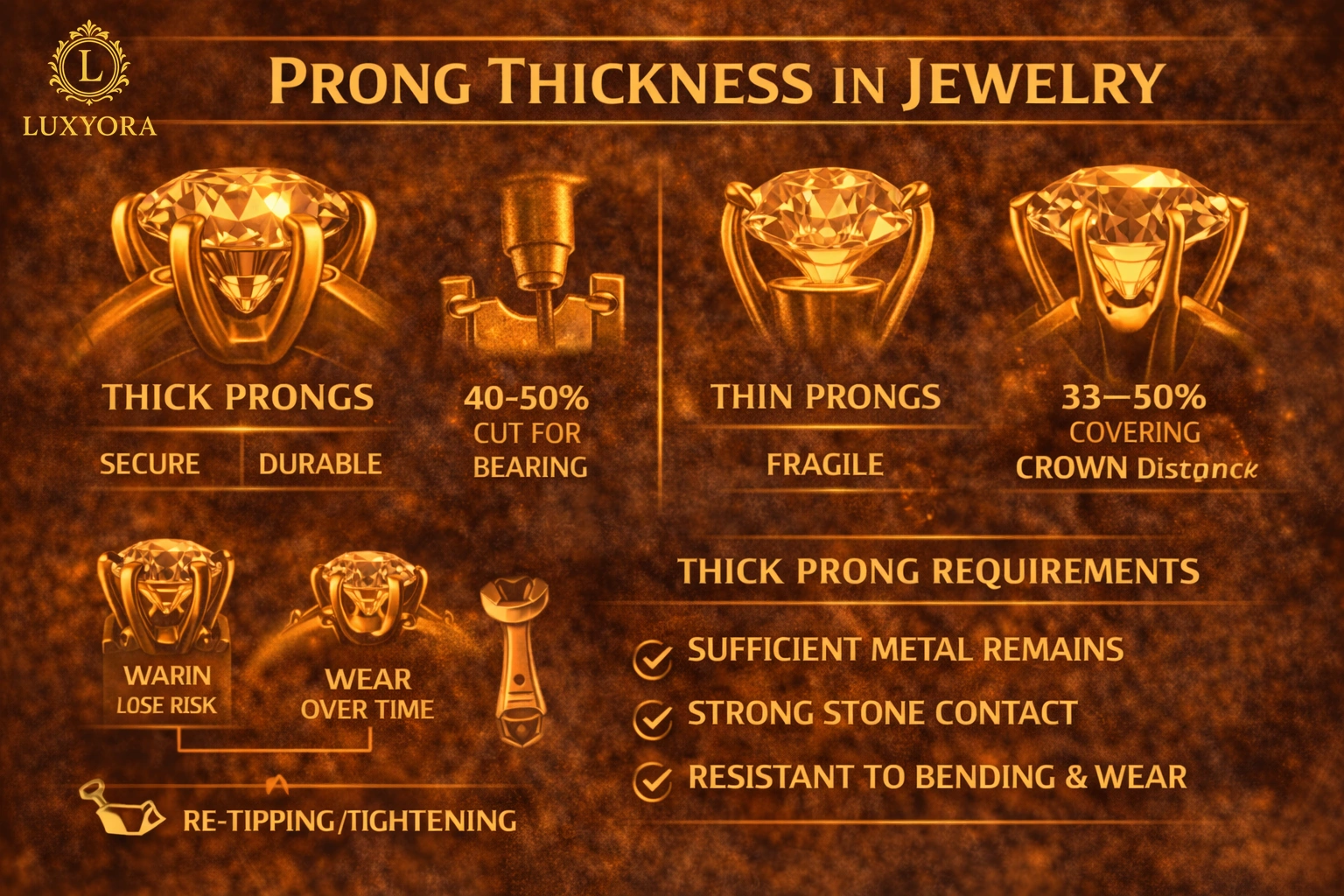
GIA’s Quality Assurance Benchmarks explicitly note that sufficient prong thickness is needed to secure the stone, with a recommended approach where 40–50% of the metal is removed at the bearing (the seat cut that matches the stone), leaving enough remaining metal to form a strong wall above the girdle.
1) What Exactly is “Prong Thickness”?
Prong thickness is best understood in two zones:
- Prong body thickness (the shaft of the prong)
- Prong head thickness (the tip/claw area that bends over the gemstone)
A well-made prong must be thick enough to:
- allow an accurately cut bearing (seat) that matches the gemstone’s contour, and
- still leave adequate metal to form a secure “cap” over the stone without becoming fragile.
Bench education emphasizes that the bearing is not just a notch; it must fit the stone precisely, because gaps allow movement that can translate into loosening over time.
2) Why is Prong Thickness Critical for Stone Security
A) Strength against bending and snagging
Prongs are vulnerable to daily forces, such as knocks, catching on fabric, or being pushed sideways. When prongs are too thin, they can bend outward more easily, especially if they are also spread too far or poorly angled. GIA’s platinum prong-setting analysis warns that over-spreading can weaken prongs and make them prone to bending outward, increasing the risk of stone loss.
B) Enough metal remains after seat cutting
Prong setting requires removing metal to create a seat. If the prong is too thin at the start, cutting a proper bearing can leave insufficient remaining metal to hold the stone over time. GIA’s benchmark guidance gives a practical rule-of-thumb: at the bearing, remove about 40–50% of prong thickness, implying the prong must begin thick enough to survive that reduction while staying strong.
C) Contact over the crown matters (not just thickness)
Prong thickness works together with prong contact (how far the prong overlaps the stone). GIA’s benchmark notes that adequate prong contact, 33–50% of the total crown distance, is critical to a stable setting.
So, a thick prong that barely touches the crown can still be insecure.
3) The Trade-off: Thick Prongs vs Delicate “Minimal Metal” Aesthetics
Clients often want prongs that look thin and refined so the diamond appears larger and more “floating.” But minimal metal has limits:
- Thinner prongs: cleaner look, more visible gemstone, but more prone to bending, wear, and requiring maintenance
- Thicker prongs: stronger, often more protective, but can visually reduce the “airiness” and may cover more of the stone
This is why “pretty” prongs and “secure” prongs must be engineered together; shape, thickness, angle, height, and contact all matter at the same time. Bench-level standards also highlight additional geometry targets, such as the finished prong height relative to the stone’s table height (GIA suggests 75–85% of thetable height in their benchmark illustration).
4) What Influences the “Right” Prong Thickness?
There is no universal single measurement because the ideal thickness depends on:
A) Stone shape and risk points
- Round brilliant stones distribute stress more evenly.
- Princess, marquise, pear, and other pointed shapes concentrate risk at corners/tips, often benefiting from more robust prong design and protective coverage.
B) Stone size and mounting height
A larger center stone or a higher-set stone increases leverage on the prongs. Some settings that sit high can snag more and place greater bending stress on prongs, prompting many guides to recommend lifestyle-aware design choices.
C) Metal choice (platinum vs gold alloys)
Metal affects how prongs wear and deform. Platinum settings may “move” differently than gold alloys under impact, and prong geometry can become more vulnerable when angles are too steep or prongs are improperly spread.
(Practical takeaway: the jeweler’s alloy choice and prong design must be matched, not chosen independently.)
D) Prong style
- Claw (talon) prongs: often appear thinner at the tip, but must still have adequate thickness at the base and bearing.
- Rounded prongs may wear more slowly at the contact point and are easier to maintain.
- V-prongs: common for corners (princess/pear/marquise) and can add protective bulk where it matters most.
5) Thickness vs Maintenance: How Prongs Wear Over Time
Even a well-built setting degrades over time. Multiple consumer-facing education sources note that prongs can loosen or wear and should be inspected regularly; worn prongs can cause stones to fall out if not tightened or repaired.
Common maintenance terms tied to prong thickness
- Retipping: rebuilding worn prong tips (common when tips thin out from abrasion)
- Repronging: replacing prongs entirely if they’re too compromised
- Tightening: correcting small shifts before major wear occurs
GIA bench guidance also emphasizes that regular inspection can detect looseness early and outlines practical tightening methods (e.g., “vector tightening”) to re-secure stones safely.
6) Practical Quality Checks (Consumer-Friendly)
While thickness is hard to measure without tools, consumers can look for signs of adequate construction:
- Prongs look even, symmetrical, and consistent in size and finish (GIA benchmark point: prongs should be rounded/polished and consistent).
- Each prong overlaps the stone with meaningful contact, not a tiny “tick” of metal.
- The stone does not rattle or shift under gentle tapping (a jeweler should check this properly).
- Prongs aren’t already “knife-thin” at the tip on a brand-new ring unless engineered as a reinforced claw design.
For higher-risk lifestyles (hands-on work, gym, frequent gloves), buyers may prefer a slightly more robust prong profile or a more protective setting style.
7) Best-Practice Summary: What “Good Prong Thickness” Accomplishes
A well-proportioned prong thickness helps ensure:
- Enough metal remains after proper bearing cutting (40-50% removed at the bearing guidance)
- Strong overlap/contact over the crown (33-50% crown distance)
- Better resistance to bending and long-term wear (avoiding weakening through over-spreading)
- A realistic maintenance schedule where inspections and occasional tightening prevent emergency repairs
References
Hunt, M. (2022). Stonesetting for Jewellery Makers (New ed.). Search Press. (Search Press)
Revere, A. (2018). Professional Stonesetting: A Contemporary Guide to Traditional Setting Techniques. Brynmorgen Press. (goodreads.com)
Gemological Institute of America. (n.d.). Features of platinum prong settings (Quality Assurance Benchmark). (GIA)
Gemological Institute of America. (n.d.). Bench tip: Avoid stone loss with quality assurance benchmarks. (GIA)
Gemological Institute of America. (n.d.). Avoid stone loss with quality assurance benchmarks (UK page). (GIA)
Gemological Institute of America. (n.d.). Bench tip: Use vector tightening to overcome metal memory in prongs. (GIA)
Angara. (2020, December 4). Prong setting: Everything you need to know. (Angara)
VRAI. (2025, June 2). Complete guide to engagement ring prongs. (VRAI)
Whiteflash. (n.d.). The ultimate guide to prong settings. (Whiteflash)