Perfume Layering Guide: How to Combine Scents Correctly | Luxyora
Perfume layering is the fragrance world’s version of tailoring: subtle adjustments, impeccable fit, and the kind of signature effect that makes people lean in not because it’s loud, but because it’s yours. Done well, layering can stretch longevity, add dimension, and turn a familiar scent into something personal and luxe. Done poorly, it can smell like a department-store tester strip got into a fistfight with your body lotion.
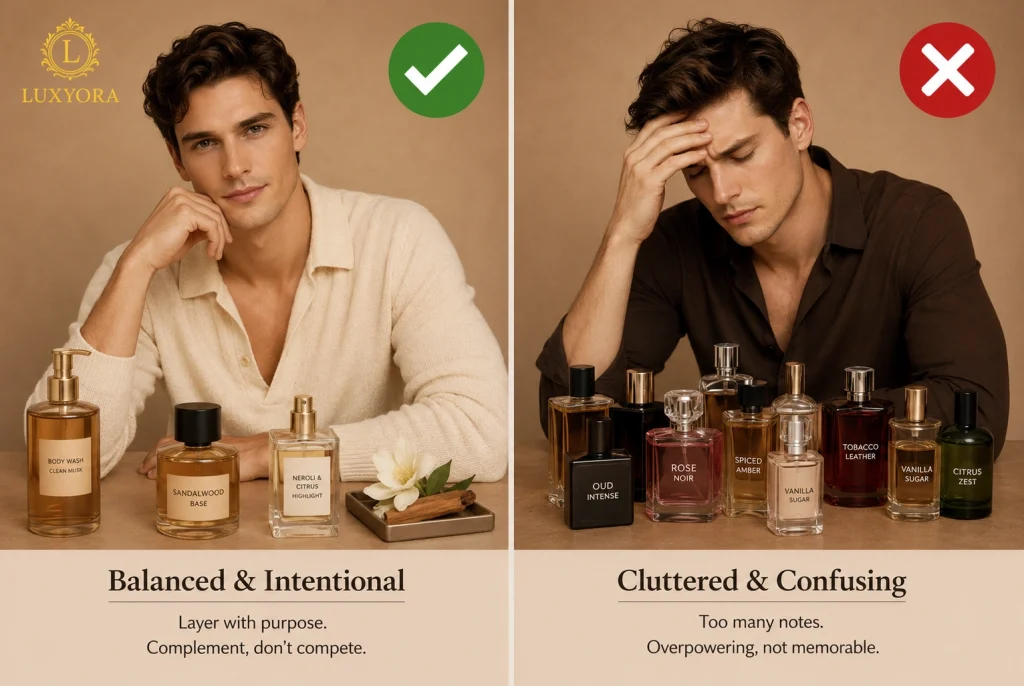
The secret is that layering isn’t “mix everything and hope.” Its structure: a clean base, a clear idea, and one or two thoughtful pairings that behave beautifully together over time.
Step 1: Understand what you’re actually layering
Layering can mean two different things, and mixing them up is where most people go wrong.
1) Product layering (the safest, easiest method):
Body wash → lotion/oil → perfume. This builds a consistent scent “story” and boosts wear time.
2) Perfume-on-perfume layering (the artful method):
Two (occasionally three) different fragrances are combined intentionally. This is where chemistry and restraint matter most.
If you’re new to layering, start with product layering first. It gives you control and lowers the chance of clashing.
Step 2: Start with a “base” that plays well with others
Think of your base as the neutral cashmere turtleneck of your fragrance wardrobe. It should blend, support, and elevate.
Great base options:
- Clean musks (skin-like, softly soapy, “your skin but expensive”)
- Soft vanillas (not frosting-sweet, more airy, creamy, warm)
- Gentle woods (sandalwood, cedar, “dry” woody notes)
- Light ambers (glowy, smooth, not smoky)
These notes tend to act like a frame around other scents, rather than competing for attention.
Step 3: Pick a “highlight” note you want to feature
Now choose the vibe you want to add: sparkle, romance, spice, freshness, or depth. This is where layering becomes expressive instead of random.
High-impact highlight families:
- Citrus/neroli for brightness
- Rose/floral bouquets for elegance
- Spices for warmth and drama
- Green/aromatic notes for crisp sophistication
- Fruity notes for playful glow
The goal is in contrast with harmony, like adding a silk scarf to a minimal look.
Step 4: Follow the golden rule: two scents is a signature, three is a gamble
Most “muddy” layering disasters happen because too many complex perfumes are stacked together. Each fragrance already has top, heart, and base notes. Combine two busy compositions, and you’ve basically created a fragrance traffic jam.
A good formula:
- One base scent + one highlight scent
- If you add a third, make it a simple modifier (a clean musk, a sheer citrus, a single-note-style vanilla).
Step 5: Layer in the right order
Order matters because different formats sit on the skin differently.
A polished layering sequence:
- Shower (clean skin = clearer development)
- Unscented or lightly scented lotion/oil (helps fragrance cling)
- Heavier scent first (woody/amber/vanilla)
- Lighter scent second (citrus/floral/musk)
Why this works: heavier structures anchor. Lighter notes float on top and sparkle.
Step 6: Use placement like a stylist uses accessories
You don’t have to stack both perfumes on the exact same spot. In fact, you often shouldn’t.
Try these placement strategies:
A) “Split placement” (clean and controlled):
- Base scent on chest/inner elbows
- Highlight scent behind ears/back of neck
This creates a soft evolution as you move.
B) “Halo layering” (airy and elegant):
- Base scent on skin
- Highlight scent lightly on hair brush or scarf Perfect when you want a trail, not a cloud.
C) “Same spot, micro-dose” (for pros):
- One spray base + half-spray highlight (or a tiny dab if it’s an oil). This is powerful, keep it restrained.
Step 7: Learn your “safe pairings” (and the ones that get tricky)
Some combinations are famously easy because they share a similar vibe or structure.
Reliable pairings:
- Vanilla + citrus (creamy brightness)
- Rose + woods (modern romance)
- Clean musk + almost anything (the ultimate blender)
- Amber + spice (warm, evening-ready depth)
- Green notes + florals (fresh, expensive garden energy)
Trickier pairings (approach carefully):
- Two heavy gourmands (can go syrupy fast)
- Two smoky/oud-forward scents (can become dense and overwhelming)
- Very sweet + very powdery (can read dated or “makeup bag” depending on ratios)
Step 8: Test like a professional (no drama, no regret)
Layering needs a little patience, because the opening is not the whole story.
A simple testing routine:
- Test on clean skin when you’re not already wearing scented products.
- Apply your base, wait 10-15 minutes, then apply the second scent.
- Live with it for at least 2-4 hours before you judge.
Fragrance changes with warmth, time, and skin chemistry. The blend that feels “too much” at minute five can turn into something stunning by hour two.
Step 9: Master longevity without turning up the volume
If you want your layered scent to last longer, don’t just add more sprays. Build a better foundation.
Longevity boosters that keep things chic:
- Moisturize first (unscented is best when mixing perfumes)
- Use one anchor scent with strong base notes (woods/ambers/musks)
- Add a light “refresh” later with a travel spray, one targeted spritz, not a full reset
Step 10: Safety and skin comfort matter in luxury
Layering multiple scented products increases overall fragrance exposure on skin. If you’re sensitive, keep it simple:
- Start with one perfume + unscented lotion
- Avoid spraying on irritated or freshly shaved skin
- Patch test if you’re trying a new combo or oil
And if you’ll be in direct sun, be thoughtful about where you apply heavily, especially with bright citrus profiles, because certain materials used in fragranced products can have phototoxicity considerations depending on concentration and product type.
Luxyora Philosophy: The most luxurious fragrance is never an accident; it’s a composition. Layer with intention, and your scent becomes a signature that whispers taste, not noise.
References:
- Cosmopolitan. (2025). 20 tips to make your perfume last longer, according to experts. Cosmopolitan.
- International Fragrance Association. (n.d.). IFRA standards documentation (51st amendment and guidance materials). IFRA. (Web content accessed 2025).
- Research Institute for Fragrance Materials. (2019). Guidance for the use of IFRA standards. RIFM/IFRA.
- Perinelli, D. R., Cespi, M., Bonacucina, G., Palmieri, G. F., & Casettari, L. (2020). Encapsulation of flavours and fragrances into polymeric capsules and cyclodextrins inclusion complexes: An update. Molecules, 25(24), 5878.
- Real Simple. (2025). How to layer fragrances to create a signature scent everyone remembers. Real Simple.
- Rodrigues, A. E., Nogueira, I., & Faria, R. P. V. (2021). Perfume and flavor engineering: A chemical engineering perspective. Molecules, 26(11), 3095.
- Turin, L., & Sanchez, T. (2018). Perfumes: The guide 2018. Perfüümista OÜ.