Amber : What is Amber in Perfumes
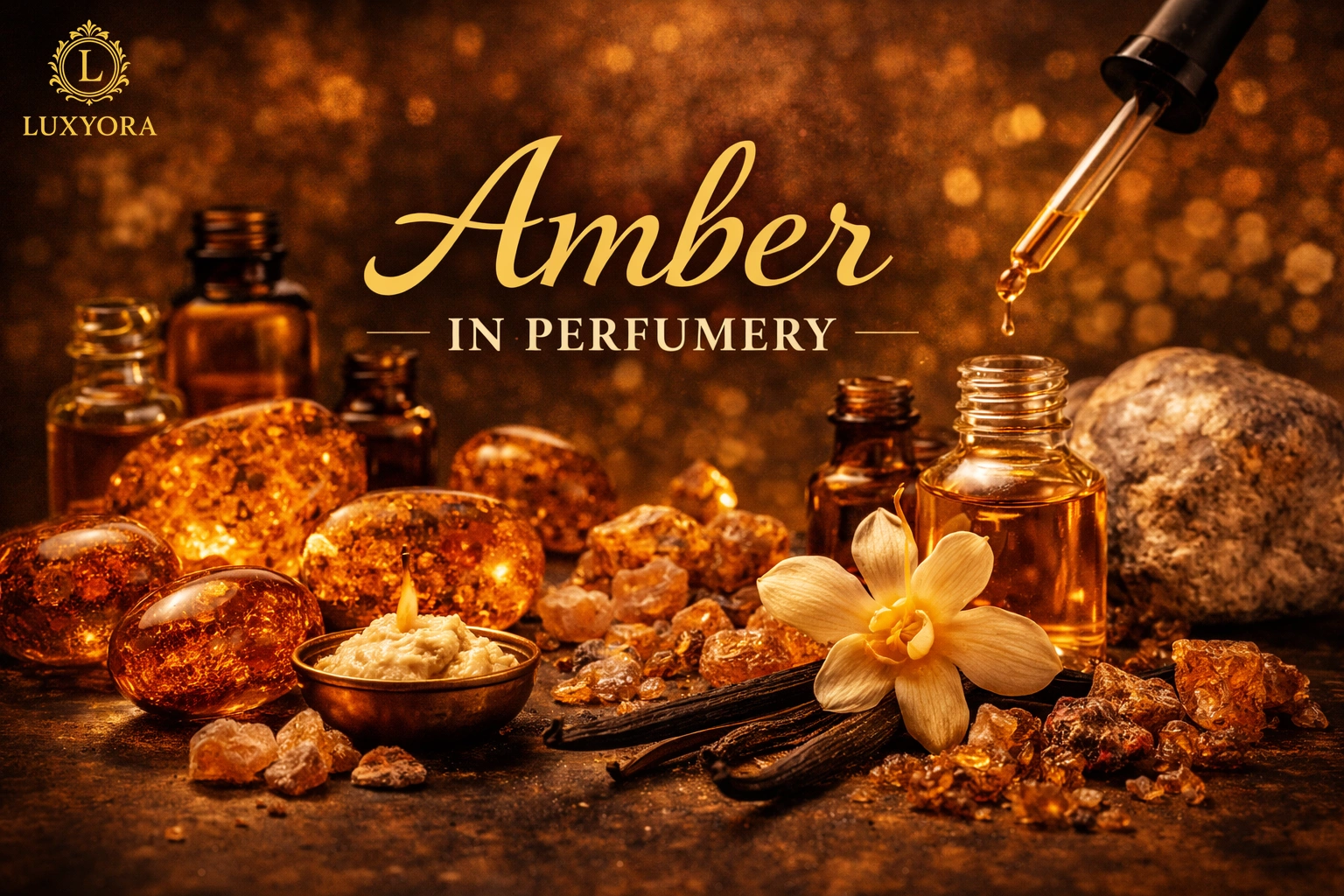
In the fragrance industry, Amber is one of the most used (and most misunderstood) industry terms. When a perfume is described as “amber,” it usually does not mean it contains a literal chunk of fossil amber (the gemstone-like resin). Instead, amber in perfumery is typically a “fantasy note” or accord, a crafted blend designed to evoke a warm, resinous, sweet, glowing, and sensual character. This is why amber is central to many long-lasting base notes, especially in styles historically known as oriental/ambery compositions.
This article explains what amber means in perfumery, how it is built, what materials create the effect, and how it differs from ambergris, Ambrox/Ambroxan, and other similar-sounding terms.
What Does “Amber” Mean in the Fragrance Industry?
In perfumery vocabulary, Amber refers to a complex odor impression often described as:
- warm
- sweet
- balsamic
- resinous
- sometimes powdery, spicy, or musky
IFRA’s fragrance ingredient glossary explicitly frames “amber” as a descriptive term for a complex fragrance note (an effect created by combining materials), rather than a single raw material.
Why it’s called “Amber”
The name “amber” is partly sensory storytelling: it evokes the golden glow and warmth of amber-colored resins and tinctures used in perfumery. Over time, the industry adopted “amber” as a convenient label for a recognizable, cozy base style.
Amber as an Accord: The Classic Formula Logic
Because amber is an accord, perfumers build it using ingredients that collectively produce the “ambery” signature. Many educational perfumery sources describe the traditional amber accord as centered on:
- Labdanum (cistus) resin – leathery, ambery, resinous warmth
- Benzoin resin – balsamic sweetness with vanilla-like facets
- Vanilla / Vanillin – creamy sweetness and soft diffusion
This trio is commonly presented as the backbone of an amber accord, with variations depending on brand style and target mood.
Common supporting materials (to shape different “amber styles”)
Perfumers frequently extend the accord with:
- Styrax, Peru/Tolu balsam, myrrh, olibanum (frankincense) for incense-balsamic depth
- Patchouli for earthy darkness and richness
- Musks for softness, diffusion, and persistence
The result is not “one smell” but a family of amber profiles, ranging from vanillic-gourmand amber to smoky-incense amber and dry woody amber.
Amber vs. Ambergris: Two Different Concepts
A major source of confusion is the similarity between amber and ambergris.
Amber (in most perfumes)
- A constructed accord (fantasy note)
- Usually built from resins + vanilla/vanillin + woods/musks
- “Amber” on a note pyramid typically signals warmth and depth
- Ambergris (a rare natural material with a specific odor effect)
Ambergris is a waxy substance associated with sperm whales and historically valued for its fixative qualities and unique ambery-animalic radiance. Modern perfumery largely uses synthetic substitutes (for practicality, availability, ethics, and regulation considerations).
Modern “Amber” and the Rise of Ambergris-Type Molecules (Ambrox/Ambroxan)
In contemporary perfumery, “amber” can also refer to a more mineral-woody-ambery profile that comes from ambergris-style aroma chemicals.
Ambrox / Ambroxide / Ambroxan (industry context)
- These are widely used materials that recreate parts of the ambergris effect: smooth, woody, ambery, long-lasting diffusion.
- Recent scientific and engineering literature discusses efforts to produce ambergris substitutes more sustainably (including biosynthesis approaches).
A 2024 review in Chem & Bio Engineering highlights ongoing work toward the biosynthesis of key ambergris substitute compounds, such as ambrein/, via ambroxide pathways, reflecting industry interest in scalable and potentially greener production routes.
Where Amber Sits in Perfume Structure (Top-Heart-Base)
Amber is most often a base note because many of its building blocks, resins, vanillin, musks, and woody ambers evaporate slowly and provide fixation and lasting power.
In formula terms, amber helps:
- anchor bright top notes (citrus, spices)
- warm up florals (rose, jasmine, orange blossom)
- deepen woods (cedar, sandalwood)
- improve overall tenacity and sillage (trail)
This is why you’ll see amber prominently in categories like ambery woods, ambery florals, amber spicy, and many compositions previously labeled “oriental.”
Quality, Transparency, and Standards (What Professionals Consider)
Natural material definitions and naming
When amber is produced from natural raw materials (e.g., labdanum extracts or benzoin resinoids), industry standards and nomenclature frameworks help define and label materials consistently. ISO provides terminology for aromatic natural raw materials, while IFRA offers nomenclature guidance for natural complex substances used in fragrance palettes.
Safety and compliance
Resins and balsams may contain naturally occurring constituents that warrant attention in safety assessments and product labeling. IFRA’s Transparency List and related materials support clearer communication about ingredient categories used in perfumery.
Key “Amber” Keyword Map (Industry-Rich Terminology)
If you’re learning fragrance language, these are the high-value keywords connected to amber:
- Amber accord (constructed note)
- Resins & balsams (labdanum, benzoin, styrax, tolu/peru balsam)
- Vanillic amber (vanilla/vanillin-driven warmth)
- Incense amber (frankincense/myrrh facets)
- Woody amber/modern amber (ambergris-type molecules)
- Ambergris substitute (Ambrox/Ambroxan/ambroxide-related materials)
- Base note/fixation/tenacity (performance vocabulary)
Practical Takeaways
- Amber is usually an accord, not a single ingredient.
- Classic amber often relies on labdanum, benzoin, and vanilla/vanillin, with many creative variations.
- Ambergris differs from amber; modern perfumery often uses synthetic ambergris-like molecules to enhance longevity and diffusion.
The term “amber” may refer to either sweet resinous warmth (classic) or woody-mineral radiance (modern), depending on the composition.
References
Experimental Perfume Club. (2020, November 18). How to create amber in perfume. Experimental Perfume Club. (Experimental Perfume Club)
Experimental Perfume Club. (2019, November 19). What is amber in perfume. Experimental Perfume Club. (Experimental Perfume Club)
Gopi, S., Sukumaran, N. P., Jacob, J., & Thomas, S. (2023). Natural flavours, fragrances and perfumes: Chemistry, production, and sensory approach. John Wiley & Sons. (Google Books)
He, N., et al. (2024). Efforts toward ambergris biosynthesis. Chem & Bio Engineering. (ACS Publications)
International Fragrance Association (IFRA). (2020). IFRA fragrance ingredient glossary (April 2020). (d3t14p1xronwr0.cloudfront.net)
International Fragrance Association (IFRA). (n.d.). Nomenclature for natural complex substances on the IFRA Transparency List. (IFRA)
International Fragrance Association (IFRA). (n.d.). The IFRA Transparency List: The perfumer’s palette. (IFRA)
ISO. (2021). ISO 9235: Aromatic natural raw materials—Terms and definitions. International Organization for Standardization. (Iteh Standards)
Takase, D., et al. (2025). An odorant receptor for a key odor constituent of ambergris. [Article in PMC/PubMed Central]. (PMC)
Wang, W., et al. (2025). Cis-abienol from tobacco trichomes to ambergris-like fragrance compounds: A review. Frontiers in Bioengineering and Biotechnology. (Frontiers)
Sell, C. S. (2019). Fundamentals of fragrance chemistry. Wiley-VCH. (Offline reference)