Caseback : What is Caseback
In watchmaking, the caseback is the rear closure of the watch case, the component that seals the watch and protects the movement from dust, moisture, pressure, and impact. Although it’s often overlooked compared to the dial or bezel, the caseback is a highly consequential component because it directly affects three things buyers care about: water resistance, durability, and maintenance/service access.
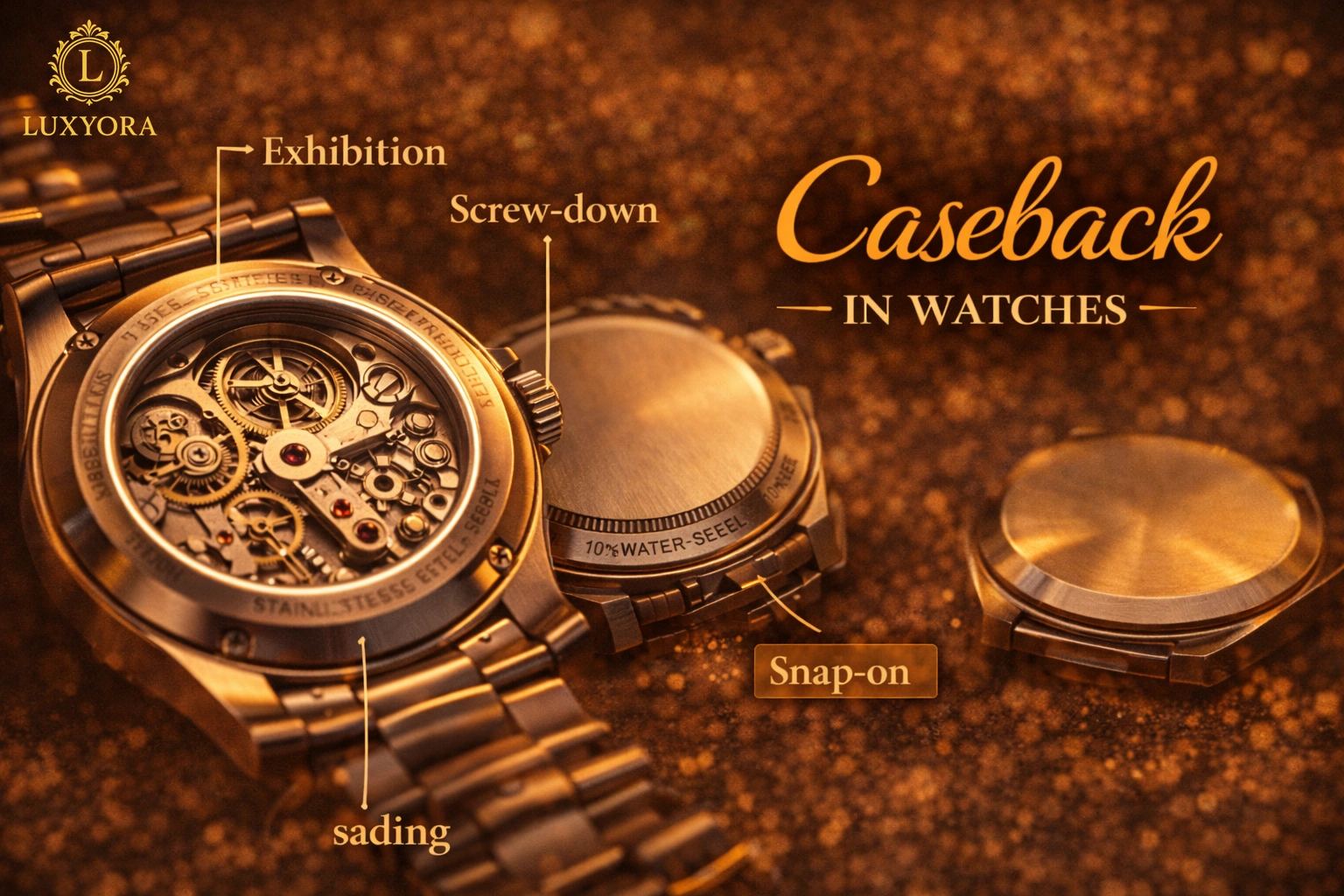
Modern watch education sources describe casebacks in practical categories (screw-down, snap-on, exhibition/transparent), and those categories map closely to how a watch is engineered to survive real-world wear.
What Is a Caseback?
A caseback is the “rear lid” of the watch case that closes the housing around the movement. It typically includes:
- a metal back (solid) or a crystal window (display/exhibition)
- a gasket (seal) that helps prevent water and dust ingress
- a fastening method (threads, pressure fit, screws)
In industry language, the caseback is part of the watch’s sealing system, working together with the crystal, crown tube/crown seals, and gaskets. This is why caseback design is closely tied to water-resistance standards and testing.
Why the Caseback Matters More Than It Looks
A. Water-resistance and pressure integrity
A watch can maintain water resistance only if the caseback interface maintains a reliable seal under temperature and pressure changes. ISO’s water-resistant watch standard specifies test methods used to verify water resistance and the marking manufacturers may apply.
The ISO 22810 sample document also describes the condensation test, a practical check for water ingress that demonstrates that sealing is verified under controlled conditions rather than assumed.
B. Serviceability and long-term ownership
Opening the caseback is how watchmakers access the movement for servicing. A caseback that’s easy to open (e.g., snap-on) may be convenient for maintenance, while a highly secure design (e.g., screw-down) may prioritize sealing integrity.
C. Design storytelling
The caseback is also where brands place engravings (serial numbers, water resistance ratings, commemorations) or display finishing via a sapphire window, turning the back of the watch into a design canvas.
Main Types of Watch Casebacks
1) Screw-down caseback
A screw-down caseback uses threads to secure the caseback to the case, typically compressing a gasket for a secure seal. This design is widely associated with sport and dive watches because it provides better sealing than many pressure-fit designs.
Pros
- strong mechanical security
- typically better sealing potential (with proper gasket condition)
- common on tool watches and higher water-resistance ratings
Consideration
- requires proper tools and torque for safe opening/closing (service quality matters)
2) Snap-on caseback
A snap-on (press-fit) caseback “snaps” into place, often with a gasket. It’s often seen on dress watches and simpler designs where extreme water resistance isn’t the primary focus.
Pros
- easier/faster access for service
- can support slimmer profiles in some designs
Consideration
- generally not the default choice for high water-resistance tool watches
3) Exhibition or display caseback
A display (see-through) caseback includes a transparent window, often sapphire crystal, so you can see the movement. This is popular in mechanical watches because it showcases finishing, rotor motion, and architecture. The media also notes that display cases are most effective when there’s something worth displaying, and the design trade-offs are justified.
Pros
- celebrates movement finishing and mechanical identity
- improves perceived value for enthusiasts
Trade-offs
- can reduce the space for engraving
- may affect thickness or water-resistance engineering choices depending on construction (varies by model)
4) Screw-held (multi-screw) caseback
Some casebacks are held with multiple screws around the perimeter rather than a fully threaded screw-down ring. This approach is evident in various designs, including more angular or integrated-case styles; it’s another way to achieve uniform gasket compression.
Caseback Choices in Dive Watches and Standards Context
Dive watches are the clearest example of why caseback engineering matters. Industry explainers of ISO 6425 emphasize that divers’ watches must meet specific criteria such as minimum water resistance and a time-control system (often a unidirectional bezel), along with durability requirements.
In practice, many dive watches pair these expectations with screw-down crowns and robust sealing choices; Citizen’s technical explainer describes screw-down crowns as a way to ensure higher water resistance and prevent operational errors during dives.
While discussions of ISO 6425 often focus on bezel safety and legibility, the broader point is that dive-watch “tool credibility” depends on a total sealing system caseback.
Materials, Engravings, and What You’ll See Printed on a Caseback
Common caseback markings
- water resistance rating (e.g., 100 m / 10 bar)
- serial number/reference number
- material (stainless steel, titanium, gold)
- limited edition numbering
- sometimes compliance marks and service codes
Many consumer and retailer guides note that casebacks may include “information stamps” plus decorative engravings, especially on solid backs.
Solid vs display backs as an identity choice
Some brands prefer solid backs for:
- a cleaner tool aesthetic
- more engraving space
- potentially simpler reinforcement for high water resistance
Others use display backs to highlight:
- movement finishing
- brand pride in caliber architecture
Watch media debates around “open vs closed” backs reflect how strongly enthusiasts associate the caseback with authenticity and intent.
Maintenance Reality: The Gasket Is the Quiet Hero
Even the best caseback design relies on the condition of the gasket. Over time, gaskets can compress, dry, or degrade, especially with heat, sweat, chemicals, or frequent opening. That’s why water resistance is not “forever”; it’s a performance state that depends on maintenance and proper assembly procedures under controlled conditions. This idea aligns with ISO’s emphasis on test methods and verification rather than assumptions.
Practical takeaway: if water resistance is important to you, treat gasket replacement and pressure testing as routine care, especially after battery changes (quartz) or full servicing (mechanical).
How to Choose the Right Caseback for Your Use
If you want a daily sports watch or a swim-capable watch
- prioritize screw-down caseback (and strong crown sealing)
- check real water-resistance rating and brand guidance
- service with a reputable watchmaker
If you want to dress elegantly and wear slim wear
- A snap-on caseback may be perfectly appropriate
- Focus on comfort, thickness, and style priorities
If you love mechanics and finishing
- Choose an exhibition caseback
- Look for movement finishing that justifies the view (per enthusiast guidance)
References
Brunner, G. L. (2023). The Watch Book: Compendium – Revised Edition. teNeues. (Offline reference)
Ethos Watches. (2025, May 31). The watch caseback: Types of styles & engravings. (Ethos Watches)
Hodinkee. (2022, March 16). When should a watch have a see-through caseback? (Hodinkee)
Hodinkee. (2022, March 21). The caseback conundrum. (Hodinkee)
Hodinkee. (2021, May 3). The controversial case of casebacks, open & closed. (Hodinkee)
International Organization for Standardization. (2010). ISO 22810:2010 — Horology: Water-resistant watches. ISO. (ISO)
International Organization for Standardization. (2010). ISO 22810:2010 (sample excerpt PDF). (ITeh Standards)
Jomashop. (2025). Your comprehensive guide to watch casebacks. (jomashop.com)
Schmidt, R. (2019). The Wristwatch Handbook: A Comprehensive Guide to Mechanical Wristwatches. ACC Art Books. (Offline reference)
The 1916 Company. (2021, February 23). What is a dive watch? (ISO 6425 definition & meaning). (The 1916 Company)
Time and Watches. (2024, August 17). The essential requirements of a diver’s watch: A quick guide. (Time and Watches | The watch blog)
Citizen Watch Global. (n.d.). Diver’s watches | CITIZEN Technologies (screw-down crown rationale). (CITIZEN WATCH Global Network)