Molecular Sensors : What is a Molecular Sensor | Luxyora
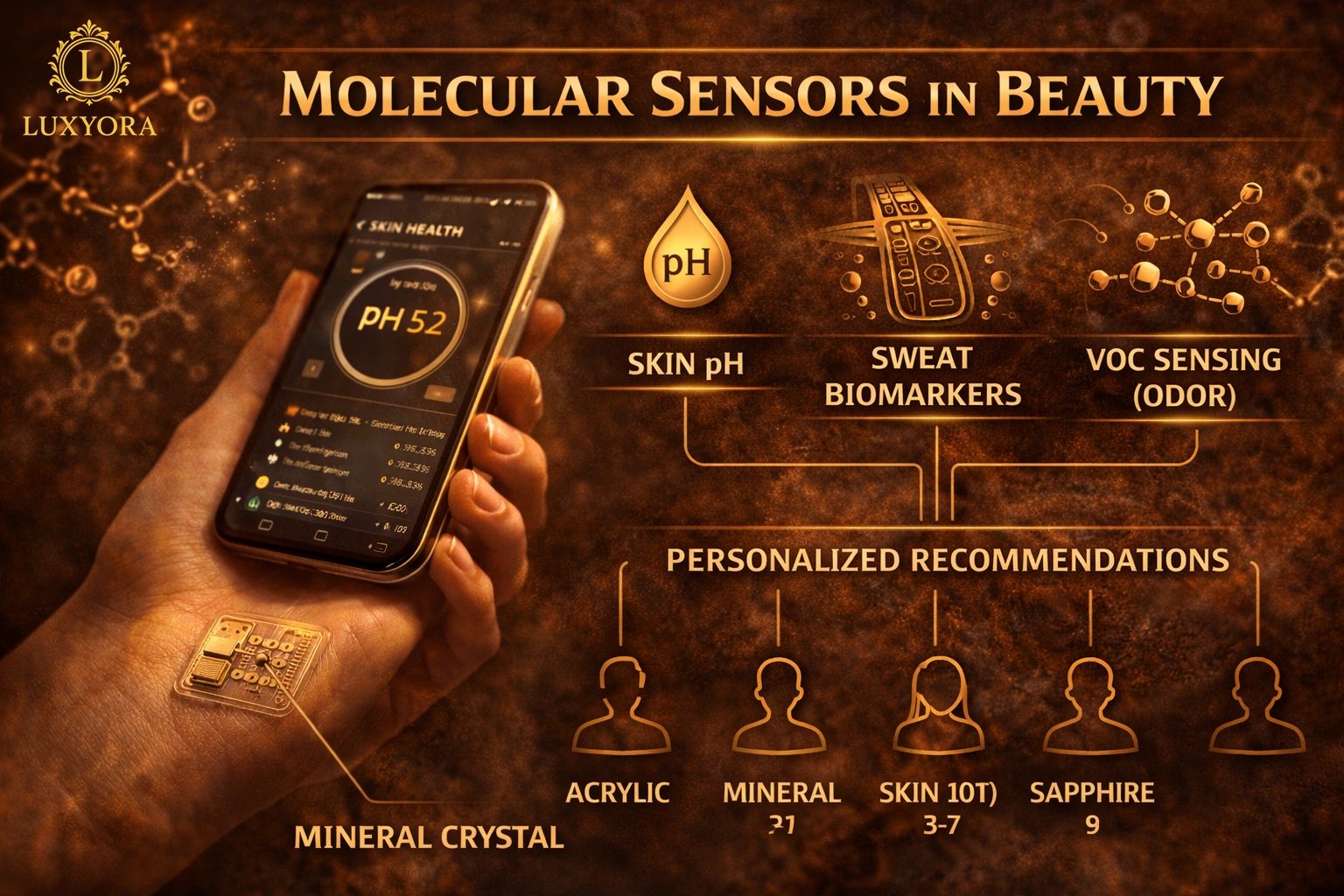
The beauty industry is rapidly shifting from “one-size-fits-all” products to data-driven personalization, with molecular sensors as a key enabler. In the context of beauty and skincare, molecular sensors are technologies that detect, quantify, or track specific molecules or chemical markers related to skin and scalp health. These markers can include skin pH, sweat electrolytes (e.g., chloride, sodium), metabolites (e.g., lactate, glucose), amino acids (e.g., serine), volatile organic compounds (VOCs) linked to odor, and more.
Many of these sensors are “wearable” (skin patches) or “near-body” (handheld readers), transforming invisible chemistry into actionable insights for product selection, routine optimization, and claims testing.
1) What are molecular sensors in beauty?
A molecular sensor generally combines:
- a recognition layer that interacts with a target molecule (for example, an enzyme, polymer, hydrogel, or functional material), and
- a transducer that converts that interaction into a measurable signal, often electrical, optical (color/fluorescence), or spectroscopic.
In beauty, the goal is not only “measurement,” but measurement that supports:
- Personalized skincare recommendations
- Barrier health tracking (pH, hydration proxies, irritation markers)
- Environmental exposure monitoring (UV-related sensing in adjacent beauty-tech use cases)
- Product R&D (screening ingredients and validating efficacy)
- Consumer education via apps and dashboards
2) Why beauty brands care about molecules (not just “skin type”)
Traditional consumer categories, oily, dry, combination, and sensitive, are helpful but broad. Molecular sensing supports precision beauty, because it can detect small changes that precede visible symptoms:
- A shift in skin pH can indicate barrier disruption or an increased risk of irritation.
- Changes in sweat chemistry can reflect stress, heat, hydration, or an inflammatory context.
- VOC patterns can help explain body odor and deodorant performance.
- Skin surface biomarkers may reflect barrier function and microbiome-linked chemistry.
Wearable biosensor reviews emphasize that skin is an accessible interface for continuous chemical monitoring and that miniaturized materials, microfluidics, and mobile computing have accelerated real-world deployment.
3) Major types of molecular sensors used in beauty
A) Skin pH sensors
Skin pH is one of the most “beauty-relevant” chemical metrics because it’s tied to barrier function, comfort, and the performance/tolerance of some formulations.
A landmark beauty-tech example is L’Oréal/La Roche-Posay’s My Skin Track pH prototype (introduced at CES 2019). It’s presented as a wearable microfluidic sensor that measures personal skin pH and includes a companion app for skincare guidance.
Beauty keywords: skin pH, acid mantle, barrier health, irritation risk, personalization, microfluidic patch.
B) Sweat-based molecular sensors (electrolytes + metabolites)
Sweat is a convenient biofluid for non-invasive sensing. Microfluidic wearable sweat sensors commonly target:
- Electrolytes: chloride, sodium, potassium
- Metabolites: lactate, glucose
- pH and other indicators
These systems often use microfluidic channels to collect sweat and electrochemical or optical methods to quantify targets.
In beauty, sweat sensing can support:
- Deodorant and antiperspirant testing (sweat dynamics, odor-linked conditions)
- Sports beauty positioning (freshness, skin comfort during exercise)
- “Skin stress” context (heat, humidity, high sweat conditions)
C) Epidermal biomarker patches for skincare-relevant molecules
Research is increasingly exploring direct measurement of skin-surface biomarkers beyond sweat. For example, a 2025 Nature Communications paper describes an epidermal serine-sensing system designed for skin healthcare, illustrating how specific biomolecules could serve as trackable “skin metrics.”
Even when these systems begin as biomedical research, they influence beauty through:
- Advanced skin diagnostics
- New claims substantiation methods
- Better sensitivity/irritation prediction and targeted routines
D) “Electronic nose” and VOC sensing (odor + skin chemistry)
VOC sensing uses sensor arrays (an “electronic nose”) plus pattern recognition to classify complex odor profiles. A 2019 study discusses a wearable electronic nose for identifying human skin odor, highlighting that skin odor is chemically complex and can be addressed using multi-sensor arrays.
For beauty, this connects to:
- Deodorants and fragrance performance
- Skin odor profiling and malodor control strategies
The future of “odor diagnostics” and personalized scent
4) How molecular sensors are built for real-world beauty use
Beauty-grade sensors must handle messy realities:
- Sensor drift (signals changing over time)
- Fouling (skin oils, lotions, sunscreen, sweat residue)
- Calibration differences between individuals
- Comfort and adhesion on different skin types
- Data interpretation that consumers can understand
Wearable biosensor reviews repeatedly highlight challenges such as calibration, biofouling, stability, and the translation of lab performance to everyday use, issues that beauty companies must address to build trust and drive adoption.
5) Where molecular sensors show up in the beauty value chain
Consumer experiences
- Personalized skincare coaching (pH-guided routines, “skin state” dashboards)
- Smart skincare devices (patch + app ecosystems)
- Potential future: at-home biomarker kits aligned with dermatologist workflows
Product development (R&D)
- Faster screening of how formulas influence skin pH, comfort, sweat interactions, and odor chemistry
- Stronger claims substantiation with measurable biomarkers
- Iteration on sensitive-skin and barrier-repair product strategies
Clinical and derm-adjacent beauty
Wearable sensing is also being explored for clinical skin management contexts (e.g., chronic conditions), and these insights can spill over into beauty categories through dermocosmetic positioning and improved monitoring tools.
6) Responsible use: privacy, bias, and “over-personalization.”
Because molecular sensors generate personal biological data, beauty brands must handle:
- Privacy and consent (biometric-like data handling)
- Algorithm transparency (how recommendations are generated)
- Avoiding overclaiming: a single sensor metric (like pH) is informative, but not the whole story.
7) What’s next: the “molecular layer” of personalized beauty
From 2018-2026, research and industry prototypes, the trajectory is clear:
- More multi-analyte patches (multiple biomarkers at once)
- Better optical sensing integrated with smartphones (colorimetry, fluorescence, Raman-adjacent approaches)
- Stronger AI pattern recognition for VOC/odor and complex biomarker signatures
- Sensors designed specifically for dry skin surfaces (not only sweat-heavy conditions)
As these mature, “molecular sensors” will increasingly be a standard term in beauty, referring to tools that translate skin chemistry into personalized routines, smarter formulations, and verifiable performance.
References
Dreher, F., Jungman, E., Sakamoto, K., & Maibach, H. (Eds.). (2022). Handbook of Cosmetic Science and Technology (5th ed.). CRC Press. (Routledge)
Sazonov, E., & Neuman, M. R. (Eds.). (2020). Wearable Sensors: Fundamentals, Implementation and Applications (2nd ed.). Elsevier. (Elsevier Shop)
De Guzman, K. E. A. (2020). Epidermal sensors for monitoring skin physiology (Doctoral thesis). Dublin City University. (DORAS)
Hua, J., et al. (2022). Skin-attachable sensors for biomedical applications. Micromachines. (PMC)
L’Oréal. (2019, January 7). L’Oréal unveils prototype of first-ever wearable microfluidic sensor to measure skin pH levels (My Skin Track pH). (loreal-finance.com)
Ramachandran, B., et al. (2022). Microfluidic wearable electrochemical sweat sensors for health monitoring. Biosensors. (PMC)
Vo, D. K., et al. (2024). Advances in wearable biosensors for healthcare. Biosensors. (MDPI)
Wang, J., et al. (2024). Epidermal wearable optical sensors for sweat monitoring. Communications Materials. (Nature)
Yuan, X., et al. (2023). Epidermal wearable biosensors for monitoring biomarkers in sweat. Biosensors. (MDPI
Yuan, Y., et al. (2025). An epidermal serine sensing system for skin healthcare. Nature Communications. (Nature)
Zheng, Y., et al. (2019). Wearable electronic nose for human skin odor identification: A preliminary study. Sensors and Actuators B: Chemical. (ScienceDirect)
-