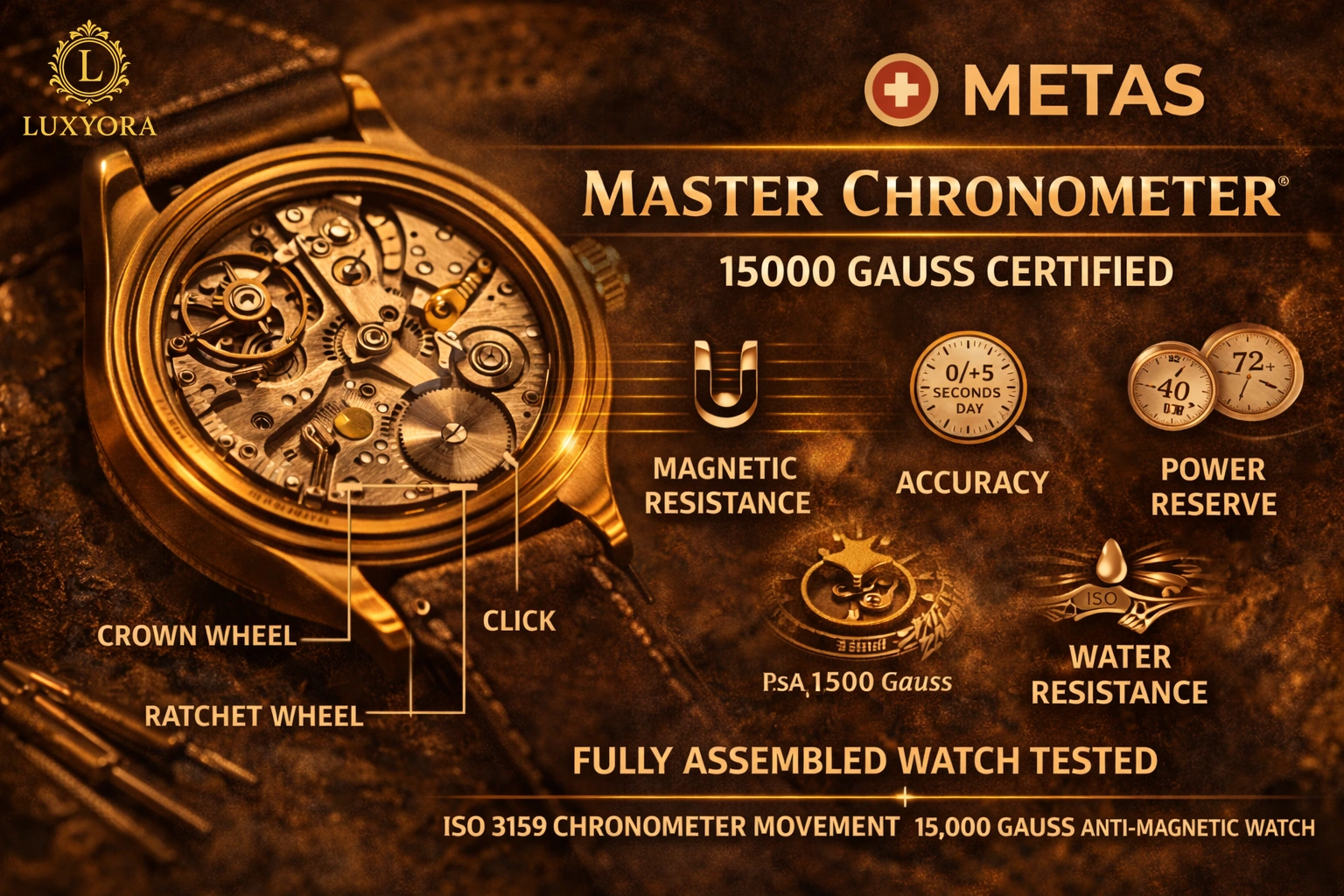
METAS “Master Chronometer” : What is “Master Chronometer”
In today’s watch industry, METAS “Master Chronometer” is one of the most widely discussed quality designations because it goes beyond traditional chronometer testing and evaluates a fully assembled mechanical watch for real-world performance factors such as magnetic resistance, water resistance, power reserve, and chronometric precision. The certifying authority is METAS (Federal Institute of Metrology, Switzerland), and the certification standard is defined in the METAS N001 requirements.
Unlike many standards that test only the uncased movement, the Master Chronometer process is built around the “watch head” (the completed cased watch), making it especially relevant for wearers who care about how the watch performs once it leaves the lab and goes on the wrist.
1) What does “Master Chronometer” mean?
A watch that carries the designation “MASTER CHRONOMETER Certified 15 000 Gauss” (or simply “MASTER CHRONOMETER”) has passed an independent certification process that focuses primarily on four pillars:
- Chronometric performance (accuracy and stability)
- Resistance to magnetic fields
- Power reserve performance
- Water resistance
This certification is open to all brands, provided the watch meets the entry conditions and is produced under a monitored testing and quality system.
2) The critical prerequisite: ISO 3159 “chronometer” movement first
One of the defining features of Master Chronometer is that it is not meant to replace classical chronometer certification; it builds on it.
METAS N001 explicitly requires that the movement satisfy the “chronometer” criteria of ISO 3159 and that the relevant tests be performed by an appropriately accredited laboratory.
This is why many explanations describe the pathway as:
(1) movement qualifies as a chronometer → (2) the complete watch passes METAS Master Chronometer testing.
Why it matters: ISO 3159 chronometer testing is movement-centric, while METAS testing is watch-centric and evaluates performance after casing, with magnetism and water resistance as formal test targets.
3) The headline performance numbers people quote (and what they really mean)
Accuracy: “0 to +5 seconds/day” (with category nuance)
METAS acceptance criteria specify average daily rate limits depending on movement category (based on fitting diameter/surface). In the METAS N001 table, the average daily rate requirement is:
- Category 1a: 0 ≤ average daily rate ≤ 5 s/day
- Category 1b: 0 ≤ average daily rate ≤ 6 s/day
- Category 2: 0 ≤ average daily rate ≤ 7 s/day
This is why you’ll often see “0/+5” as the simplified headline, especially in brand communications and popular summaries, but the full specification is slightly more granular by category.
Magnetic resistance: 1.5 Tesla (15,000 Gauss)
The METAS N001 document is explicitly titled “Resistance to a magnetic field of 1.5 T (15,000 G).”
Industry keyword takeaway: anti-magnetism, silicon hairspring, non-ferrous components, amplitude stability under magnetism. Master Chronometer is a certification that makes these engineering choices measurable outcomes, not just marketing claims.
4) What METAS actually tests: the “cycle” approach (from the official standard)
METAS N001 defines the test cycles used to generate certification measurements. Here’s what those cycles translate to in practical, reader-friendly terms:
A) The watch must keep running in a strong magnetic field
The standard includes magnetic exposure steps at 1.5 T and checks that:
- The movement does not stop during magnetic exposure (criterion S1)
- The cased watch does not stop during magnetic exposure (criterion S2)
This is huge because magnetism is one of the most common real-world disruptors of mechanical timekeeping.
B) Daily precision is evaluated across positions and temperatures
The cycles specify sequences that simulate use through:
- Multiple positions (e.g., crown up/down orientations and dial up/down)
- Temperature conditions (e.g., around 23°C and 33°C within the cycle definitions)
These sequences produce the daily rate values used for the acceptance criteria table.
C) Precision after magnetism: “deviation from daily precision.”
METAS defines a metric for the change in daily precision after magnetic exposure (deviation from daily precision). This captures not just “did it run,” but “did accuracy remain controlled after a major magnetic event.”
D) Power reserve must meet the manufacturer’s declared number
A Master Chronometer watch must operate for a duration corresponding to the declared power reserve (criterion RM).
This discourages inflated power-reserve claims: the number on the spec sheet is treated as a verifiable performance promise.
E) Rate stability across wind state and positions (torque realism)
METAS N001 includes instantaneous-rate measurements at six positions shortly after winding and again when the watch has approximately 1/3 of its power reserve remaining (65%-75% used). This is designed to evaluate how the watch behaves as the torque drops.
Collector keywords: torque curve, isochronism, amplitude, rate stability. This is where movement engineering and escapement efficiency show up in numbers.
F) Water resistance is part of the standard
Water-resistance testing includes defined overpressure test sequences, and the watch must pass a condensation test aligned with ISO water-resistance standards referenced in the document (ISO 22810 and, for dive requirements, ISO 6425, as applicable).
5) METAS vs COSC: why the market treats Master Chronometer as “next level”
A helpful way to understand the difference:
- COSC/ISO 3159 focuses on the movement (typically uncased) and classic chronometric criteria.
- METAS Master Chronometer requires the movement already qualify as a chronometer, then tests the complete watch for magnetism, water resistance, power reserve, and additional rate-behaviour metrics under realistic conditions.
The industry’s direction also shows how influential these “whole-watch” tests have become: a 2025 report described COSC planning stricter “Super-COSC” standards (targeting September 2026) with tighter tolerances and additional criteria, an implicit acknowledgement that the market now expects more than legacy movement-only testing.
6) Who uses Master Chronometer (and key timeline milestones)
Master Chronometer is not brand-exclusive, but adoption has been selective because it demands both engineering (especially anti-magnetism) and operational readiness (testing processes monitored by METAS).
Key widely cited milestones:
- 2015: Omega’s Globemaster is frequently referenced as the first Master Chronometer watch; Omega has continued expanding the standard across collections.
- May 2021: Tudor launched its first METAS Master Chronometer-certified model (notably highlighted with the Black Bay Ceramic).
7) Why the term matters to buyers, collectors, and professionals
If you’re reading a watch spec sheet or evaluating a purchase, “METAS Master Chronometer” is meaningful because it signals:
- Verified anti-magnetic performance at 15,000 gauss
- Tight daily accuracy targets (commonly summarised as 0/+5 s/day)
- Power reserve claims that are tested against declared values
- Water-resistance performance is included in the certification framework
- Testing on the cased watch head, closer to real use
In short, it’s an industry term that links engineering, quality assurance, and consumer trust, and it helps explain why some modern mechanical watches can be both traditional in spirit and highly robust in everyday environments, including magnetic fields and temperature fluctuations.
References
Schmidt, R. (2018). The Wristwatch Handbook: A Comprehensive Guide to Mechanical Wristwatches. ACC Art Books.
Stone, G., & Pulvirent, S. (2020). The Watch: Thoroughly Revised. Abrams.
Federal Institute of Metrology (METAS). (2025, April 17). Certification MASTER CHRONOMETER. (metas.ch)
Federal Institute of Metrology (METAS). (2022). METAS-N001: Requirements for certification of movements and mechanical watches resistant to magnetic fields of 1.5 T (15 000 G) (Version 1.2). (metas.ch)
Omega. (2025, October 21). OMEGA celebrates 10 years of Master Chronometer certification (press release). (OMEGA Press Room)
FHS (Federation of the Swiss Watch Industry). (2021, June 17). Master Chronometer certification for Tudor. (fhs.swiss)
Tudor. (n.d.). METAS certification | Inside TUDOR. (tudorwatch)
Time+Tide Watches. (2024, June 11). Everything you need to know about METAS. (Time+Tide Watches)
Hodinkee. (2025, March 28). Switzerland’s COSC to upgrade chronometer certification standards (industry report). (Hodinkee)
Financial Times. (2025, September 5). Swiss watch certifier unveils stricter ‘Super-COSC’ standard (industry report). (Financial Times)