Mineral Crystal : What is Mineral Crystal
In the watch industry, mineral crystal (often called mineral glass or hardened mineral crystal) is one of the most common materials used for a watch’s front “window,” the transparent cover that protects the dial and hands. It sits between two other popular options: acrylic/plexiglass (very impact-tolerant but scratch-prone) and sapphire crystal (highly scratch-resistant but typically more expensive and, depending on the design, more brittle under sharp impacts). Because of its balance of cost, clarity, and durability, mineral crystal is widely used in affordable to mid-range watches, tool watches, and many everyday wear models.
Mineral crystal isn’t a “cheap substitute” by default; it’s a deliberate engineering choice. Understanding how a mineral crystal is made (heat-treated or chemically strengthened), how it performs, and when it’s the best choice will help buyers interpret spec sheets and choose watches that match real-world use
1) What is a Mineral Crystal?
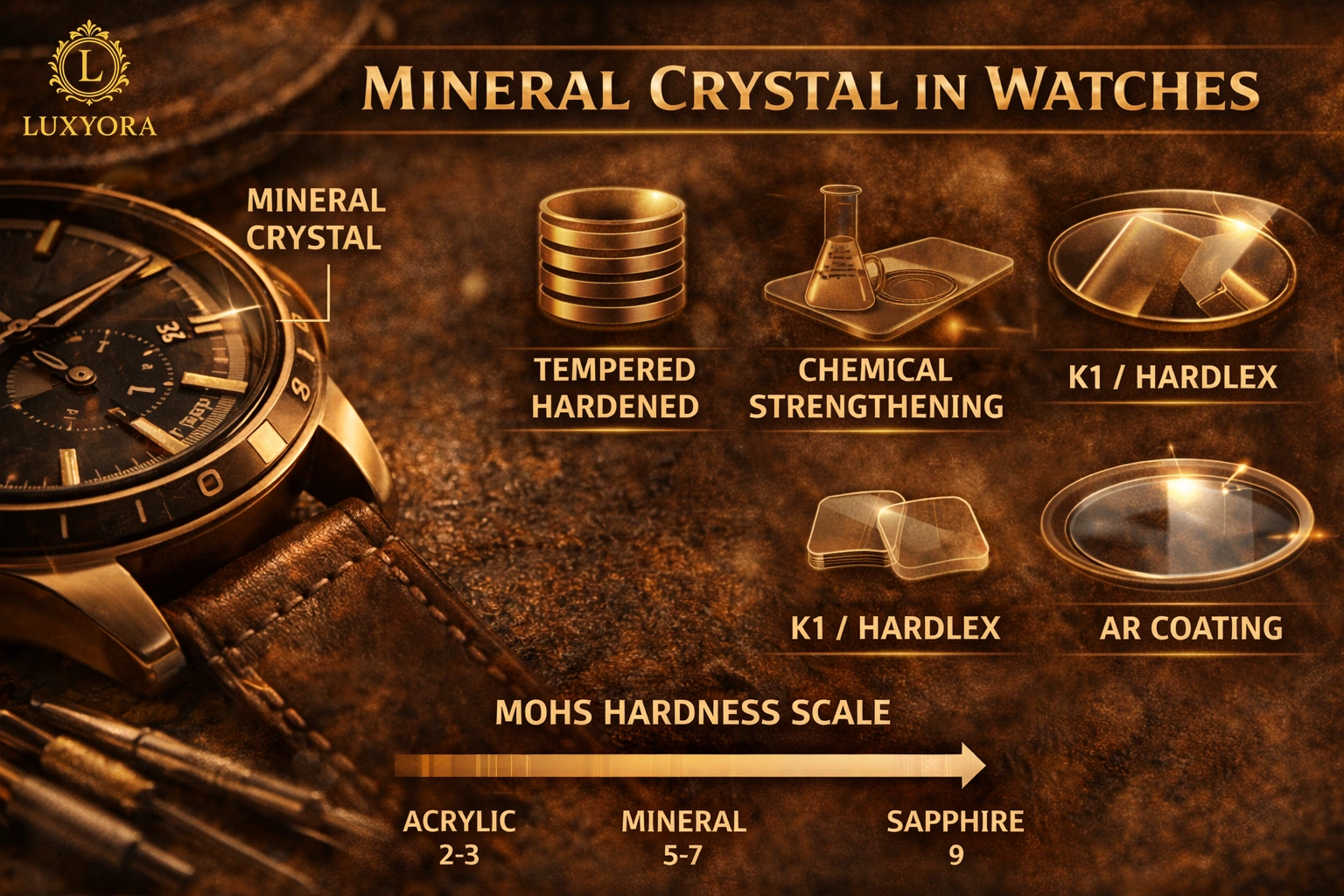
Mineral crystal is a glass, typically silica-based, processed for greater durability than ordinary window glass. In watchmaking, mineral glass is commonly tempered (heat-hardened) and may also be chemically strengthened to improve resistance to breakage and, to a degree, scratching. Many watch guides describe modern mineral glass as “tempered mineral glass” because heat hardening is so widespread in production.
Key industry keywords
- Mineral crystal/mineral glass
- Hardened mineral crystal (heat-treated and/or chemically strengthened)
- K1 mineral crystal (a marketing term often used for hardened mineral variants)
- Hardlex (Seiko’s proprietary hardened mineral glass)
- AR coating (anti-reflective coating)
- Mohs hardness scale (scratch-resistance indicator)
2) How Mineral Crystal is Strengthened: Tempering vs Chemical Strengthening
A) Heat tempering (thermal hardening)
Tempering generally involves heating glass and cooling it under controlled conditions to induce compressive stresses at the surface, improving resistance to cracking and breakage. Watch-industry explainers frequently describe mineral watch glass as heat-hardened to improve everyday durability.
B) Chemical strengthening (ion exchange)
Chemical strengthening is commonly described as an ion-exchange process: smaller ions at the glass surface are replaced by larger ions (e.g., sodium by potassium), creating compressive stress at the surface that increases strength. Technical explanations of ion exchange in a watch-glass context describe soaking soda-lime glass in molten potassium nitrate to replace Na⁺ with larger K⁺ ions, thereby strengthening the surface layer. Broader materials-science sources describe the same mechanism and its role in producing high surface compression and improved durability in strengthened glass.
Why this matters in watches: A strengthened mineral crystal can be more resistant to knocks and cracking than untreated glass, making it useful for everyday wearers, field watches, and many sports watches
3) Mineral Crystal Performance: Scratch Resistance vs Impact Resistance
Scratch resistance (the Mohs scale)
Scratch resistance is often described using the Mohs hardness scale (a comparative mineral hardness scale). Sources commonly place mineral glass in the midrange, harder than acrylic but softer than sapphire. Monochrome’s technical guide notes that traditional mineral glass is around Mohs 5, rising to the 6–7 range with hardening treatments. Retail/education guides similarly contrast mineral glass with sapphire’s much higher hardness, often referencing sapphire around Mohs 9.
Practical takeaway:
- Mineral crystal: good everyday scratch resistance, but it can pick up scratches from sand, grit, concrete dust, and other hard particles over time.
- Sapphire: much better scratch resistance, typically staying clearer for longer.
Impact resistance (real-world durability)
Here mineral crystal often shines. Many guides characterize mineral glass as a good balance, less likely to shatter than sapphire in some sharp-impact scenarios and significantly tougher than acrylic in terms of surface resilience. Mineral crystals’ ability to withstand daily knocks is one reason they remain popular in “daily driver” watches.
Watch-buyer reality: If your lifestyle includes frequent bumps (worksites, travel, sports, commuting), mineral crystal can be a sensible, cost-effective choice.
4) Mineral Crystal Types You’ll See on Spec Sheets
A) Standard mineral crystal
Common on affordable and mid-range watches. Typically tempered. Good clarity, fair scratch resistance, strong value.
B) Hardened mineral crystal (including K1)
“Hardened mineral” usually signals additional processing (tempering and/or chemical strengthening). Different brands use different terms, and real-world scratch resistance can vary depending on the exact treatment.
C) Seiko Hardlex
Hardlex is Seiko’s proprietary hardened mineral glass used on many Seiko lines, historically positioned as a durability-focused alternative to sapphire in some models. Watch educational sources describe Hardlex as mineral glass modified through heating and chemical treatment to improve scratch and shatter resistance.
5) Coatings on Mineral Crystal: AR and “Sapphire-Coated Mineral.”
Anti-reflective (AR) coatings
Mineral crystal may include AR coating (often on the underside, sometimes both sides) to improve dial legibility by reducing glare, especially under strong indoor lighting or direct sunlight. AR coatings can enhance clarity but can also scratch (particularly external AR coatings).
Sapphire-coated mineral glass
Some watches use mineral crystal with a sapphire coating to improve scratch resistance without the full cost of a thick sapphire crystal. Market explainers mention this as a hybrid approach, though performance depends on coating quality and thickness.
6) Mineral Crystal vs Sapphire vs Acrylic: When Mineral is the Smartest Option
Choose a mineral crystal when you want:
- Strong value (better cost-to-durability than sapphire for many buyers)
- Good clarity and daily toughness
- A watch you won’t worry about too much
- Easier and cheaper replacement than sapphire in many service scenarios (varies by brand/service ecosystem)
Choose sapphire when you want:
- Maximum scratch resistance and long-term optical cleanliness
Choose acrylic when you want:
- High impact absorption and easy polishing of scratches (often favored for vintage styles)
7) Care Tips: Keeping a Mineral Crystal Looking Good
- Rinse grit off: Sand and dust can act like abrasives. Rinse with water before wiping when possible.
- Use a microfiber cloth rather than paper products (which can trap particles).
- If scratched, mineral crystal is harder to polish effectively than acrylic; replacement is often the practical solution for deeper scratches.
- If your watch has an external AR coating, treat it carefully coatings can scratch even if the underlying glass is strong.
8) Why Mineral Crystal Remains Important in Modern Watchmaking
Mineral crystal is popular because it supports a wide range of watch designs at accessible prices while offering dependable everyday performance. It pairs well with modern watch priorities: legibility, durability, and service practicality, and it remains a core “default” material across the industry, especially where the product goal is balanced value rather than spec-sheet extremity.
References
Schmidt, R. (2018). The Wristwatch Handbook: A Comprehensive Guide to Mechanical Wristwatches. ACC Art Books.
Stone, G., & Pulvirent, S. (2020). The Watch: Thoroughly Revised. Abrams.
American Ceramic Society. (2022, March 1). Introduction to “Chemically strengthened glasses” for Glass (then and now). https://ceramics.org/acers-spotlight/introduction-to-chemically-strengthened-glasses-for-glass-then-and-now/
Ashford. (2025). Watch glass: Learn everything about watch crystals. https://www.ashford.com/blogs/watch-resources/watch-glass-learn-about-watch-crystals
Corning. (n.d.). The secret of tough glass: Ion exchange. https://www.corning.com/in/en/innovation/the-glass-age/science-of-glass/the-secret-of-tough-glass-ion-exchange.html
DIY Watch Club. (2021, May 28). Comparing acrylic crystal, mineral crystal, K1 crystal and sapphire crystal. https://diywatch.club/en/blog/comparing-acrylic-crystal-mineral-crystal-k1-crystal-and-sapphire-crystal
Kapoor Watch. (2024, November 2). The science of watch glasses: Materials and their impact. https://www.kapoorwatch.com/blogs/the-science-of-watch-glasses-materials-and-their-impact/
Monochrome Watches. (2024, December 9). A comprehensive guide to watch crystals: History, types, pros and cons. https://monochrome-watches.com/technical-perspective-comprehensive-guide-to-watch-crystals-plexiglass-mineral-hesalite-sapphire-crystal-history-pros-and-cons/
Orbray. (2021, December 20). Watch glass (Story of Watch 2). https://orbray.com/magazine_en/archives/1095
Rotate Watches. (2025, October 28). Watch crystal types: Sapphire, mineral & acrylic guide. https://rotatewatches.com/blogs/blog/watch-crystal-types
The Watch Company. (2021, March 9). Hardlex crystal: How does it compare to other crystals? https://www.thewatchcompany.com/blog/guide-to-hardlex-crystal/