Manual-Wind : What is Manual-Wind | Luxyora
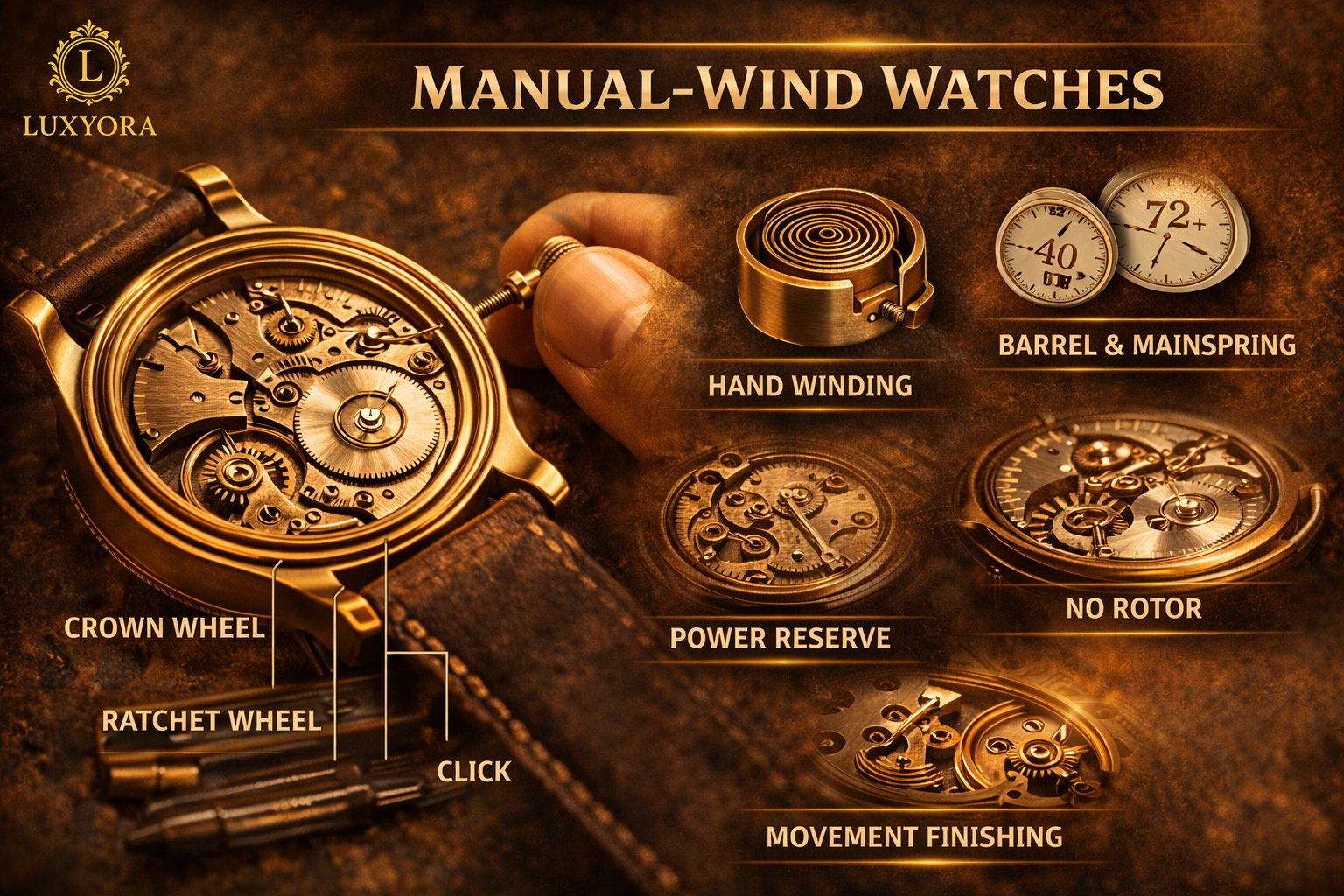
In the watch industry, manual-wind (also called hand-wound or manual winding) refers to a mechanical watch movement that must be wound by turning the crown to store energy in the mainspring. Unlike an automatic watch, there is no oscillating rotor to wind the watch from wrist motion. Instead, the wearer actively “charges” the movement, creating a daily ritual that many collectors consider one of the purest expressions of traditional horology.
Manual-wind watches are not simply “older technology.” They remain central to modern high-end watchmaking because they can be thinner, mechanically simpler than automatics, and visually more satisfying thanks to an unobstructed view of movement finishing (no rotor blocking bridges and decoration).
1) What does “manual-wind” mean in practical terms
A manual-wind watch runs on a coiled metal strip, the mainspring, stored in a barrel. When you rotate the crown, you tighten the mainspring. As it unwinds, it releases energy gradually through the gear train to the escapement, powering timekeeping.
Key manual-wind keywords (industry terms):
- Crown and winding stem (user interface for winding)
- Crown wheel, ratchet wheel, and click (winding works components)
- Mainspring and barrel (energy storage)
- Power reserve (runtime after a full charge)
- Finishing (anglage, Geneva stripes, perlage often showcased on hand-wound calibers)
2) How a manual-wind movement works: from the crown to the mainspring
When you wind a manual watch, you’re engaging a chain of parts commonly called the winding works. Mechanically, the crown is connected to the stem, and turning the crown drives gears that ultimately tension the mainspring inside the barrel. Monochrome’s technical overview explains that the crown/stem interface engages the barrel via the winding gears, including the ratchet wheel, while the click prevents backwinding.
A clear visual breakdown of this action is illustrated in Bartosz Ciechanowski’s interactive mechanical watch explanation: the crown wheel and ratchet wheel interact, and the click snaps into place to stop the system from slipping backward. This is also where the familiar winding “click” sound comes from.
Why this matters:
Manual winding isn’t just about making the hands move; it affects winding feel, efficiency, and long-term wear. Smooth winding often signals good lubrication and well-designed gearing; roughness can signal resistance, dirt, or service needs.
3) Manual-wind vs automatic: what changes (and why people choose hand-wound)
The biggest mechanical difference: no rotor
A simple rule: if there’s no rotor, it’s likely manual-wind (though some special designs exist). Oracle Time notes that the absence of a rotor is the easiest visual cue when identifying manual vs automatic movements.
Thinness and design freedom
Because a rotor adds height, manual-wind watches are often thinner and can support elegant case profiles, especially in dress watches and many high horology pieces.
Ritual, connection, and ownership experience
Brands that emphasize traditional craftsmanship often describe manual winding as part of the experience. A. Lange & Söhne explicitly frames manual winding as regularly rewinding with the crown to supply “fresh energy” to the mainspring barrel.
4) Power reserve and winding frequency: what owners should understand
Power reserve is the length of time a fully wound movement runs before stopping. Manual-wind watches commonly range from around 40 hours to 70+ hours, though multi-barrel designs can run far longer.
How often should you wind?
A practical, collector-friendly approach is to wind the watch once daily at roughly the same time if it is a daily wearer. This keeps the mainspring in a healthier operating range and helps stabilize performance.
When do you stop winding?
Most manual-wind watches will eventually reach a firm stop as the mainspring is fully tensioned. The key is to slow down as you approach the stop and never force past resistance.
5) “Overwinding” myths: what’s real and what’s misunderstood
The word “overwind” causes a lot of anxiety. Real damage usually comes from forcing the crown once a manual-wind watch is fully wound, not from normal winding itself.
- Manual-wind watches: You can damage parts if you keep forcing the crown after it reaches a hard stop (risking stress on winding gears or the mainspring).
- Automatic watches: Typically use a slipping bridle in the barrel, so excess winding slips once fully wound. This is why automatics are generally described as not “overwound” in the traditional sense.
Practical takeaway:
For a manual-wind watch, the safe habit is wind until you feel firm resistance, then stop; do not force.
6) Why collectors love manual-wind movements: finishing and transparency
Manual-wind watches often appear in enthusiast discussions as “movement-forward” pieces because the lack of a rotor gives a full view of:
- Bridge architecture
- Hand-finishing
- Engravings and striping
- Chronograph levers (in hand-wound chronographs)
This is one reason manual-wind is prominent in iconic models like the Omega Speedmaster Moonwatch family, where hand-wound chronograph calibers have deep enthusiast appeal.
7) Manual-wind care and best practices
Winding technique (simple best practice)
- Remove the watch from your wrist (helps avoid lateral stress on the crown/stem).
- Keep the crown in the normal position (unless it’s screw-down; then unscrew first).
- Turn smoothly and gently.
- Stop at firm resistance.
Service implications
Manual-wind movements can be simpler than automatics (fewer winding parts like rotors and reversers), but they still require periodic maintenance. If winding becomes gritty, uneven, or unusually stiff, it’s a strong signal to seek servicing.
Time+Tide’s parts overview also underscores how the crown and stem interact with the setting/winding components, reminding owners that the crown area is a key mechanical interface that should be treated gently.
8) Where manual-wind fits in today’s watch industry
Manual-wind is not a niche leftover; it’s a deliberate design choice:
- Dress watches: slim, elegant cases
- Chronographs: traditional architecture and tactile engagement
- High horology: maximum visibility of finishing
- Enthusiast pieces: daily ritual and mechanical “purity.”
Modern watch education content continues to treat manual-wind as a core category of mechanical watchmaking rather than a retro curiosity.
References
Schmidt, R. (2018). The Wristwatch Handbook: A Comprehensive Guide to Mechanical Wristwatches. ACC Art Books.
Stone, G., & Pulvirent, S. (2020). The Watch: Thoroughly Revised. Abrams.
Lange & Söhne. (n.d.). Manual watches. (alange-soehne.com)
A. Lange & Söhne. (n.d.). Services (How do I wind my Lange watch correctly?) (alange-soehne.com)
Ciechanowski, B. (2022, May 4). Mechanical watch. (Ciechanow Ski)
Monochrome Watches. (2022, June 29). Hands-on review: The hand-wound Omega Speedmaster ’57… (Monochrome Watches)
Monochrome Watches. (2025, November 15). The ABCs of Time: How are mechanical watches wound? A comprehensive guide… (Monochrome Watches)
- Oracle Time. (2024, September 14). Wristwatch essentials: What is a manual wind movement? (Oracle Time)
- Swisswatches Magazine. (2025, January 27). What is a mechanical watch and how does it work? (Swisswatches Magazine)
- Time+Tide Watches. (2024, September 9). Every part of a watch movement, from screw to pinion. (Time+Tide Watches)
Wikipedia. (2026). Automatic watch. (Wikipedia)