Lost-Wax Casting : What is Lost-Wax Casting | Luxyora
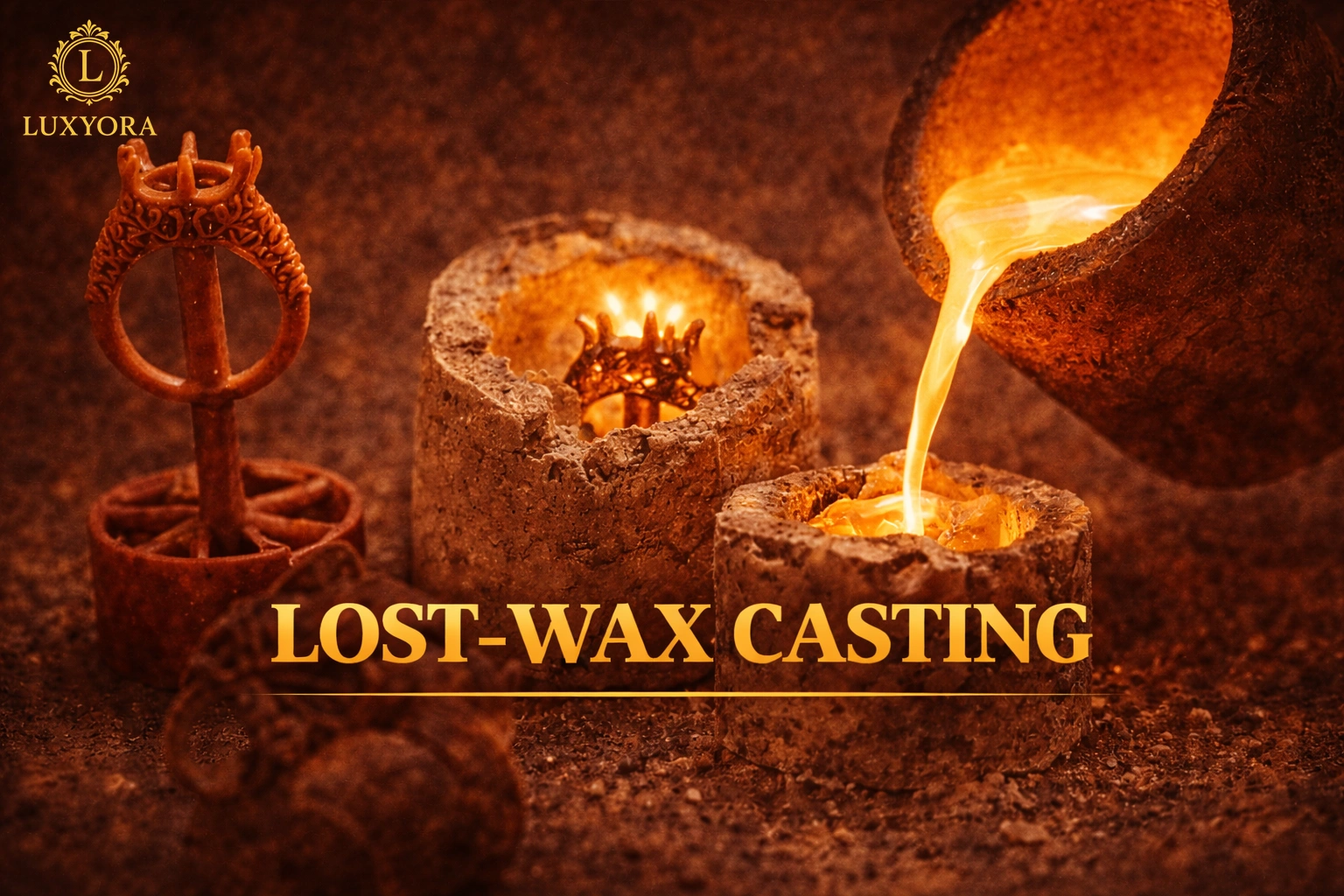
Lost-wax casting, also known in industry as investment casting or precision casting, is a metal-forming process where a temporary wax (or castable resin) pattern is used to create a mold cavity. The “wax” is removed (lost) during dewaxing/burnout, and molten metal is poured into the resulting void to form a highly detailed, near-net-shape part. This process is celebrated for producing intricate geometry, fine surface detail, thin walls, and tight tolerances, often reducing the need for heavy machining or assembly.
The term “investment” comes from the step where the pattern is invested (encased) in a refractory mold material, either a gypsum-bonded investment used widely in jewelry casting or a ceramic shell system used heavily in industrial foundries.
1) Why Lost-Wax Casting Matters
Lost-wax casting stands out because it delivers a rare combination of benefits:
- Exceptional detail reproduction (engraving, filigree, texture)
- Complex shapes cast as one piece (reducing joints and failure points)
- High-dimensional accuracy and surface quality
- Broad alloy compatibility (precious metals, stainless steels, superalloys, aluminum alloys)
That’s why the technique is used across radically different sectors from custom bridal rings and signet jewelry to aerospace and medical components that demand consistency and repeatability.
2) Core Workflow: Step-by-Step Lost-Wax Casting Process
Although studios and foundries vary their equipment and parameters, most lost-wax casting follows a recognizable sequence:
Step 1: Pattern creation (wax pattern/resin pattern)
The process begins with a “positive” pattern that matches the final piece and accounts for predictable metal shrinkage. Traditionally, this is carved in wax or injected into a rubber mold; increasingly, it is 3D printed using castable wax-filled resins to support digital workflows.
Step 2: Spruing and treeing
A wax sprue (and sometimes a full “tree”) is attached to the pattern to create channels for:
- metal flow (gating),
- air escape (venting),
- and feeding during solidification.
Poor sprue design can cause misruns, shrinkage porosity, and incomplete filling, making spruing a major quality driver.
Step 3: Investing (encasing the pattern in refractory)
The patterns are placed in a casting flask and surrounded by an investment that hardens into a rigid mold.
Two major mold systems dominate:
- Gypsum-bonded investments (common in jewelry): mixed and poured around wax patterns in flasks.
- Ceramic shell molds (industrial investment casting): the pattern is repeatedly dipped in ceramic slurry and stuccoed to build multiple layers into a shell.
Step 4: Dewaxing and burnout
This is where the “lost” part happens. Heat removes wax/resin from the mold cavity and prepares the mold for casting.
- In jewelry, burnout schedules are critical: the goal is complete burnout without cracking the investment and without leaving ash or residue that would cause surface defects. Formlabs’ jewelry burnout guidance emphasizes staged burnout to preserve investment strength and achieve clean removal of fine details.
- Foundries often use controlled dewaxing methods for ceramic shells, then fire the molds to stabilize them and burn off residue.
Step 5: Pouring/casting
Molten metal is introduced into the hot mold cavity. Common jewelry methods include centrifugal casting and vacuum casting, both designed to capture fine details by allowing metal to flow into thin sections before solidification.
Step 6: Knockout, devesting, and finishing
Once the metal solidifies and cools:
- the investment or ceramic shell is broken away (devesting),
- sprues are removed,
- surfaces are cleaned (sometimes by pickling),
- Then, finishing steps such as filing, sanding, polishing, and stone setting follow (for jewelry).
3) Key Materials and Industry Terms You’ll Hear
Investment material
The refractory mold compound. Jewelry often uses gypsum investments; industrial casting uses ceramic shell systems built from slurry + stucco layers.
Ceramic shell
A multilayer ceramic mold is formed around the pattern; research examines the shell-layer structure and the role of binder and particle systems in achieving shell quality and reducing defects.
Burnout schedule
A temperature/time program is used to remove pattern material and condition the mold. This is essential when using modern castable resins that require clean burnout.
Gating and feeding
Design of channels that control how metal fills and solidifies; a major driver of porosity risk and surface quality.
4) Common Defects and How Professionals Prevent Them
Lost-wax casting is precise, but not “automatic.” Typical issues include:
- Porosity (shrinkage or gas): often linked to gating/feeding design, melt handling, or incorrect temperatures.
- Incomplete fill / misruns: usually from metal cooling too early, inadequate spruing, or insufficient casting force (vacuum/centrifugal).
- Surface roughness/inclusions: can come from shell/investment breakdown, residue, or contamination.
- Cracked investment/shell: frequently linked to burnout ramp rates, pattern expansion, or handling stress.
Quality systems in industrial settings also emphasize testing and control of slurry/shell properties; the Investment Casting Institute highlights ceramic testing practices for binders, slurries, and shells to improve repeatability.
5) Where Lost-Wax Casting Is Used Today
Jewelry and luxury craft
Lost-wax is the backbone of modern jewelry manufacturing because it enables:
- micro-detail reproduction,
- consistent production,
- and digital design-to-casting workflows with castable resins.
Industrial and high-performance components
Investment casting is widely used to produce near-net-shape parts for demanding applications. Research on ceramic shells and advanced manufacturing (including 3D printing of shells) demonstrates that the process continues to evolve to meet performance requirements and improve production efficiency.
6) Modern Trends: Digital Lost-Wax and Advanced Shell Manufacturing
A major trend for 2018–2026 is the integration of CAD and 3D-printed patterns with increasingly sophisticated shell methods. Formlabs provides detailed guidance for using castable resins in jewelry workflows, including burnout strategy and compatibility notes. On the industrial side, recent research reviews the application of additive manufacturing to ceramic shell fabrication, thereby expanding options for tooling and mold design.
Conclusion
Lost-wax casting (investment casting) remains one of the most powerful precision manufacturing methods because it converts a temporary pattern into a high-fidelity metal object, capturing intricate geometry with excellent surface quality. Whether you’re looking at a finely detailed gold ring or a high-performance engineered component, the underlying principles are the same: pattern → investment/shell → burnout → casting → finishing. Understanding the vocabulary (sprue, investment, ceramic shell, burnout schedule) and the major process controls (gating, burnout, shell integrity) provides readers with practical industry knowledge rather than merely definitions.
References
Formlabs. (2022). Castable Wax: Jewelry pattern burnout process [PDF]. https://formlabs-media.formlabs.com/datasheets/1901277-GD-ENUS-0P.pdf (Formlabs Media)
Investment Casting Institute. (2021). Ceramic testing guidebook. https://www.investmentcasting.org/ceramic-testing-guidebook.html (INVESTMENT CASTING INSTITUTE)
Ransom & Randolph. (n.d.). Jewelry casting process. https://www.ransom-randolph.com/jewelry-process (ransom-randolph 2022)
Sviridova, I., Tang, W., Holling, H., & Küell, A. (2024). Production of ceramic investment casting shells using lithography-based ceramic manufacturing and binder jetting technology. Journal of Manufacturing and Materials Processing, 8(4), 162. https://www.mdpi.com/2504-4494/8/4/162 (MDPI)
The Crucible. (2022, March 28). Lost wax casting guide: Definition & process. https://www.thecrucible.org/guides/metalworking/lost-wax-casting/ (The Crucible)
Lee, W. H., et al. (2020). Fabrication of ceramic moulds using recycled shell materials (investment casting context). Applied Sciences, 10(13), 4577. https://www.mdpi.com/2076-3417/10/13/4577 (MDPI)
Beeley, P. R., & Smart, R. F. (2023). Investment casting (1st ed.). CRC Press. (Amazon)
Kalpakjian, S., & Schmid, S. R. (2018). Manufacturing processes for engineering materials (6th ed.). Pearson. (Amazon)