Gear Train : What is Gear Train in Watches | Luxyora
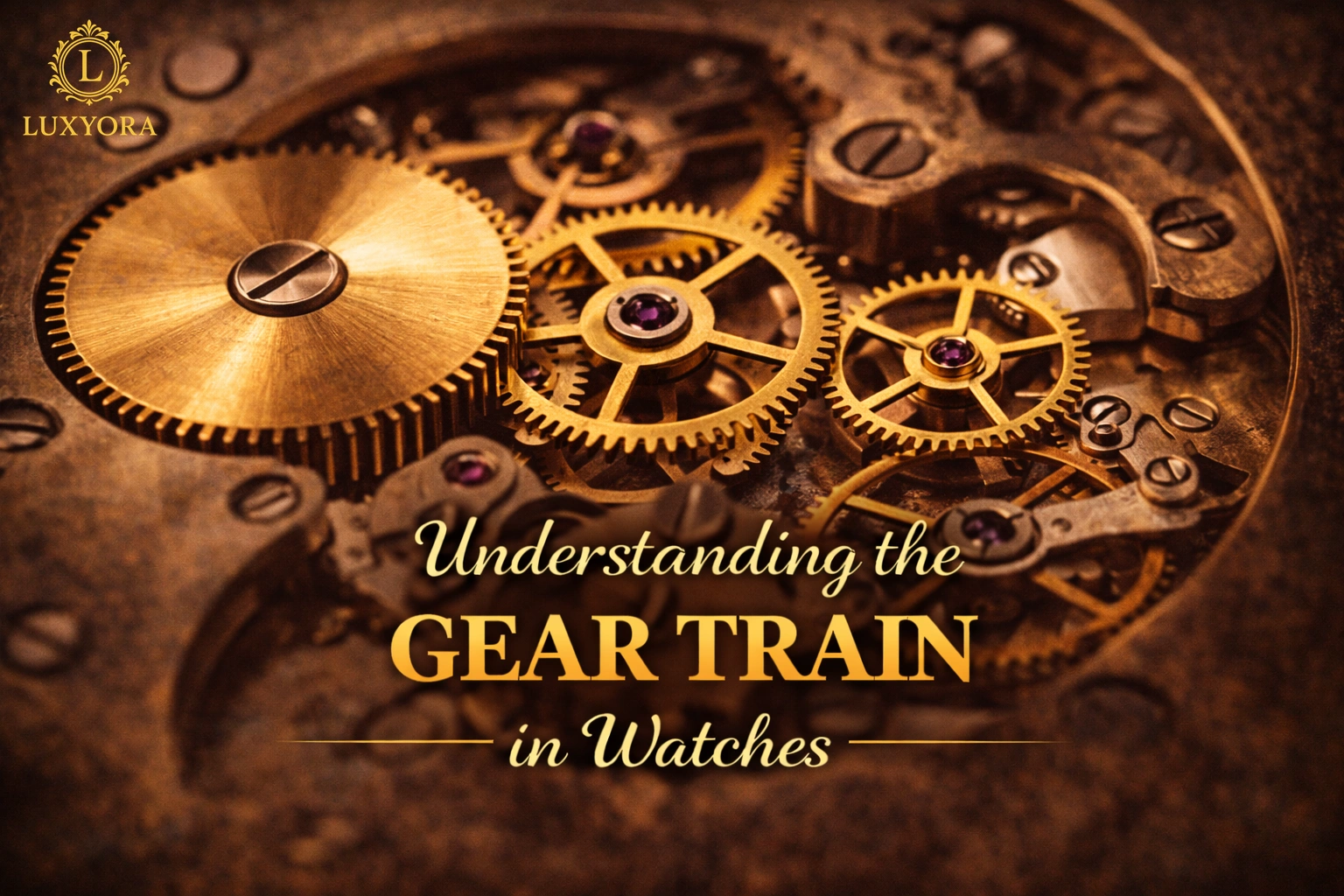
In mechanical watchmaking, the gear train (often called the wheel train or going train) is the series of intermeshing wheels and pinions that transfers energy from the mainspring barrel to the escapement, while also converting that energy into the correct rotational speeds for the seconds, minutes, and hours displays. Without a gear train, a mainspring would simply unwind rapidly; with a properly designed train, that stored torque is delivered in a controlled pathway to support steady timekeeping.
A helpful way to picture the gear train is as the watch’s mechanical transmission: it manages torque, speed, and direction of motion across multiple stages small enough to fit inside a wristwatch, but precise enough to measure time reliably.
1) What the Gear Train Does
A watch gear train has three essential functions:
A. Transmit power efficiently
The mainspring barrel supplies torque, and the train transmits it, wheel by wheel, to the escapement. Because a mechanical watch runs on limited stored energy, the gear train must minimize friction loss and inertia.
B. Multiply rotational speed
The barrel turns relatively slowly compared with the hands, especially the seconds hand. The gear train uses multiple gear pairs to gradually “step up” speed rather than attempting an impractical single, huge ratio.
C. Create usable time units
By choosing the right gear ratios, the train enables specific wheels to rotate at convenient rates, such as once per minute for a seconds display and once per hour for the minute-driving architecture.
2) Core Vocabulary: Wheels, Pinions, and Arbors
In watch industry language:
- Wheel: the larger gear in a pair (more teeth)
- Pinion: the smaller gear it drives (fewer leaves/teeth)
- Arbor/Shaft: the axis on which a wheel and its pinion may be mounted
A common pattern is wheel → pinion, where the pinion is mounted on the same arbor as the next wheel, enabling staged speed increases through the train.
3) The Typical “Going Train” Layout
Most traditional mechanical movements share a broadly similar going-train structure:
- Barrel / first (great) wheel
- Center (second) wheel
- Third wheel
- Fourth wheel
- Escape wheel (part of the escapement interface)
This “standard layout” is described in modern watchmaking textbooks and is widely used because it provides practical hand speeds and a stable power flow.
Key rotational roles (typical behavior)
- The center wheel commonly rotates once per hour and is closely linked to the motion work that drives the hands.
- The fourth wheel often rotates once per minute, making it ideal for carrying a seconds hand either as a small seconds subdial or, in many architectures, driving center seconds via additional arrangements.
- The escape wheel is the train’s endpoint and is repeatedly locked/unlocked by the pallet fork, regulating energy release into “ticks.”
Design note: In watches with center seconds, wheel placement can vary. One common approach places the second wheel off-center, allowing the fourth wheel to sit centrally and drive the seconds hand.
4) Gear Ratios: Why They Matter So Much
The gear train is fundamentally a ratio machine. Each gear pair changes speed based on the number of teeth. If a driving wheel has many teeth and drives a small pinion with few leaves, the pinion spins faster. This is how the train increases speed step by step.
Because a watch must display:
- seconds (fast),
- minutes (moderate), and
- hours (slow),
The train ratios are chosen so these units remain consistent and readable. This is also why gear-train design is considered the backbone of movement architecture. Ratios influence everything from hand placement to power-reserve performance.
5) The Gear Train vs. Motion Work (A Common Confusion)
A watch often contains more than one gear system. The running train primarily transmits power to the escapement and provides a foundation for timekeeping. Meanwhile, the motion work is a reduction system that turns the hour hand at 1/12 the speed of the minute hand and enables setting.
So:
- Going train: power flow + regulation pathway
- Motion work: hand display gearing + setting function
This distinction matters because issues like “hard hand-setting” or “hour hand drift” may relate to motion work friction and fit, not the going train itself.
6) Engineering Priorities in Gear Train Design
A. Efficiency and friction control
Mechanical watches live on small energy budgets. Spur gears dominate watchmaking because they’re compact and efficient for transmitting torque between parallel shafts, with relatively low losses.
B. Tooth geometry
Mechanical watches commonly use specialized tooth profiles; educational technical explanations note that watches often use cycloidal profiles, which differ from the involute profiles common in many larger machines.
C. Bearings and jewels
The wheel train runs continuously under load. Many movements use jewel bearings (synthetic rubies) to reduce friction and wear at pivot points, especially in higher-quality calibers.
D. Depthing, endshake, and alignment
Watchmakers care intensely about:
- Depthing: correct gear mesh depth
- Endshake: controlled axial play of a wheel
- Side shake: controlled lateral play
Poor adjustment can cause excess friction, noise, instability, or power loss, showing up as low amplitude, poor rate stability, or stoppages.
7) How the Gear Train Affects Real-World Performance
A well-designed gear train supports:
- Stable amplitude (the balance swings strongly enough for consistent timekeeping)
- Power reserve efficiency (less energy wasted to friction)
- Durability (reduced wear over the years)
- Complication capability (chronographs, calendars, and remontoirs often interact with or add loads to the train)
Modern watch education sources emphasize that the escape wheel sits at the end of the train and is continuously controlled by the pallet fork, meaning any inefficiency upstream can affect the escapement’s ability to deliver consistent impulses.
8) Service and Wear: What Happens Over Time
Even with jewels and fine finishing, the gear train is not “maintenance-free.” Common long-term issues include:
- Lubricant aging and migration (increasing friction)
- Pivot wear (especially if lubrication fails)
- Debris ingress (dust or dried oils)
- Shock effects (bent pivots or displaced components)
When a watch is serviced, a watchmaker typically cleans the movement, inspects the pivots and teeth, relubricates as needed, and checks for smooth train freedom before regulating the timing.
Conclusion
The gear train is the mechanical watch’s core power transmission and time-conversion system. It links the mainspring barrel to the escapement via a disciplined sequence of wheels and pinions, typically the barrel (great wheel), center wheel, third wheel, fourth wheel, and escape wheel, chosen to deliver the correct ratios for seconds, minutes, and hours. Understanding the gear train gives you a strong foundation for reading movement specs, appreciating mechanical engineering inside watches, and speaking confidently about professional horology terms.
References
Ciechanowski, B. (2022, May 4). Mechanical watch. (Gear train ratios and multi-stage speed increase explanation). Retrieved February 5, 2026, from https://ciechanow.ski/mechanical-watch/
Horage. (2023). Gear train explained (Watchmaking Weekend forum). Retrieved February 5, 2026, from https://www.shop.horage.com/forum/watchmaking-weekend-english/gear-train-explained
Revolution. (2024, November 22). Gear design: The backbone of watchmaking. Retrieved February 5, 2026, from https://revolutionwatch.com/gear-design-the-backbone-of-watchmaking/
Time+Tide Watches. (2024, September 9). Every part of a watch movement, from screw to pinion. Retrieved February 5, 2026, from https://timeandtidewatches.com/watch-movement-parts-watch-education/
Brunner, G. L. (2019). The Watch Book: Compendium. teNeues.
Kaplan, B. B. (2022). Horology: An illustrated primer on the history, philosophy, and science of time, with an overview of the wristwatch and the watch industry. Schiffer Publishing.
Stone, G., & Pulvirent, S. (2018). The watch, thoroughly revised: The art and craft of watchmaking. Abrams.