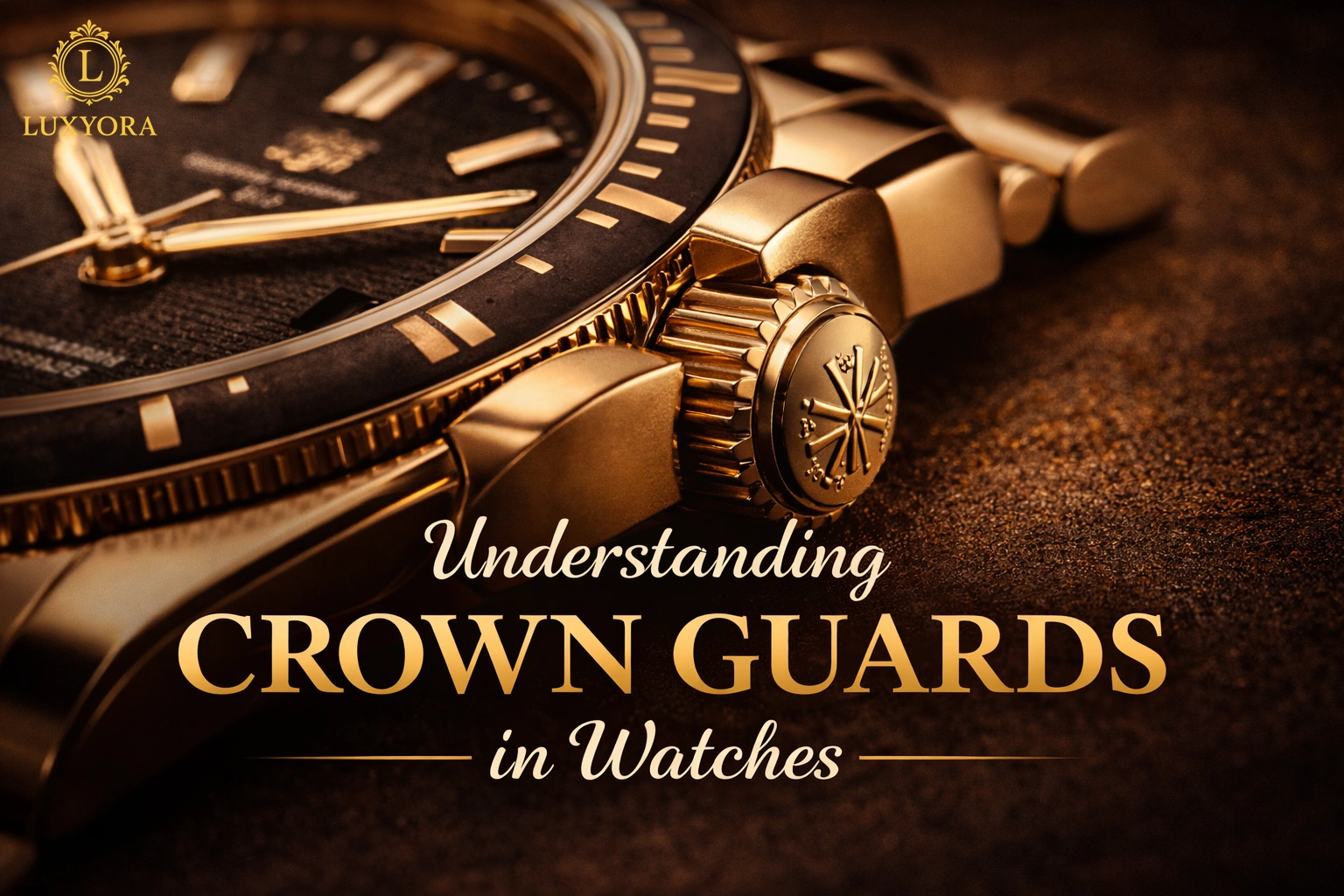
Crown Guards : What are Crown Guards in Watches
In modern horology, crown guards are the protective structures built into (or attached to) a watch case that shield the crown, the user’s main control for winding and setting, from impact, snagging, and accidental operation. While they’re often seen as a sporty design cue, crown guards are fundamentally a durability and reliability feature, especially for dive watches, tool watches, and sports watches, where the crown is exposed to knocks, pressure, and frequent use.
This article explains the industry term “crown guards” in depth: what they are, how they work, major design types, why they matter for water resistance, and what collectors and buyers should look for.
What Are Crown Guards?
Crown guards are case extensions or protective elements located around the crown, typically on the right side of a watch (3 o’clock area), though some watches place crowns at 4, 8, or 9 o’clock for comfort and protection.
Their primary objective is simple:
- Reduce the impact risk to the crown and winding stem
- Lower snagging chances on sleeves, straps, gear, or wetsuits
- Help prevent accidental crown pull-out (which can compromise water resistance and timekeeping)
Rolex describes its crown guard as a case feature designed to protect the winding crown, introduced in 1959 on professional models like the Submariner and GMT-Master.
Why Crown Guards Matter: The Crown Is a Vulnerable Entry Point
The crown sits at a critical junction: it must move and rotate for user operation, yet the case must remain sealed against dust and water. The crown/stem area is one of the most vulnerable points on a watch because it combines motion + an opening into the case.
Key risks crown guards address
- Stem bending or breakage: A hard knock can bend the stem, damage keyless works, or cause misalignment.
- Seal disruption: If a crown is pulled out accidentally (or not secured), water resistance is reduced.
- Crown shear/tube damage: Repeated impacts can damage threads in screw-down systems or deform the crown tube.
Tool-watch design guides frame crown guards commonly as a practical protection element for watches intended for active environments (diving, military, sports).
Crown Guards and Water Resistance: The “Don’t Pull the Crown” Problem
Many watches, especially diver-style watches, use screw-down crowns. If the crown is inadvertently unscrewed or pulled, water resistance can be compromised immediately.
The diver’s watch standard ISO 6425:2018 specifies requirements and tests for divers’ watches. While the standard addresses many aspects of performance, it explicitly tests watches under pressure and applies forces to the crown during testing.
Even outside strict ISO testing, the principle is clear: keeping the crown protected, seated, and secure is crucial for reliable water resistance. Crown guards help by reducing the likelihood of accidental operation and by reducing mechanical shock to crown components.
Main Types of Crown Guards (Industry Design Vocabulary)
A. Integrated crown shoulders (case-built guards)
These are built into the case shape: two “shoulders” flank the crown, a common featureon dive and sports watches. They:
- Recess the crown slightly
- Absorb impacts before the crown is hit directly
- Keep the crown from catching on the edges
Rolex notes its crown guard is stamped as an integral part of the middle case and extends the case sides toward the crown.
B. Add-on or sculpted guards (prominent protrusions)
Some watches use pronounced guards that project outward. These are common when a brand wants maximum protection or a bold “tool watch” identity.
C. Lever-lock crown protection systems (Panerai-style)
A famous crown-protection approach is Panerai’s crown-protection device, associated with Luminor designs. Panerai’s official history notes an international patent for the crown protecting device dating to 1956.
This style typically uses a locking lever that presses the crown inward, helping with security and creating a distinctive silhouette.
D. Spring-loaded or articulated protectors
Some modern watches use protective mechanisms that move or spring to allow crown access while still shielding it when not in use (seen in certain avant-garde designs).
Design Trade-Offs: Protection vs. Ergonomics
A crown guard can be “too much of a good thing.” Well-designed crown guards balance protection with usability:
Better protection can mean…
- More difficult crown grip (especially with gloves)
- Extra bulk on the case side
- Less comfort for some wrist shapes
Better ergonomics can mean…
- Guards that taper smoothly into the case
- A crown that’s partially recessed but still easy to operate
- Crown placement at 4 o’clock to reduce wrist contact (a common tool-watch comfort strategy).
Brands often tune crown guard geometry to keep the crown accessible while reducing protrusion and snag risk.
Materials and Finishing: Why Crown Guards Affect “Perceived Quality.”
Crown guards are part of the case, so they influence:
- Case machining complexity
- Polish/brush transitions
- Symmetry and alignment
- Impact resistance of edges
In higher-end cases, you’ll often see crisp chamfers and clean finishing lines on crown guard details that collectors treat as a quality signal. Modern watch references and compendiums on luxury watch design and case features often highlight how these external elements contribute to a timepiece’s identity and engineering feel.
Practical Buyer Checklist: How to Evaluate Crown Guards
When you’re inspecting a watch (in person or online), check:
- Crown alignment: Is the crown centered and seated cleanly between guards?
- Clearance: Is there sufficient clearance for the crown to be gripped and operated comfortably?
- Protection level: Does the guard actually shield the crown from direct side impacts?
- Screw-down action (if applicable): Smooth threading, no wobble, no grinding feel.
- Case integrity: Guards should look structurally integrated, not fragile or thin at stress points.
If the watch is marketed as a diver or rugged sports model, crown guard execution should match that promise.
Care and Maintenance Notes (Owner Education)
Crown guards don’t eliminate the need for maintenance. Water resistance depends heavily on seals and system condition. Regular servicing often involves replacing gaskets and pressure-testing to verify the integrity of water resistance over time.
Owner habits that protect the crown system:
- Avoid operating the crown when wet or underwater.
- Always secure a screw-down crown after setting.
- If the crown action feels rough or loose, service it; don’t force it.
Conclusion
Crown guards are not just a styling flourish; they are a functional, protective case feature designed to safeguard one of the watch’s most vulnerable components: the crown and its stem interface. In dive and tool watches, crown guards enhance reliability by reducing impacts, snagging, and accidental crown operation, helping maintain water resistance and mechanical integrity. Whether you prefer subtle shoulders or bold lever-lock systems, understanding crown guards gives you a sharper eye for watch durability, case engineering, and true tool-watch design.
References
Brunner, G. L. (2019). The Watch Book – Compendium. teNeues.
Brunner, G. L. (2020). The Watch Book – More than Time. teNeues. (teneues.com)
International Organization for Standardization. (2018). ISO 6425:2018—Horology—Divers’ watches [Standard]. (Iteh Standards)
Rolex. (n.d.). Crown guard – Cases (Watchmaking features). Retrieved February 5, 2026, from the Rolex website. (Rolex)
Stone, G., & Pulvirent, S. (2018). The watch, thoroughly revised: The art and craft of watchmaking. Abrams.
Time and Watches. (2024, August 17). The essential requirements of a diver’s watch: A quick guide. (Time and Watches | The watch blog)
Wristler. (2025, August 1). Watch crown guards: The unsung watch bodyguards. (wristlr.eu)
SHWR. (n.d.). The importance of gasket replacement for water resistant watches. Retrieved February 5, 2026. (shwr.co.uk)
Panerai. (n.d.). The history of Panerai watches. Retrieved February 5, 2026, from the Panerai website. (Panerai)