How to Read Perfume Descriptions and Notes Like an Expert | Luxyora
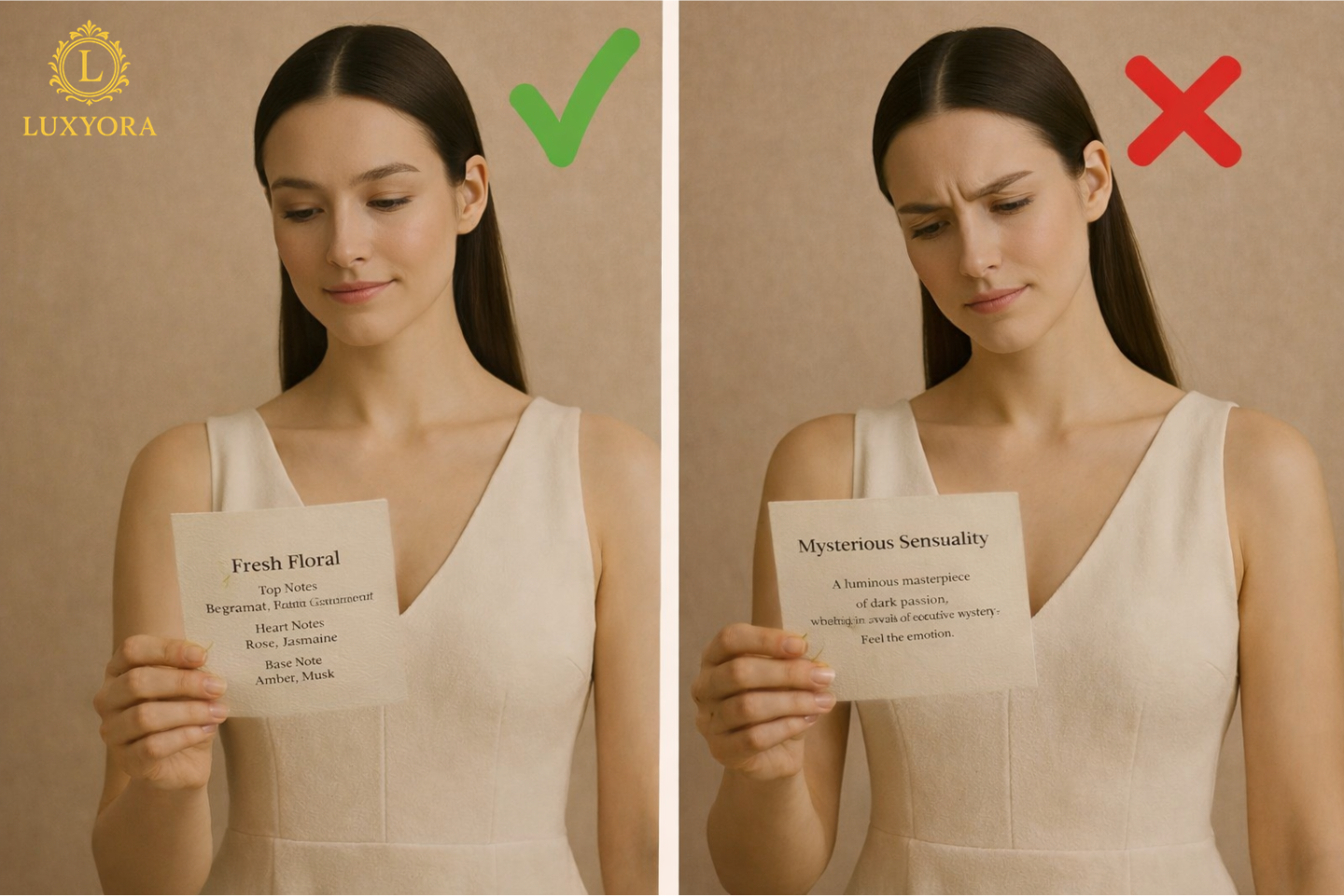
Perfume descriptions are basically the fashion copy of the fragrance world: “sun-warmed bergamot,” “cashmere woods,” “a whisper of skin musk.” Gorgeous? Yes. Crystal clear? Not always.
But here’s the secret: you don’t need a perfumery degree to decode those dreamy paragraphs. Once you know what to look for, notes vs accords, fragrance families, and the way a scent evolves, you can read a perfume description like an editor reads a runway review: quickly, accurately, and with a little delightful skepticism.
Let’s turn the marketing poetry into a real-world cheat sheet.
Step 1: Start with the pyramid, not the poetry
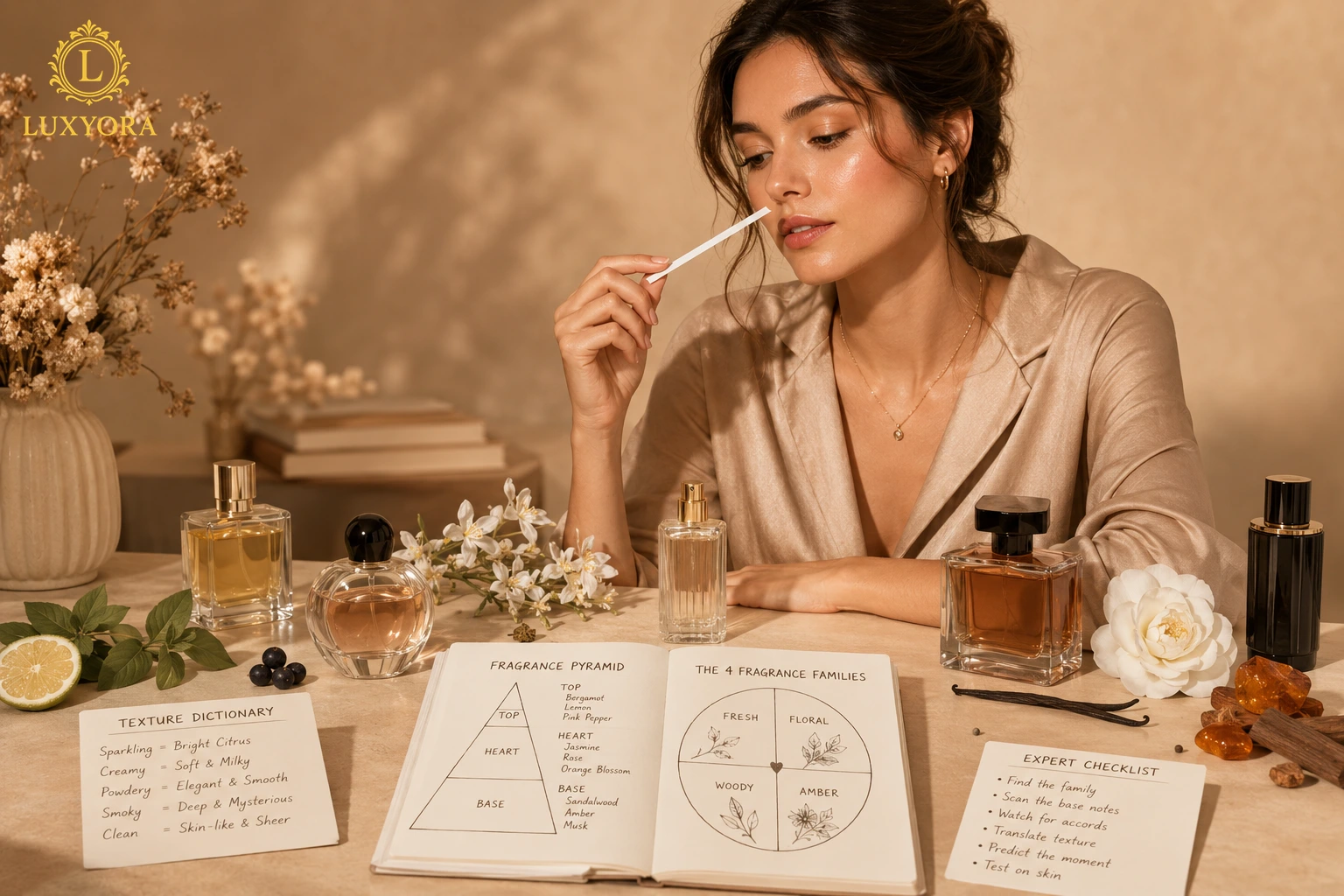
Most descriptions (or note lists) are organized into top, heart (middle), and base notes, the fragrance pyramid. Top notes show up first, heart notes shape the main character, and base notes are the long-lasting signature you notice hours later.
When a brand writes:
- “Sparkling citrus opening” → expect top notes like bergamot, lemon, grapefruit.
- “Floral bouquet” → heart notes like jasmine, rose, orange blossom.
- “Warm amber dry-down” → base notes like vanilla, resins, woods, musks.
The beauty of a fragrance often lies in what happens after the first spritz, as new facets quietly emerge and transform the scent over time. Discover the hidden structure behind this evolution in Understanding Perfume Notes: Top, Middle & Base Notes Explained.
Expert move: don’t judge a fragrance by the first line of the description. The “opening sparkle” is often the shortest chapter of the story.
Step 2: Learn the four big fragrance families (and you’ll rarely get lost)
Perfumers and retailers use classification systems, most famously Michael Edwards’ Fragrance Wheel, to group scents by family and help people find similar styles. Edwards’ official Fragrance Wheel explains the relationship between fragrance families and preferences.
A simple way to remember it (and it matches how many modern guides teach it):
- Fresh: citrus, aromatic, watery, green (crisp, clean, bright)
- Floral: anything flower-forward (from sheer to opulent)
- Woody: sandalwood, cedar, vetiver, smoky woods (tailored, grounded)
- Amber (often replacing “oriental” in modern classification): vanilla, resins, spices, warm sweetness (sensual, rich)
Expert move: when a description feels too abstract, look for family clues. If you see vetiver/cedar / smoky → you’re probably in woody territory. If you see vanilla/resin / spice → think amber
Step 3: Notes aren’t always ingredients (sometimes they’re vibes)
This is where beginners get tricked: a “note” can be a real material, but it can also be an effect, especially when you see things like:
- “amber”
- “cashmere woods.”
- “skin musk.”
- “clean laundry.”
- “sea breeze.”
These are often accord-composed blends designed to create an impression.
An accord is when multiple materials combine into a unified scent idea, more than the sum of its parts.
A preference for crisp citruses, delicate florals, or rich woody accords may reveal more about your individuality than you realise. Explore the fascinating connection between scent preferences and self-expression in How to Find the Right Fragrance Notes for Your Personality.
Expert move: treat poetic notes as aesthetic direction, not a shopping list. “Cashmere woods” usually means soft, creamy, modern woods + musks, not literal cashmere.
Step 4: Decode “texture words” like you’re reading fabric
Perfume descriptions are packed with texture language. Once you translate it, you can predict how the fragrance will feel.
Here’s your mini dictionary:
- “Sparkling/zesty/bright” → citrus top, airy aromatics, quick lift
- “Dewy / watery/airy” → aquatic or sheer musks, clean transparency
- “Creamy/lactonic” → vanilla, sandalwood, tonka, milky musks
- “Powdery” → iris/violet-style effects, soft musks, vintage elegance
- “Smoky/incense” → resins, woods, sometimes leathery facets
- “Clean/skin-like” → modern musks (close, intimate projection)
Expert move: if you’re sensitive to heavy scents, watch for “opulent,” “intense,” “rich,” “heady,” and big amber/gourmand cues. If you want something office-friendly, look for “sheer,” “fresh,” “soft,” “skin.”
Step 5: Watch for the “performance promises” hidden in the copy
Descriptions often hint at longevity and projection without stating it directly:
- “Lingers,” “long-lasting trail,” “intense,” “night” → likely stronger base + more presence
- “Second skin,” “whisper,” “delicate veil,” “airy” → intimate, softer projection
- “Refreshing splash,” “cologne-style,” “bright burst” → usually more top-heavy and short-lived
And remember: your skin chemistry changes the outcome. Treat descriptions as guidance, not prophecy.
Step 6: Use safety language as a sign of seriousness
If you’re shopping for “natural” fragrances, don’t assume “natural” means irritation-free. IFRA’s consumer Q&A is explicit: natural ingredients can still be allergenic or irritating, and “chemical-free” is a misleading concept.
Brands that reference responsible standards and safety practices are often signaling that they understand modern fragrance compliance. IFRA also describes its standards as a global benchmark for safe use, developed through scientific review.
Expert move: if you have sensitive skin, don’t shop by “natural vs synthetic.” Shop based on how your skin reacts, and patch-test when needed.
Step 7: A practical “expert” reading routine (60 seconds)
When you’re looking at a perfume page, do this:
- Find the family: Fresh / Floral / Woody / Amber (Fragrance Wheel logic).
- Scan the base notes first: that’s what you’ll live with.
- Mark any “accord words”: amber, musk, cashmere woods = vibe, not literal.
- Translate texture terms: sparkling, creamy, smoky, powdery = feel.
- Predict the moment: daytime sheer vs night rich.
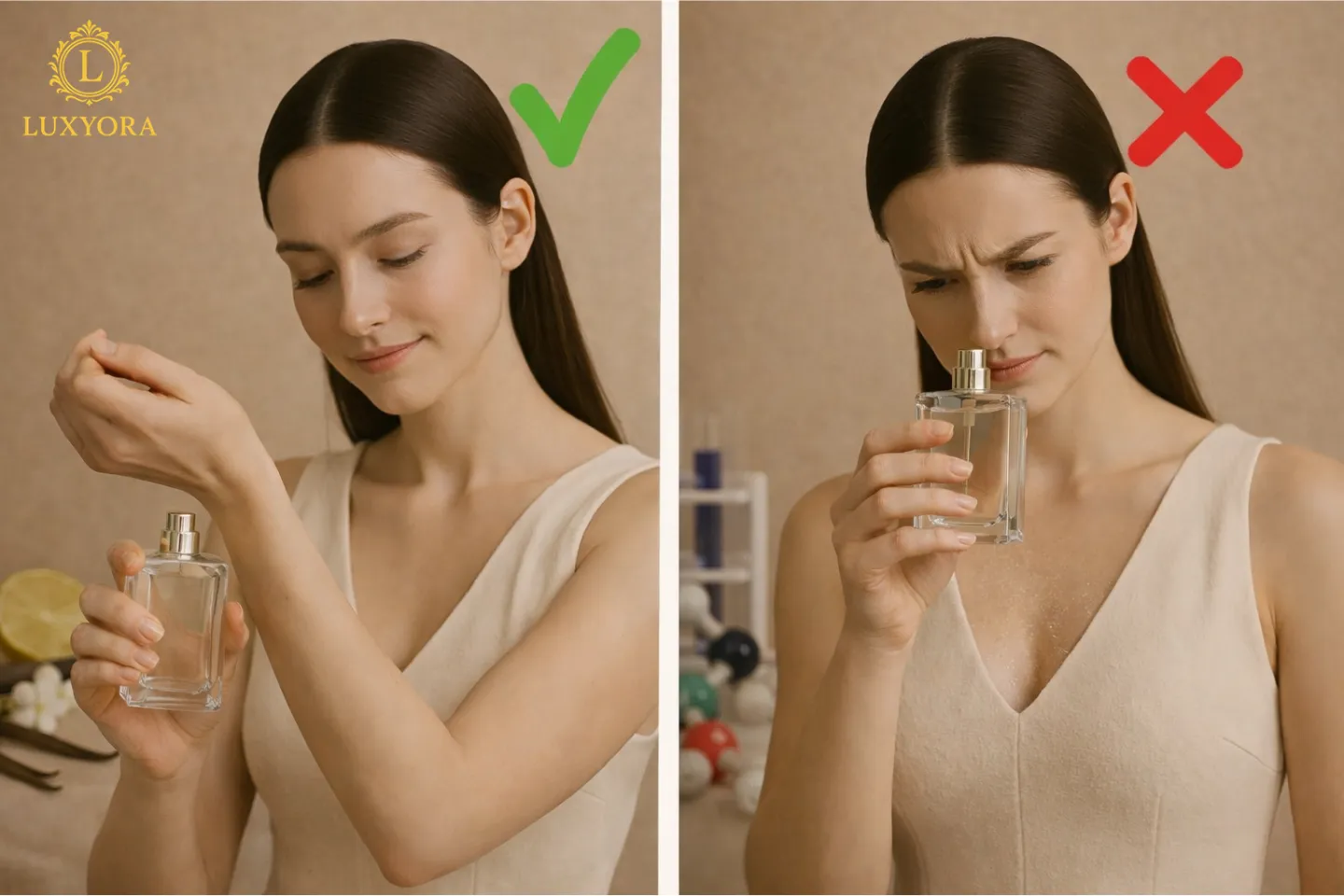
- Then test on skin: and give it time to evolve.
That’s it. You now read perfume copy like an expert without losing the romance
How to shop smarter (and avoid being fooled by labels)
- Don’t worship the word “natural.” It’s not a safety guarantee.
- Look for transparency: allergen info, IFRA compliance language, sourcing, or sustainability statements.
- Test on skin for a full day. The “right” perfume should still feel like you at hour six.
- If you’re sensitive: consider fragrance-free body care and keep perfume on clothes (if safe for fabric), or use a lighter application.
Luxyora Philosophy: Perfume is poetry with a structure. Learn the language, trust your skin, and choose scents that read like you beautifully, unmistakably, and with intention.
References:
- International Fragrance Association. (n.d.). Questions about fragrance (Natural/organic does not mean allergen-free; “chemical-free” is misleading). Retrieved December 21, 2025. (IFRA)
- Research Institute for Fragrance Materials (RIFM) & International Fragrance Association (IFRA). (2019). Guidance for the use of IFRA Standards (PDF). (RIFM)
- International Fragrance Association. (n.d.). Safe use and fragrance science (Overview of IFRA Standards as a safety benchmark). Retrieved December 21, 2025.(IFRA)
- Fragrances of the World. (n.d.). Explore Michael Edwards’ Fragrance Wheel. Retrieved December 21, 2025. (fragrancesoftheworld.com+1)
- The Fragrance Foundry. (2022, October 19). What are accords in perfumery?(The Fragrance Foundry)
- Shay & Blue. (2021, February 7). Top, Heart, Base – What does it all mean?!(Shay & Blue UK)
- GQ.(2022). The best cologne from each fragrance family (Discussion of fragrance families and the Fragrance Wheel). (GQ)