Vetiver : What is Vetiver
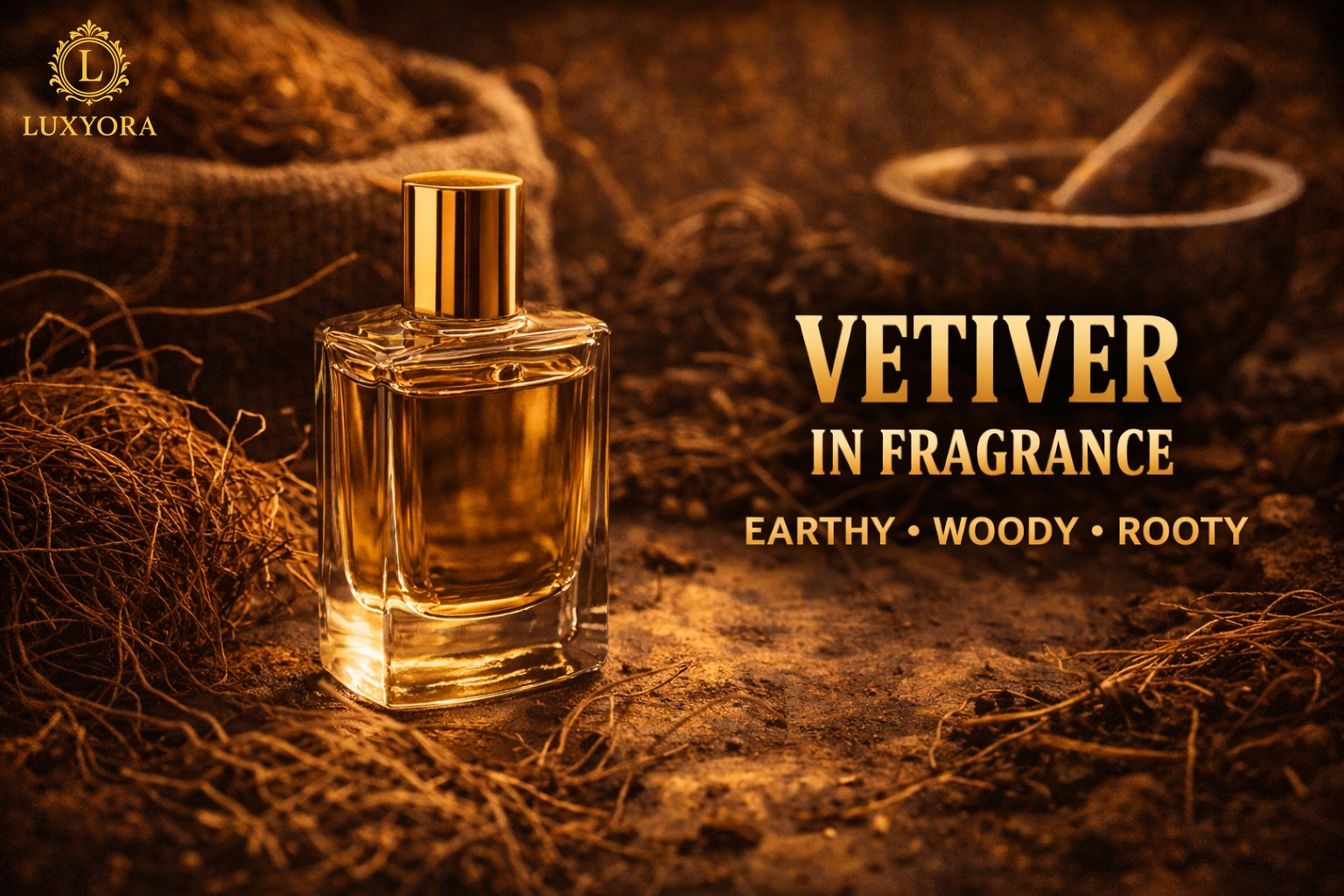
In the fragrance industry, vetiver refers to a perfumery material derived mainly from the roots of Chrysopogon zizanioides (formerly Vetiveria zizanioides). It is prized for a signature scent profile that can feel earthy, woody, smoky, green, dry, nutty, leathery, or even grapefruit-bright, depending on origin and processing.
Vetiver is one of the most important woody base notes in modern perfumery because it delivers structure, depth, elegance, and fixative power, often helping a composition feel “complete” and long-lasting.
What vetiver smells like in perfumery terms
Perfumers often describe vetiver as a “woody-earthy backbone” with multiple facets:
- Earthy/rooty / mineral: reminiscent of damp soil, roots, and cool stone.
- Smoky/dry/burnt: a darker profile often associated with certain origins and distillation practices.
- Green/grassy/aromatic: a fresh, outdoorsy character that keeps woody fragrances from feeling heavy.
- Woody-amber clarity: a polished, transparent wood effect that is prominent in modern vetiver styles and derivatives.
A key industry nuance is that “vetiver” is not a single scent; it’s a family of profiles influenced by terroir, curing, and distillation choices. Haitian vetiver is widely described as cleaner and more refined, while Javanese styles are often described as more smoky and intense.
Where vetiver comes from and how it’s produced
The plant and the part that matters
Vetiver is a tall grass, but in perfumery, the star is the root system. Roots are harvested, cleaned, dried/cured, and then processed to extract aromatic material.
Extraction: why vetiver is usually “oil.”
The classic perfumery material is vetiver essential oil, typically obtained by steam distillation of the roots. Because the aromatic compounds are heavy and complex, vetiver oil is often viscous, tenacious, and long-lasting, exactly what perfumers want from a base note.
Origins and “types” of vetiver used in perfumery
In perfumery, origin matters because it changes the olfactive “shape” of the ingredient. Common market language includes:
- Haitian vetiver: often perceived as cleaner, greener, and more elegant, a favorite in refined masculine and modern unisex woods.
- Java (Indonesian) vetiver: frequently described as smokier, darker, more pungent, sometimes “burnt” depending on processing.
- Bourbon (Réunion/Madagascar region styling): often described as earthy and spicy, sometimes with nutty nuances.
This is why vetiver can act as either a clean, tailored “dry woods” note or a raw, smoky “roots and earth” note, depending on the creative direction.
Vetiver’s role in a fragrance formula
1) Base note and long-lasting “anchor.”
Vetiver is a classic base note, meaning it persists and supports the fragrance for hours. Its slow evaporation helps perfume feel grounded, especially in woody, fougère, chypre, and woody-amber families.
2) Natural fixative effect
Because of its tenacity, vetiver can function as a fixative-like material, extending the life of more volatile notes (citrus, herbs, light florals) and improving the “trail” (sillage).
3) A bridge between freshness and depth
A modern perfumery trick is to pair vetiver with citrus (especially grapefruit-style brightness) to create a crisp top that dries down into a sleek woody base. Interestingly, scientific work on vetiver’s odor profile describes a structure in which bright top notes connect to a distinctive woody-amber base.
Vetiver chemistry and why it’s hard to “copy.”
Vetiver oil is renowned for its chemical complexity, containing numerous sesquiterpene-derived compounds. This complexity is one reason perfumers love it; there’s a “living” quality to the oil that shifts as it dries down.
Modern research has also sought to identify which molecules drive vetiver’s characteristic odor. A 2021 study (Angewandte Chemie) reported identification of an extremely potent key contributor to the typical vetiver character, underlining why vetiver can feel both softly radiant and deeply woody.
A 2021 chemistry news explainer further emphasized the very low odor threshold and the pronounced woody-ambery impression of the identified contributor.
Industry takeaway: Vetiver’s magic is not a single smell molecule; it’s a complex natural accord, and even when a key molecule is identified, recreating the full character remains an art.
Vetiver derivatives and modern “clean woods” styling
Perfumery doesn’t rely only on natural oils. It also uses vetiver derivatives (materials derived from or inspired by vetiver) to emphasize certain facets, like:
- transparent woody-amber
- creamy dryness
- reduced smokiness
- improved stability/consistency
These modern materials let perfumers design “clean vetiver” signatures that feel crisp, contemporary, and versatile across genders and seasons.
Sustainability, sourcing, and authenticity (a big theme)
Sourcing and community impact
Vetiver is a major crop in countries such as Haiti, and fragrance industry supply chains increasingly emphasize traceability, farming support, and ethical sourcing, particularly as consumers ask where ingredients come from. A 2019 Perfumer & Flavorist piece highlights Haiti’s importance in vetiver production and the cultural/industry interest around vetiver origins.
Adulteration and verification
As demand grows, essential oils face challenges like adulteration. Perfumer & Flavorist (2025) discussed verification approaches (including carbon-14 analysis) and explicitly included vetiver among oils that face authenticity pressures.
Safety and regulatory use in perfumery
In fragrance manufacturing, vetiver materials are used under safety frameworks such as the IFRA Standards, a global risk-management system that sets restrictions, as needed, based on safety assessments.
Supplier IFRA documents for vetiver essential oil illustrate how maximum use levels can be assigned by product category and amendment version, reflecting industry compliance practice.
For certain modified materials, regulators may publish safety opinions. The EU Scientific Committee on Consumer Safety (SCCS) issued a safety opinion on acetylated vetiver oil as a fragrance ingredient, supporting safety at proposed limits (as referenced against IFRA-proposed concentrations).
How to recognize vetiver in perfume descriptions
Look for keywords like:
- dry woods, earthy, rooty, smoky, grassy-green, clean woods
- cedar + vetiver, vetiver + grapefruit, vetiver + patchouli
- woody-amber, modern fougère, aromatic woods
If a fragrance is described as “tailored,” “barbershop-clean,” “pencil-shavings woody,” “cool earthy,” or “smoky elegant”, vetiver (or a vetiver-style molecule) is often part of the backbone.
Conclusion
In fragrance, vetiver is a cornerstone material: a root-derived woody note that can swing from green and refined to smoky and intense, while delivering exceptional tenacity and structure. Between 2018 and 2026, the vetiver conversation has expanded beyond smell alone to include ingredient chemistry breakthroughs, authenticity testing, ethical sourcing, and safety compliance, making it one of the most important “industry terms” for anyone learning perfumery today.
References
AvenaLab. (2024). Vetiver essential oil IFRA certificate of conformity (COC) [PDF]. (avenalab.com)
Carrément Belle. (2021, August 4). Vetiver, the natural woody elegance. (CARREMENT BELLE)
ChemistryViews. (2021, January 14). The active smelling principle of vetiver oil. (ChemistryViews)
International Fragrance Association. (n.d.). IFRA Standards. (IFRA)
Nez + LMR (Collective). (2020, June 11). Vetiver in perfumery (Nez + LMR: The naturals notebook). Nez Éditions. (Nez Éditions)
Ouyang, J., Bae, H., Jordi, S., Dao, Q. M., Dossenbach, S., Dehn, S., Lingnau, J. B., De, C. K., Kraft, P., & List, B. (2021). The smelling principle of vetiver oil, unveiled by chemical synthesis. Angewandte Chemie International Edition. (PMC)
Scientific Committee on Consumer Safety. (2021). Opinion on fragrance ingredient acetylated vetiver oil (AVO) [PDF]. European Commission. (Public Health)
Perfumer & Flavorist. (2019, March 27). Haiti’s vetiver museum. (Perfumer & Flavorist)
Perfumer & Flavorist. (2025, November 1). Fragrance ingredients verified via Carbon-14 analysis (testing authenticates natural source). (Perfumer & Flavorist)
Barros, D. (2024). 1001 perfumes: The guide (English ed.). Independently published. (Amazon)