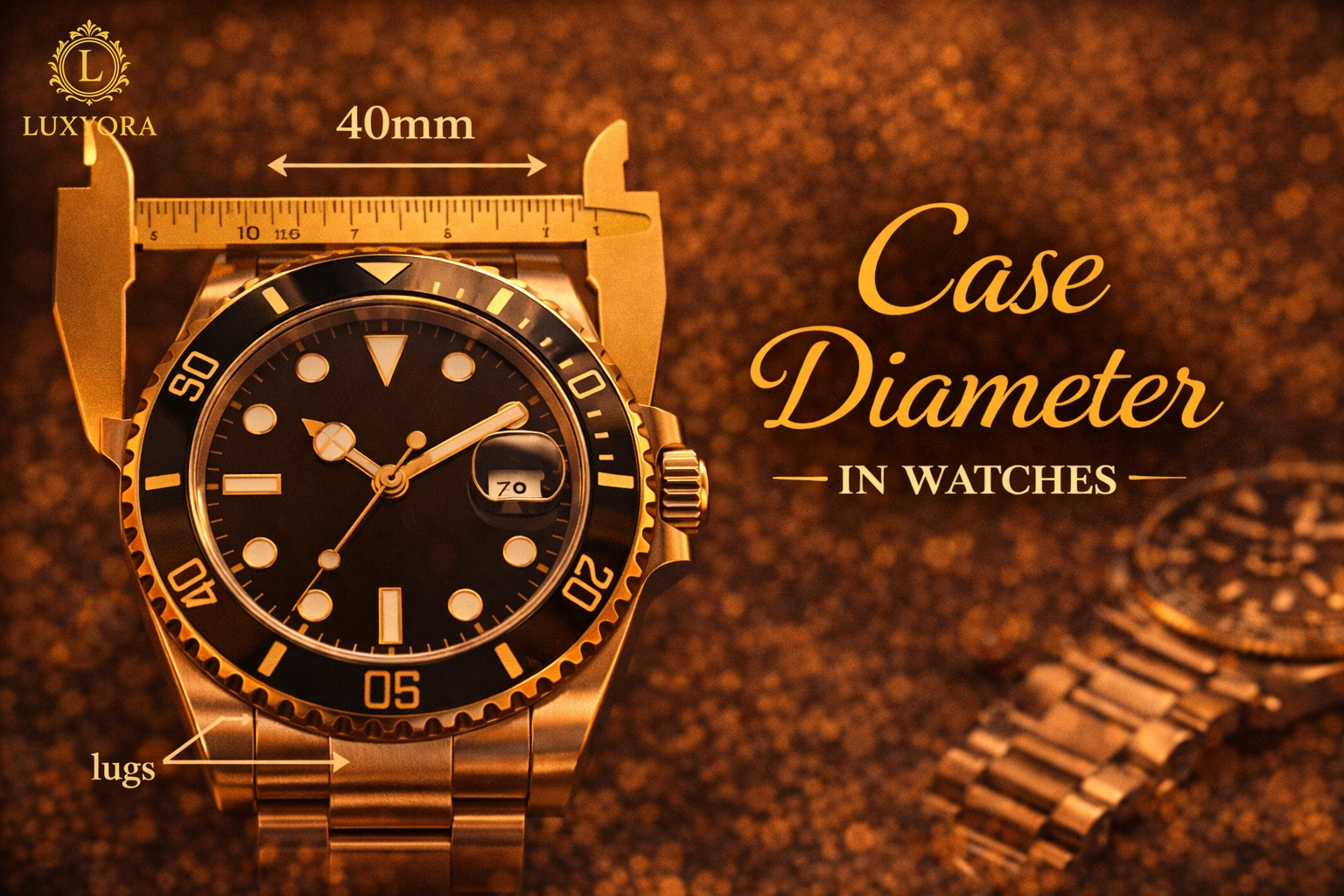
Case Diameter : What is Case Diameter
In watch terminology, case diameter is the most commonly quoted sizing specification, usually measured in millimeters (e.g., 36 mm, 40 mm, 42 mm). It describes the width of the watch case and acts as a quick shorthand for how large a watch will look on the wrist. But in professional watch sizing, case diameter is best treated as a starting point, not a complete answer, because two watches with the same stated diameter can wear very differently depending on lug length, thickness, bezel design, and overall case geometry. Hodinkee’s guide to watch specs explicitly calls out that case diameter, thickness, and lug-to-lug together are what help you predict fit.
This article explains the industry-standard meaning of case diameter, how it’s measured, why brands sometimes report it inconsistently, and how to interpret it alongside other dimensions to choose a watch that fits both your wrist and your style.
What Is Case Diameter?
Case diameter is the measurement across the watch case from one side to the other, most commonly excluding the crown. Many consumer guides describe this as measuring the case “across” at its widest points (excluding the crown), because crowns vary widely in size and would distort comparisons between models.
Case diameter is not the dial size
The dial aperture (the visible dial area) may be smaller or larger depending on the bezel width and case construction. A 40 mm diver with a thick bezel can show a smaller dial than a 40 mm dress watch with a thin bezel, even though both are “40 mm.”
How to Measure Case Diameter Correctly
If you’re measuring a watch yourself, a digital caliper is ideal (a ruler works in a pinch). The typical approach is:
- Place the watch on a stable surface (or hold it carefully).
- Measure the case width from the 9 o’clock side to the 3 o’clock side.
- Do not include the crown (and typically don’t include the crown guards).
Why is the crown excluded?
The crown is an external control component and varies by design (e.g., small dress crowns vs. large screw-down tool crowns). Excluding it keeps the case diameter comparable across different watches.
Why Case Diameter Can Be “Misleading” in Real Wear
Many buyers assume case diameter equals “how big it will feel.” In practice, the wrist experience comes from a combination of measurements and shapes:
A) Lug-to-lug length often matters as much as diameter
Lug-to-lug is the distance from the tip of the top lug to the tip of the bottom lug. Watches with long lugs can wear larger even at modest diameters; short-lug designs can wear compact even at large diameters. Teddy Baldassarre’s lug-to-lug explainer highlights how diameter and lug-to-lug work together and gives examples where smaller diameters wear larger due to long lugs.
B) Thickness changes the visual “mass.”
Thickness affects how tall the watch sits, how it fits under cuffs, and how “chunky” it feels. Hodinkee’s specs guide notes thickness as one of the key dimensions for predicting fit.
C) Bezel width changes perceived size
A wide bezel reduces visible dial area (often making the watch feel smaller), while a thin bezel enlarges the dial opening (often making it feel larger). This is why two 40 mm watches can look dramatically different.
D) Case shape can change how a number “wears.”
Round watches are easiest to compare by diameter. Non-round cases (square, rectangular, tonneau) are often described by width × length, and a single “diameter” number may not represent real wrist coverage as well as lug-to-lug or overall length. Hodinkee’s discussions of sizing emphasize that dimensions beyond diameter are crucial to understanding wrist presence.
Industry Reporting Differences: Why One Brand’s 40 mm Isn’t Another Brand’s 40 mm
There is no universal rule that forces all brands to measure diameter at the exact same case point. Depending on design, brands may measure:
- across the bezel
- across the mid-case
- across protruding case features (less common, but it happens)
- with or without crown guards
Because of this, “case diameter” can sometimes behave like a marketing-friendly simplification rather than a strict engineering standard. The practical solution is to compare multiple measurements rather than diameter alone.
“Good” Case Diameters: Practical Ranges by Wrist Size
Watch sizing is partly a matter of personal style, but general guidance can serve as a starting point. One widely shared approach is to match approximate wrist size to typical diameter bands. Teddy Baldassarre’s watch sizing guide suggests that smaller wrists often suit mid-30s to high-30s millimeter cases, while average wrists can often accommodate upper-30s to low-40s millimeter cases (style-dependent).
A practical “starting grid” many buyers find useful:
- 34 – 38 mm: classic/dress and smaller-wrist friendly
- 39 – 42 mm: modern mainstream range (sport + everyday)
- 43 mm and above: strong presence; best when lug-to-lug and thickness are controlled
Important: these ranges can shift based on lug-to-lug, bezel width, and thickness, so treat them as guidance rather than rules.
How Case Diameter Connects to Other Key Specs
Case diameter vs lug width
Lug width is the strap/bracelet width between the lugs (e.g., 20 mm). It affects balance and aesthetics. Teddy’s lug-to-lug article also clarifies lug width as a separate measurement from lug-to-lug and diameter.
Case diameter vs water resistance (a case engineering reminder)
While diameter itself doesn’t determine water resistance, case design and sealing do. ISO 22810 describes requirements and test methods for water-resistant watches and the markings manufacturers may apply.
This matters because sporty watches often have thicker cases and crowns to support sealing systems, which can make the watch feel larger even at the same diameter.
Buyer Checklist: How to Use Case Diameter Like a Pro
When evaluating a watch (online or in-store), use case diameter intelligently:
- Read the diameter (exclude crown if specified).
- Check lug-to-lug (predicts overhang).
- Check thickness (comfort and cuff fit).
- Look at bezel and dial opening (visual size).
- Confirm lug width (strap flexibility and proportions).
- If possible, view real wrist photos or try it on.
Conclusion
Case diameter is a core watch industry term because it offers a quick, standardized-ish way to talk about size. But it’s only one part of the fit equation. The most reliable sizing assessment comes from combining the case diameter, lug-to-lug, and thickness, then interpreting those numbers through bezel design and case shape. As major watch-education sources emphasize, those specs together give you a far better prediction of how a watch will actually wear.
References
Brunner, G. L. (2023). The Watch Book: Compendium – Revised Edition. teNeues. (Offline reference)
International Organization for Standardization. (2010). ISO 22810:2010 — Horology: Water-resistant watches. ISO. (ISO) (Offline/standard reference)
International Organization for Standardization. (2010). ISO 22810:2010 — Horology: Water-resistant watches (PDF excerpt). (ITeh Standards)
Hodinkee. (2021, September 9). In-depth: Watch specs: What they mean, why they matter. (Hodinkee)
Hodinkee. (2017, October 20). Editorial: Squaring the circle (case shape sizing discussion). (Hodinkee)
Schmidt, R. (2019). The Wristwatch Handbook: A Comprehensive Guide to Mechanical Wristwatches. ACC Art Books. (Offline reference)
Teddy Baldassarre. (2023, February 15). Watch sizes vs. wrist sizes: What’s the right size for you? (Teddy Baldassarre)
Teddy Baldassarre. (2025, September 12). Lug-to-lug explained: The most important watch sizing. (Teddy Baldassarre)
Daniel Wellington. (2025). How to measure a watch the correct way (case diameter excluding crown). (Daniel Wellington)