Movement : What is Movement
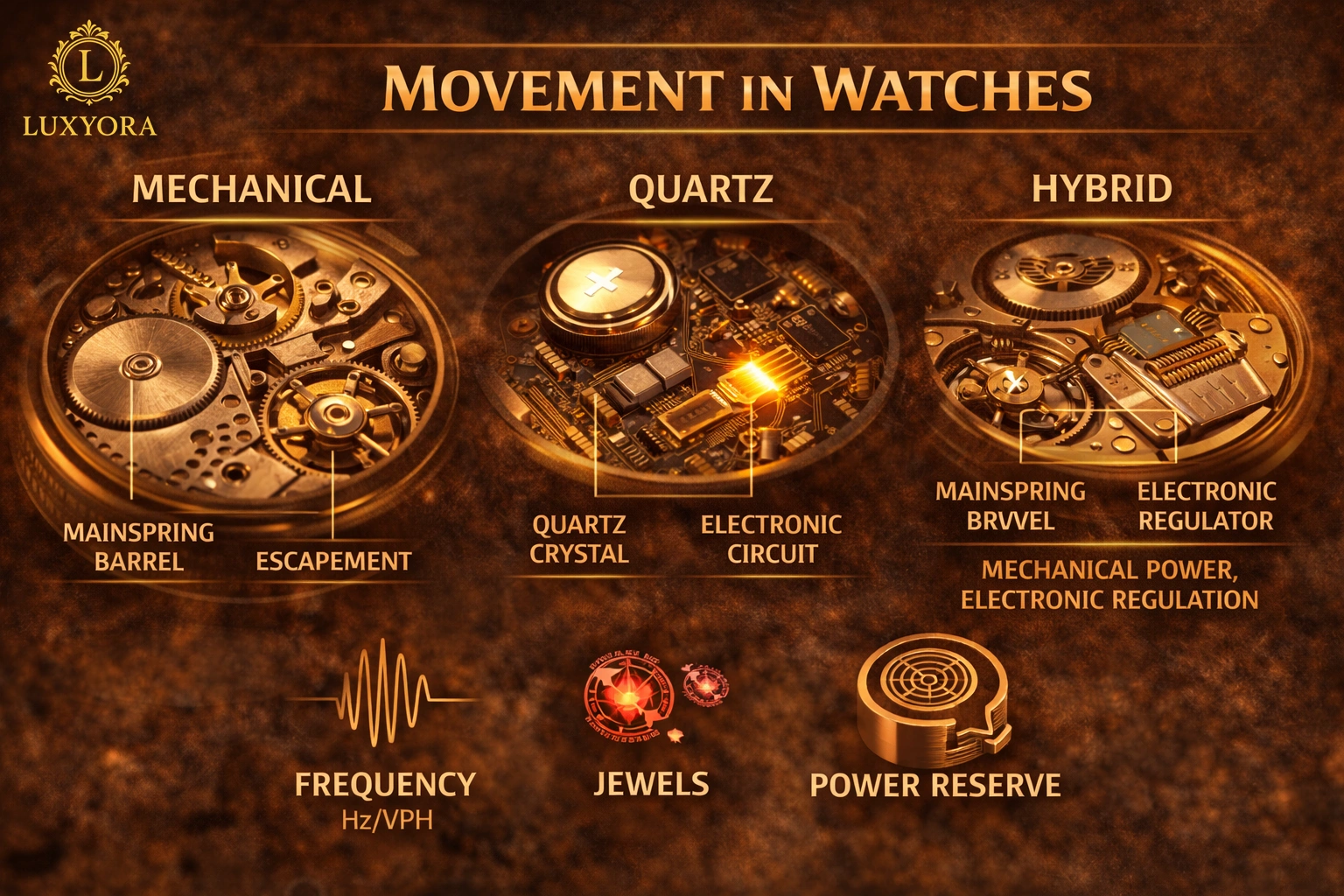
In the watch industry, the term movement (also called a caliber) refers to the internal mechanism that measures time and drives the hands and complications (date, chronograph, GMT, moonphase, etc.). If the case is the body and the dial is the face, the movement is the engine, a compact system of gears, springs, levers, and/or electronics designed to deliver consistent timekeeping in a wearable object. Modern watch education often defines the mechanical watch by its movement itself: it is the “beating heart” housed inside the case.
Understanding movements gives buyers and enthusiasts real “spec literacy”: why two watches that look similar can differ massively in accuracy, service needs, cost, power reserve, and even collector value.
1) Key Movement Vocabulary (Industry Keywords)
- Movement/caliber: the internal timekeeping mechanism; “caliber” is commonly used as a model designation for a movement.
- Mechanical movement: runs on energy stored in a mainspring, regulated by a balance and escapement.
- Quartz movement: battery-powered timekeeping regulated by a quartz oscillator and electronic circuit.
- Hybrid movement: combines mechanical power with electronic regulation (e.g., Spring Drive concepts).
- Complication: any function beyond hours/minutes/seconds (date, chronograph, GMT, etc.).
- Frequency: the oscillator speed (mechanical, often described in Hz or vph) is a major spec tied to stability and rate behavior.
- Jewels: synthetic ruby bearings that reduce friction at key pivots are helpful, but not a simple “more is always better” number.
2) Mechanical Movements: How They Work (Manual-Wind and Automatic)
A mechanical movement is a miniature machine that runs without a battery. It stores energy in a mainspring and releases it through a gear train, which is controlled by the escapement and oscillator (balance and hairspring). Bartosz Ciechanowski’s detailed mechanical watch explainer shows this “energy flow” clearly: mainspring → gears → escapement → regulated motion.
The core architecture of a mechanical movement
Most mechanical movements can be understood in functional blocks:
- Power source: mainspring + barrel (stores energy)
- Transmission: gear train (moves energy to the escapement and hands)
- Regulation: escapement + balance wheel/hairspring (creates controlled “ticks”)
- Display: motion works (drives hour/minute hands), plus seconds and complications
- Keyless works: crown/stem mechanism for winding and setting time
Time+Tide’s parts guide is useful here: it frames how the crown and internal “keyless works” connect the wearer to the movement, and it walks through the many named components from screws and wheels to keyless works and pinions.
Manual-wind vs automatic (self-winding)
- Manual-wind: You wind the crown to tension the mainspring.
- Automatic: a rotor winds the mainspring using wrist motion, but the timekeeping core (gear train + escapement + oscillator) remains mechanical.
Swisswatches Magazine notes that mechanical movements commonly use either a manual winding system or an automatic system with an oscillating weight (rotor).
3) Quartz Movements: Accurate, Efficient, and Low-Maintenance
A quartz movement uses a battery (or solar capacitor in some systems) and an electronic oscillator regulated by a quartz crystal. The key consumer-facing benefit is high accuracy with minimal upkeep.
Brand education pages consistently describe the quartz principle: electricity causes the quartz crystal to oscillate at a stable frequency; a circuit counts the oscillations and converts them into a time display.
Why quartz “wins” on precision per dollar
Quartz is generally:
- More accurate in everyday conditions than most mechanical watches
- Less sensitive to position changes (dial up/down, crown up, etc.)
- Lower service complexity (though batteries, gaskets, and circuits still matter)
Quartz also enables extremely rugged tool designs. For example, WIRED described how Casio protects quartz modules with layered shock-absorbing construction and “floating” movement strategies in some G-Shock engineering.
4) Hybrid Movements: Mechanical Feel, Electronic Regulation (Spring Drive Example)
Some modern movements blend mechanical energy with electronic regulation. Spring Drive is commonly described as powered by a mainspring (as in a mechanical watch) but regulated by a system that replaces the traditional escapement with an electronic regulator.
Grand Seiko’s documentation describes the Spring Drive as a system that achieves accuracy comparable to quartz while being powered only by the mainspring and using no battery, and it outlines how a regulator system controls the glide-wheel speed.
Seiko’s technical explanation also describes the Tri-synchro regulator, which controls mechanical, electrical, and electromagnetic energy and replaces the escapement concept in this architecture.
Why this matters for movement education: it shows that “movement types” aren’t just mechanical vs quartz, there’s a spectrum driven by engineering goals
5) Movement Specifications That Actually Matter
Many watch buyers see movement details on spec sheets but aren’t sure what to prioritize. A practical movement-readout includes:
Accuracy and regulation
- Daily rate performance varies by movement quality, design, and regulation.
- A higher frequency can improve rate stability in some contexts because the balance “averages out” disturbances more quickly.
Jewels
Hodinkee emphasizes that jewel counts correlate loosely with construction quality but are not a simple scoreboard; some jewels can be non-functional, and some excellent designs use fewer jewels strategically.
Power reserve
Power reserve is how long a mechanical watch runs after full wind. It’s shaped by mainspring/barrel design and overall efficiency, and it’s a fundamental movement property like “horsepower” in car terms.
6) Movement Certifications: COSC Chronometer and Beyond
Movement quality is often communicated through certification language:
COSC / ISO 3159 “Certified Chronometer”
COSC explains that “Certified Chronometer” is a title awarded under ISO 3159, with a unique certificate number and an official certification process.
The industry trend toward “whole-watch” testing
Recent reports note that COSC announced a stricter “Super-COSC” standard, set to debut in September 2026, with tighter tolerances and tests beyond the classic movement-only evaluation.
This matters because it reflects how modern buyers increasingly expect performance assurance that matches real use (magnetism exposure, assembled-watch behavior, etc.).
7) What Makes a “Great” Movement (Beyond Numbers)
Collectors and professionals judge movements on multiple axes:
- Engineering and layout: smart, serviceable architecture; robust shock protection; efficient power flow
- Manufacturability and reliability: a movement must be practical to produce and maintain, not just impressive on paper
- Finishing and aesthetics: polishing, striping, anglage, and visual design (especially visible through a display back)
- Use-case fit: a field watch movement and a high horology dress movement solve different problems
Hodinkee’s long-form discussion frames movement greatness as a balance of timekeeping, reliability, supply chain practicality, and economic reality, especially for high-volume calibers.
References
Schmidt, R. (2018). The Wristwatch Handbook: A Comprehensive Guide to Mechanical Wristwatches. ACC Art Books.Stone, G., & Pulvirent, S. (2020). The Watch: Thoroughly Revised. Abrams.
Casio. (2020–2026). Quartz watches: How does a quartz movement work? Casio Europe. (Casio)
Ciechanowski, B. (2022/2026). Mechanical watch. (ciechanow.ski)
Contrôle Officiel Suisse des Chronomètres (COSC). (n.d.). Certified chronometer (ISO 3159). (cosc.swiss)
Financial Times. (2025, September 5). Swiss watch certifier unveils stricter ‘Super-COSC’ standard. (Financial Times)
Forster, J. (2021, September 9). Watch specs: What they mean, why they matter. Hodinkee. (Hodinkee)
Forster, J. (2021, October 13). Long form: What makes a movement great. Hodinkee. (Hodinkee)
Grand Seiko. (2025). Spring Drive (9RB2) instructions PDF. (Grand Seiko)
Seiko Watch Corporation. (2023–2026). Spring Drive knowledge: Tri-synchro regulator. (Seiko Watch Corporation)
Swisswatches Magazine. (2025, January 27). What is a mechanical watch and how does it work? (Swisswatches Magazine)
Time+Tide Watches. (2024, September 9). Every part of a watch movement, from screw to pinion. (Time+Tide Watches)
WIRED UK. (2019, July 23). Casio’s new Gravitymaster is shock, vibration and G-force proof (movement protection discussion). (WIRED)
Mondaine. (2020, March 2). How does a quartz watch work? (Mondaine United Kingdom)
Forster, J. (2021, August 9). What does watch frequency mean? Hodinkee. (Hodinkee)
-