Dial : What is a Dial in Watches
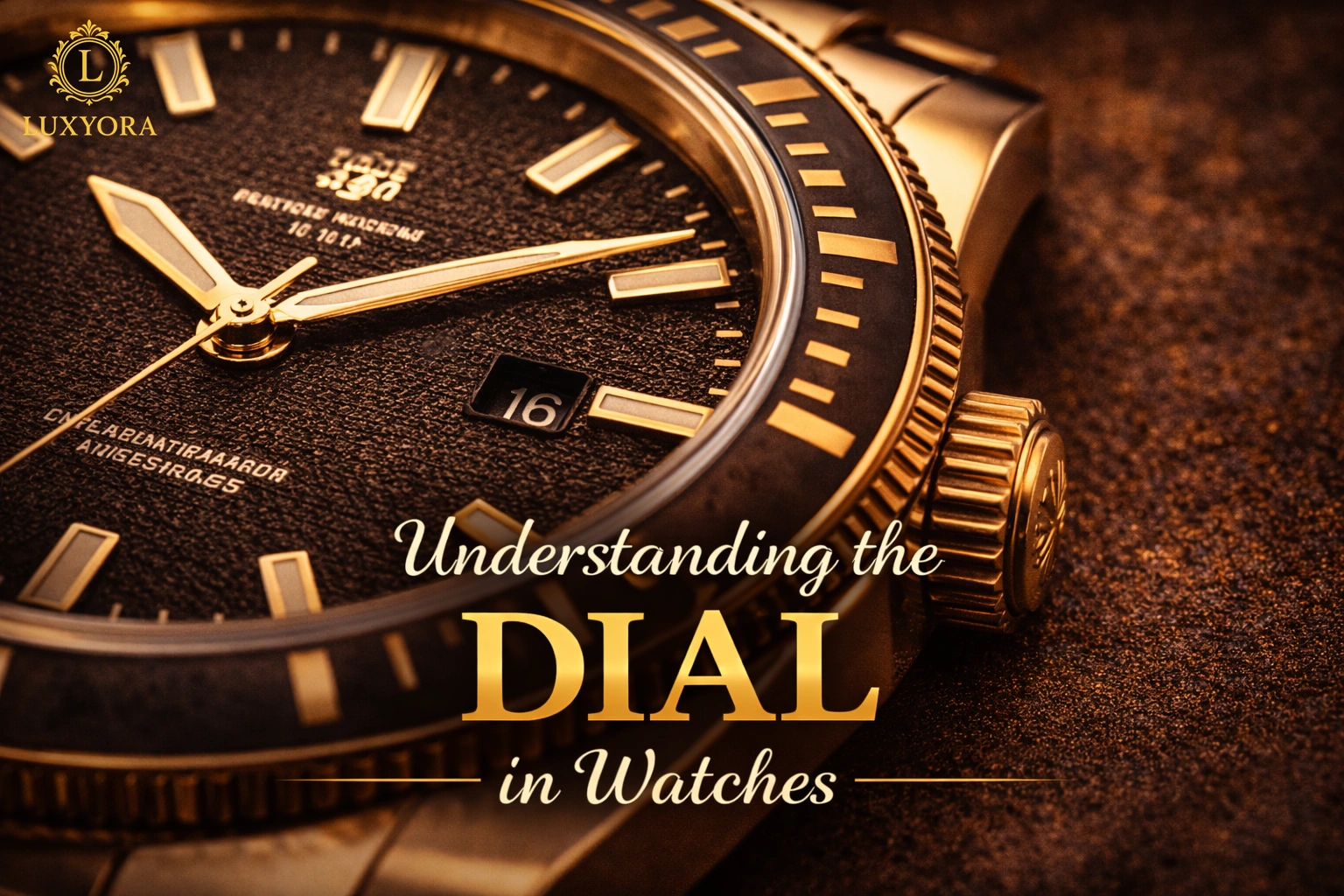
In horology, the dial is the display surface of a watch, commonly called the watch “face” that carries the time indication system (markers, scales, hands) and often showcases the watch’s identity through color, texture, finishing, and typography. While many people think of the dial as purely aesthetic, in professional watchmaking, it is a functional component engineered for legibility, durability, luminous performance, and accurate information layout.
A well-designed dial balances three demands at once:
- Readability (fast, unambiguous time reading),
- Information hierarchy (complications presented clearly), and
- Craft execution (finishing quality and stability over time).
This article explains the industry term “dial” in a structured, educational way, covering dial parts, materials, finishes, lume, and manufacturing processes.
1) What Exactly Is a Watch Dial?
A watch dial is the fixed display plate beneath the crystal and above the movement. It provides the visual reference against which the hands (or other indicators) display time and complications. Modern dials may include multiple layers and applied elements, but their primary purpose is always the same: to communicate time information clearly and attractively.
Collectors and professionals often judge a watch quickly by dial quality because the dial is the component most seen, most interacted with visually, and most likely to reveal cost-cutting or excellence.
2) Core Dial Components and Industry Keywords
A. Hour markers/indices
Indices are the markers that indicate the hours. They can be printed, applied, or cut out depending on style and budget. Different index styles strongly affect both legibility and overall character.
B. Hands
Hands are not technically part of the dial plate, but they are part of the dial display system. The dial design must support the hands (contrast, length alignment to minute track, lume matching). A basic three-hand layout is most common, with extra hands for GMT or chronograph functions.
C. Minute track/chapter ring
A minute track is the scale near the dial edge for precise minute/second reading. Some watches use a separate chapter ring carrying minute/second markings (sometimes called the minute track).
D. Subdials and apertures
Subdials (e.g., small seconds, chronograph counters) and apertures (e.g., date window) require careful spacing and typography to ensure information remains readable at a glance.
3) Dial Materials: What Dials Are Made Of
Many dials begin as a metal base plate (commonly brass), which is then shaped and treated through finishing processes such as stamping/pressing, galvanic treatments, and lacquer application. A technical overview of lacquered dials notes that the base is often brass and may be stamped or machined to create relief features such as sunken counters or patterns.
Beyond metal bases, the broader dial world includes:
- Lacquer (high gloss, deep color)
- Sunburst and matte finishes
- Enamel (high craft, fired finish)
- Mother-of-pearl (iridescent luxury)
- Stone dials (onyx, malachite, etc. in high-end pieces)
Luxury references often treat dial material and finishing as central to a watch’s identity and value perception.
4) Dial Finishes and Textures: Why Light Matters
Dial finishing is the “secret language” of high-quality watches. Texture and finish control how light reflects and how quickly your eye finds the hands and markers.
Common dial finishes include:
- Sunburst (ray) finish: radial brushing that “flares” under light
- Matte / grained: reduces reflections for clarity
- Fumé / gradient: lighter center, darker edges for depth
- Guilloché: engine-turned patterns cut into the dial surface
- Enamel: glass-like depth and permanence
A modern guide to dial finishes emphasizes that true finishes are structural or material-based treatments, not just “printed effects,” and that finishes influence legibility and how the dial looks under changing light.
Guilloché in particular
Guilloché is often associated with traditional craft. A technical feature on guilloché explains how engraved patterns add depth and visual contrast as light plays across the dial surface.
5) Lume on the Dial: Low-Light Readability as a Design Discipline
Lume is luminous material applied to hands and/or hour markers to support readability in dark environments. Many modern watches rely on non-radioactive luminous compounds (often discussed under the umbrella term “Super-LumiNova” in mainstream watch education).
Why does Lume change dial design?
Once you add lume, you must redesign:
- Index geometry (larger plots glow longer)
- Contrast in daylight (lume color vs dial color)
- Hand width and shape (to avoid confusion)
Rolex’s Submariner page describes its Chromalight display and notes the use of simple marker shapes and broad hands for instant reading, especially important in diving contexts.
6) Dial Construction Styles: From Printed to Multi-Layer “Sandwich” Dials
Not all dials are built the same way. The construction affects depth, readability, and durability.
A. Printed dials
Markings are printed directly onto the dial surface (often economical, but can also be done at a very high level with fine pad printing).
B. Applied indices
Metal markers are mounted on the dial, often improving perceived quality and giving dimensionality.
C. Sandwich dials
A sandwich dial uses two layers: a lower layer with luminous material and an upper layer with cut-outs for the numerals/markers so the lume “shines through.” This creates a distinctive stencil-like effect and often improves legibility.
Panerai’s brand history credits Giuseppe Panerai with improving dial legibility using overlapping discs, which we now widely call sandwich dials.
7) How Watch Dials Are Made: A High-Level Manufacturing View
Dial manufacturing is a blend of metalworking, surface chemistry, and printing precision. A brand with dedicated dial expertise (Glashütte Original) describes steps including galvanising/lacquering and pad printing, where ink is transferred via a pad from an etched plate onto the dial for precise text and indices.
Typical dial production stages (varies by brand and technique):
- Base plate forming (stamping or machining relief)
- Surface treatment (brushing, graining, sunburst, galvanic color, lacquer)
- Printing (logos, minute track, text via pad printing)
- Applied parts (indices, logos)
- Quality control (alignment, dust, color uniformity, lume consistency)
This is why “dial alignment” (centered printing, straight indices, clean date window framing) is one of the fastest ways enthusiasts spot quality.
8) How to Evaluate a Dial Like an Expert (Buyer/Collector Checklist)
When assessing a watch dial, look for:
- Legibility at a glance: Can you read the time instantly in daylight and low light?
- Contrast: Hands vs dial, indices vs background (especially on dark dials).
- Precision of printing: Minute track sharpness, consistent ink density, clean edges.
- Index alignment: Markers centered and evenly spaced; no tilt.
- Finishing consistency: Sunburst rays even, matte grain uniform, no blotches.
- Lume execution: Even application and balanced brightness across hands/markers.
- Design coherence: Complications don’t crowd; typography matches the watch’s intent.
In short: a great dial is not “busy.” It’s hierarchical: your eye first locates the hour/minute, then everything else.
Conclusion
In the watch industry, the dial is the most visible fusion of engineering and art. It is a designed information surface where materials, finishing, printing precision, luminous performance, and layout discipline all work together. Whether you’re looking at a minimalist dress watch, a lume-heavy diver, or a multi-layer sandwich dial, understanding dial anatomy and manufacturing gives you a strong foundation for judging quality and for speaking the language of horology with confidence.
References
Brunner, G. L. (2019). The Watch Book – Compendium. teNeues.
Glashütte Original. (n.d.). Dial manufactory | Expertise in one place. Retrieved February 5, 2026, from the Glashütte Original website. (Glashütte Original)
Kapoor Watch. (2024, November 19). Guilloche dial watches: History, patterns & top picks. (kapoorwatch.com)
Monochrome Watches. (2024, May 3). Technical perspective: The art of guilloché dials (patterns, stamped vs CNC, examples). (Monochrome Watches)
Panerai. (n.d.). History. Retrieved February 5, 2026, from the Panerai website. (Panerai)
Rolex. (n.d.). Submariner Date: Black dial (Chromalight display and legibility). Retrieved February 5, 2026, from the Rolex website. (Rolex)
Stone, G., & Pulvirent, S. (2018). The watch, thoroughly revised: The art and craft of watchmaking. Abrams.
The 1916 Company. (2025, June 5). Watch glossary: Essential terms & definitions (chapter ring / minute track). (The 1916 Company)
Time+Tide Watches. (2021, January 6). Leaders in luminosity—What makes your watch glow in the dark? (ethoswatches.com)
Watchplaza. (2024, December 19). Watch dial guide. (The Watch Plaza)
WatchLab. (2025, July 30). Watch dials 101: Understanding different types & styles. (Watchlab)
Wristler. (2025, July 18). Ultimate guide to watch dial finishes: Texture, craft & value. (wristler.eu)