Case in Watches : What is Case in Watches
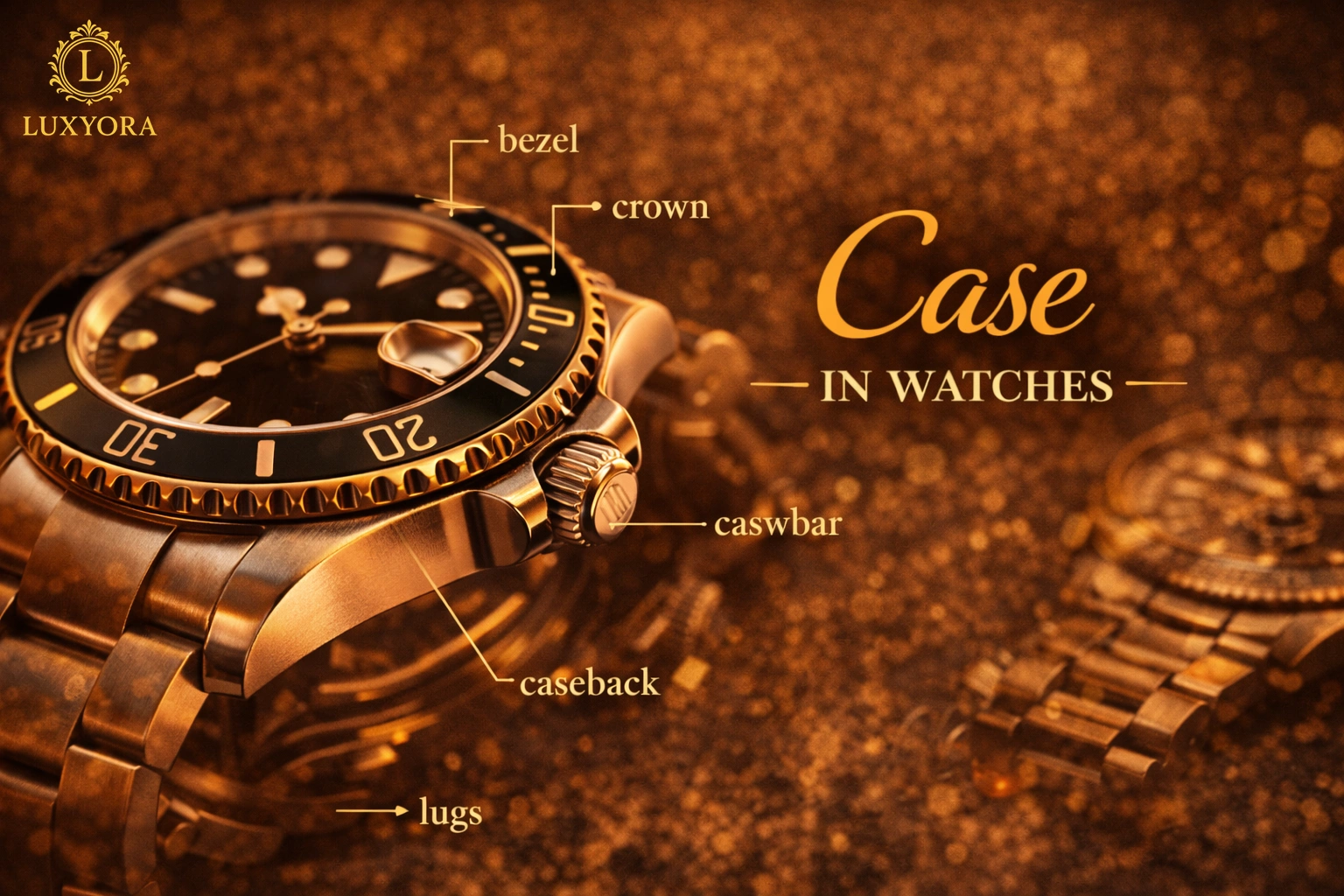
Case : In watchmaking, the case is far more than an outer shell. It is the structural housing that protects the movement and dial, provides the watch’s water resistance, determines wearing comfort, and shapes the watch’s identity through its materials, finishing, and silhouette. In industry terms, the case is where engineering, ergonomics, and aesthetics meet because even the best movement can’t perform reliably if the case doesn’t protect it from moisture, dust, shock, and daily wear.
From a buyer’s perspective, case details explain why two watches with similar movements can feel completely different on the wrist.
From a manufacturing perspective, the case is a precision assembly with tight tolerances, seals, and surface finishes that must withstand years of use.
What Is a Watch Case?
A watch case is the external body that houses and protects the movement, dial, hands, and internal components. It is typically made from metals (steel, titanium, gold), ceramics, or composites and is critical for durability and protection, especially against shock and moisture exposure.
In luxury watch language, “casework” is also a quality marker: crisp edges, uniform brushing, mirror polishing, and precise bezel action often reflect high manufacturing standards.
Core Parts of a Watch Case (Case Anatomy)
A modern case is usually a system of parts, each with a specific job:
Mid-case
The mid-case is the central body that holds the movement and provides attachment points for bezel, caseback, and bracelet/strap via the lugs.
Bezel
The bezel is the ring around the crystal. It may be fixed (dress watches) or functional (diver timing, GMT scales). Many bezels also use an insert (ceramic/aluminum/sapphire) for scales and color.
Crystal (watch glass)
The transparent cover protects the dial (often sapphire crystal in mid- to high-end watches). It works with gaskets to help seal the case.
Caseback
The rear cover that closes the case is commonly screw-down for stronger sealing, or snap-back for simpler designs. Display (exhibition) casebacks include a crystal window to show the movement.
Crown, tube, and gaskets
The crown is a major entry point for moisture and dust. Seals (gaskets) and crown construction (push-pull vs screw-down crown) strongly affect water-resistance performance.
Case Construction Types: How Cases Are Built
Different case architectures are used depending on water resistance targets, service access, and design goals:
- Three-piece case: mid-case + bezel + caseback (common; service-friendly).
- Monocoque (one-piece) cases: movement inserted from the front; can improve structural integrity but complicates servicing.
- Screw-down casebacks and crowns: popular in sports watches to support stronger sealing and pressure resistance.
- Internal bezels: found in some dive and travel watches; the external case profile remains clean, while the internal rotating ring provides timing or scale functionality (often controlled by an additional crown).
Water-Resistance: Why the Case Is a Sealing System, Not Just a Shape
A watch’s water resistance depends largely on its case engineering gaskets, crown sealing, crystal seating, caseback design, and manufacturing tolerances. International standards exist to specify how water resistance should be tested and labeled.
ISO 22810 (Water-resistant watches)
ISO 22810:2010 establishes requirements and test methods for verifying water resistance and specifies the marking that the manufacturer is authorized to apply.
The standard includes tests such as the condensation test (heating the watch and checking for moisture evidence), reflecting the reality that sealing performance must be verified, not assumed.
Important industry nuance: A water-resistance rating is tied to specific test conditions and can be affected over time by gasket aging, impacts, and servicing history, so case maintenance matters as much as the initial rating.
Case Materials: Steel, Titanium, Ceramic, and Modern Composites
Case material is one of the key drivers of weight, scratch resistance, skin feel, and perceived luxury.
Stainless steel
The industry workhorse: strong, corrosion-resistant, and easy to refinish. Steel cases can be brushed, polished, or finished with a mixed finish for contrast.
Titanium
Titanium is prized for its lightweight and comfort and is often used in sports and modern integrated-bracelet designs.
Ceramic
Ceramic cases and bezels are popular for their scratch resistance and color stability. Education in the watch industry increasingly highlights ceramics as a major modern material category.
Carbon composites and forged carbon
Carbon cases emphasize low weight and a technical aesthetic. Recent industry coverage discusses increased interest in forged carbon and other composites in contemporary watchmaking.
Finishing and Case Quality: Brushed, Polished, Bead-Blasted, and Beyond
Finishing isn’t only decorative, it affects how a watch hides scratches and how it visually “wears”:
- Polished: mirror-like shine; shows scratches more easily.
- Brushed/satin: linear grain; hides wear better and feel tool-like.
- Bead-blasted / microblasted: matte texture; modern and stealthy, but can be harder to refinish seamlessly.
Higher-end case finishing often includes sharp transitions between brushed and polished surfaces, consistent grain direction, and clean chamfers.
Ergonomics: Why Case Dimensions Matter More Than You Think
When brands list “case size,” they often cite only case diameter (e.g., 40 mm). But comfort is shaped by multiple case metrics:
- Lug-to-lug length: determines how the watch spans the wrist.
- Thickness: affects cuff fit and perceived bulk.
- Case profile and curvature: can make large watches wear smaller (or vice versa).
- Lug shape and bracelet integration: integrated designs can feel sleek, but are less flexible in the strap.
A well-designed case balances visual presence with daily comfort, which is one reason “case design” is as important as movement choice for long-term satisfaction.
Manufacturing Trends: CNC, New Materials, and 3D Printing
Modern cases are typically produced through a mix of forging/casting, CNC machining, and extensive finishing. In the mid-2020s, watch-industry reporting indicates that 3D printing ismoving beyond prototyping, with independent makers using it to create lightweight titanium cases that challenge traditional manufacturing constraints.
This matters because case innovation increasingly drives product differentiation: brands may share movement suppliers, but unique case engineering (materials, geometry, comfort, finishing) creates a distinct identity.
Conclusion
In watches, the case is the essential interface between a precision mechanism and the real world. It protects the movement, defines water-resistance performance per standards such as ISO 22810, determines comfort through dimensions and geometry, and communicates quality through material selection and finishing. If you learn only one “industry term” beyond movements, make it the case because the case is what you actually live with every day on your wrist.
References
Brunner, G. L. (2023). The Watch Book: Compendium – Revised Edition. teNeues. (Offline reference)
International Organization for Standardization. (2010). ISO 22810:2010 — Horology: Water-resistant watches. ISO. (ISO)
International Organization for Standardization. (2010). ISO 22810:2010 (sample PDF excerpt). (ITeh Standards)
Schmidt, R. (2019). The Wristwatch Handbook: A Comprehensive Guide to Mechanical Wristwatches. ACC Art Books. (Offline reference) (Amazon India)
Teddy Baldassarre. (2023, May 31). Ceramic watches: A brief history and top models. (Teddy Baldassarre)
Wallpaper*. (2026, January). Five watch trends to look out for in 2026 (includes 3D printing and advanced case materials). (Wallpaper*)
Wristler. (2025, August 6). The watch case: Parts, shapes & materials explained. (wristler.eu)
Helveti. (n.d.). Watch Academy: Water resistance of watches at a glance (notes ISO 22810 context and real-world considerations). (Helveti.eu)
Soner Watches. (2025, October 23). Wristwatch dictionary: A–Z guide (definitions for mid-case, bezel, caseback, snap-back, display back). (sonerwatches.com)
SwissWatchExpo. (2025, May 8). Unexpected materials revolutionizing luxury watchmaking in 2025 (composites and material trends). (SwissWatchExpo)