The Best Running Shoes for Beginners | Luxyora
Starting running is a very particular kind of glow-up: one day you’re “just going for a walk,” the next you’re tracking splits, Googling “why do my shins hate me,” and feeling oddly powerful in a ponytail that means business. The secret weapon for making this era feel chic (not chaotic) is the right pair of running shoes because beginners don’t need “the fastest shoe.” They need the easiest shoe to love.
Let’s talk about what actually matters when you’re new: comfort that stays comfortable at minute 25, stability that doesn’t feel like a cast, cushioning that doesn’t turn you into a wobbly baby deer, and a fit so good you forget you’re wearing shoes at all.
The real beginner agenda: comfort first, always
If you take one rule and write it on your mirror in lip liner, make it this: fit beats features. Even the most engineered foam won’t save a shoe that’s too tight in the toe box or slipping at the heel. REI’s expert guidance is blunt for a reason: fit is the most important factor when choosing running shoes.
A few fit cues that tend to work for most beginners:
- Try shoes later in the day when feet are slightly swollen (very normal).
- Expect brand sizing to vary; don’t be shy about going up or down a half size.
- Aim for secure heel hold + roomy toes (your toes should not be negotiating for space).
A beginner’s running shoe should feel supportive from the very first step. Yet the secret to finding that comfort often lies in a detail many runners overlook before they ever lace up. Read more about How to Choose the Right Shoes for Your Foot Type.
The beginner shoe “types” that make shopping simpler
Running stores can feel like a wine list written by engineers. Here’s the translation.
1) Daily trainers (the “first-date” shoe)
This is your everyday, do-it-all option: moderate cushioning, reliable grip, and a feel that’s friendly at slow paces. Beginners usually thrive here because daily trainers are designed to be stable, comfortable, and forgiving across short jogs and longer run-walk sessions. REI breaks down how uppers, midsoles, and outsoles work together so you can choose based on feel, not hype.
Beginner-friendly examples that recur in independent testing roundups include models like the ASICS Novablast and the Brooks Ghost as approachable daily trainers.
2) Stability / motion-control shoes (the “steadying hand”)
If your ankles feel like they’re auditioning for a plot twist, rolling inward a lot, collapsing, or you’ve been told you “overpronate,” a stability shoe can feel instantly calming. The research here is nuanced, but one strong, practical takeaway: a randomized trial found that motion-control shoes reduced the risk of pronation-related injuries compared with neutral shoes among recreational runners.
That doesn’t mean everyone needs stability (many runners do perfectly well in neutral shoes), but if stability feels better on your body, that matters.
Common beginner-friendly stability picks in test guides include the Brooks Adrenaline GTS.
3) Max-cushion shoes (the “pillow with posture”)
Max cushioning is the soft-launch into running, especially if you’re transitioning from walking, you’re on hard pavement, or you simply want comfort that feels luxurious. But a gentle warning from sports-medicine guidance: the goal isn’t for the shoe to “do the work of the foot” with excessive support; it should complement you, not replace your mechanics.
A max-cushion option can be great, just make sure it still feels stable under you (no wobble, no side-to-side drama).
A quick reality check on “pronation” and injury hype
The internet loves a label. Overpronation, supination, heel striker, midfoot striker, suddenly, you’re diagnosing yourself in your hallway mirror.
Two helpful truths:
- There’s limited evidence that anti-pronation shoes automatically reduce overall running injuries for everyone.
- Reviews of the broader research suggest that shoe designs may influence mechanics, but injury prevention isn’t guaranteed by a single feature. Translation: pick what feels best and supports your specific needs.
If you can, do a simple gait/fit check at a specialty store, or take a short video of yourself jogging and look for obvious collapsing/rolling. And if something hurts sharply or persistently, loop in a physio.
Beginner shopping checklist: what to look for, in plain language
Here’s your expert-approved “buying filter”:
- Comfort in the first 30 seconds: You shouldn’t need a “break-in era” to tolerate them.
- Toe room: Your toes want space to splay (especially on longer sessions).
- Heel lockdown: No slipping, no blisters-in-waiting.
- Stable platform: Especially if you’re new, a shoe that feels predictable is everything.
- Use-case match: Road running shoes for pavement; trail shoes for dirt/rocks/roots (REI outlines why they’re built differently).
A few beginner “best picks” by vibe (not just by brand)
Because yes, you want options, and you want them framed like a closet edit.
The “I just want a reliable daily shoe”
Look for daily trainers highlighted in independent test roundups; models like Brooks Ghost and ASICS Novablast frequently appear for beginner-friendly comfort.
The “my feet need a little guidance”
Consider stability classics such as the Brooks Adrenaline GTS; motion control can reduce pronation-related injury risk in certain runners.
The “I want soft landings and a luxury feel”
Max-cushion road shoes are often recommended for comfort-focused runners, with many tested lists including beginner-friendly picks that are still stylish.
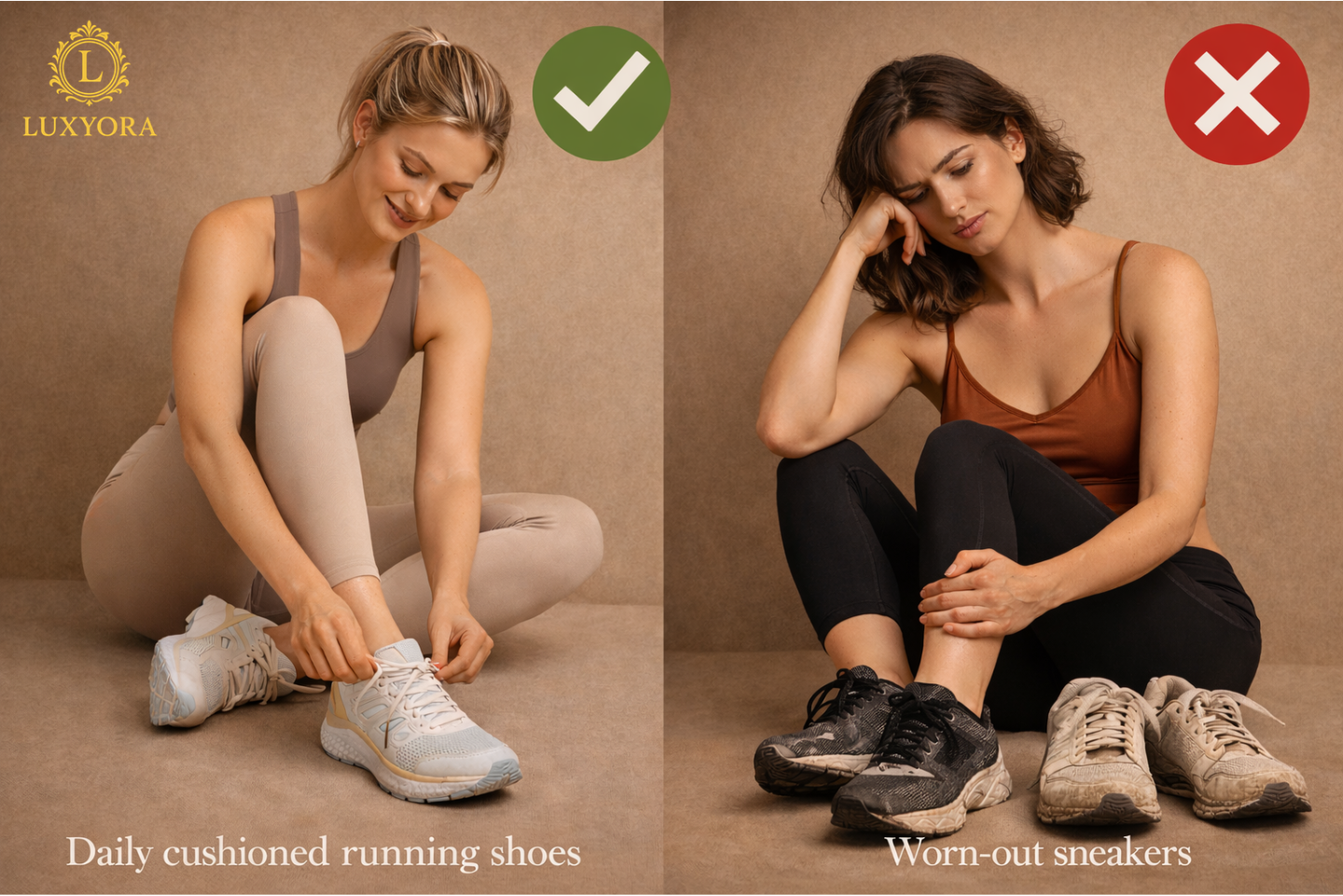
When to replace your shoes (so your knees don’t file a complaint)
Even the best shoes have an expiration date. Many expert guides cite a 300 – 500 mile (500 – 800 km) lifespan for typical running shoes, depending on the model and how/where you run.
If you’re not tracking mileage, watch for:
- Flattened cushioning (“the bounce is gone”)
- New aches that appear despite similar training
- Visible outsole wear or tilting
The most underrated beginner trick: rotate + transition slowly
If you’re buying your first real running shoe after years of casual sneakers, ease into it. Research and expert commentary on injury patterns increasingly point to sudden changes in training load and sometimes gear as a risk factor.
A simple strategy: start with short runs, alternate walk-run, and consider rotating two pairs once you’re running regularly.
Luxyora Philosophy: The best running shoe is the one that keeps you showing up comfortably, confidently, and consistently. Style is the sparkle; sustainability is the habit.
References:
- American College of Sports Medicine. (2018). Selecting running shoes (Exercise is Medicine resource). (My Active Journey)
- Jafarnezhadgero, A. A., et al. (2019). Effects of anti-pronation shoes on lower limb kinematics and kinetics during running (PMC article). (PMC)
- Mayo Clinic Health System. (2023, January 18). Expert tips for running shoe fit. (Mayo Clinic Health System)
- Mayo Clinic Health System. (2023, January 4). Planning for your big run (shoe lifespan guidance). (Mayo Clinic Health System)
- Relph, N., et al. (2022). Running shoes for preventing lower limb running injuries in adults (Review; PMC). (PMC)
- REI Co-op. (2025, November 11). How to choose running shoes (Expert advice). (REI)
- Vogue. (2024). The best running shoes for women, tested by runners. (Vogue)
- Willems, T. M., et al. (2021). Motion-control shoes reduce the risk of pronation-related running injuries in recreational runners. Journal of Orthopaedic & Sports Physical Therapy. (PubMed)
- RunRepeat. (2025). Best running shoes for beginners (Lab & wear testing guide). (#1 Athletic Shoe Review Site)
- Nike. (2025, March 22). How often should I replace my running shoes? (Nike.com)