Neroli : What is Neroli
Neroli is one of the most iconic raw materials in perfumery and modern beauty, recognized for its fresh, floral-citrus aroma and its association with luxury skincare, fine fragrance, and aromatherapy rituals. In industry terms, neroli typically refers to the essential oil distilled from the blossoms of the bitter orange tree (Citrus aurantium), not the fruit peel oil or leaf oil. Its prestige derives from both sensory beauty and production realities: it requires a large quantity of delicate blossoms to yield a small amount of essential oil, making neroli a high-value ingredient in many fragrance formulas and “hero-note” products.
Its prestige derives from both sensory beauty and production realities: it requires a large quantity of delicate blossoms to yield a small amount of essential oil, making neroli a high-value ingredient in many fragrance formulas and “hero-note” products.
1) What is Neroli?
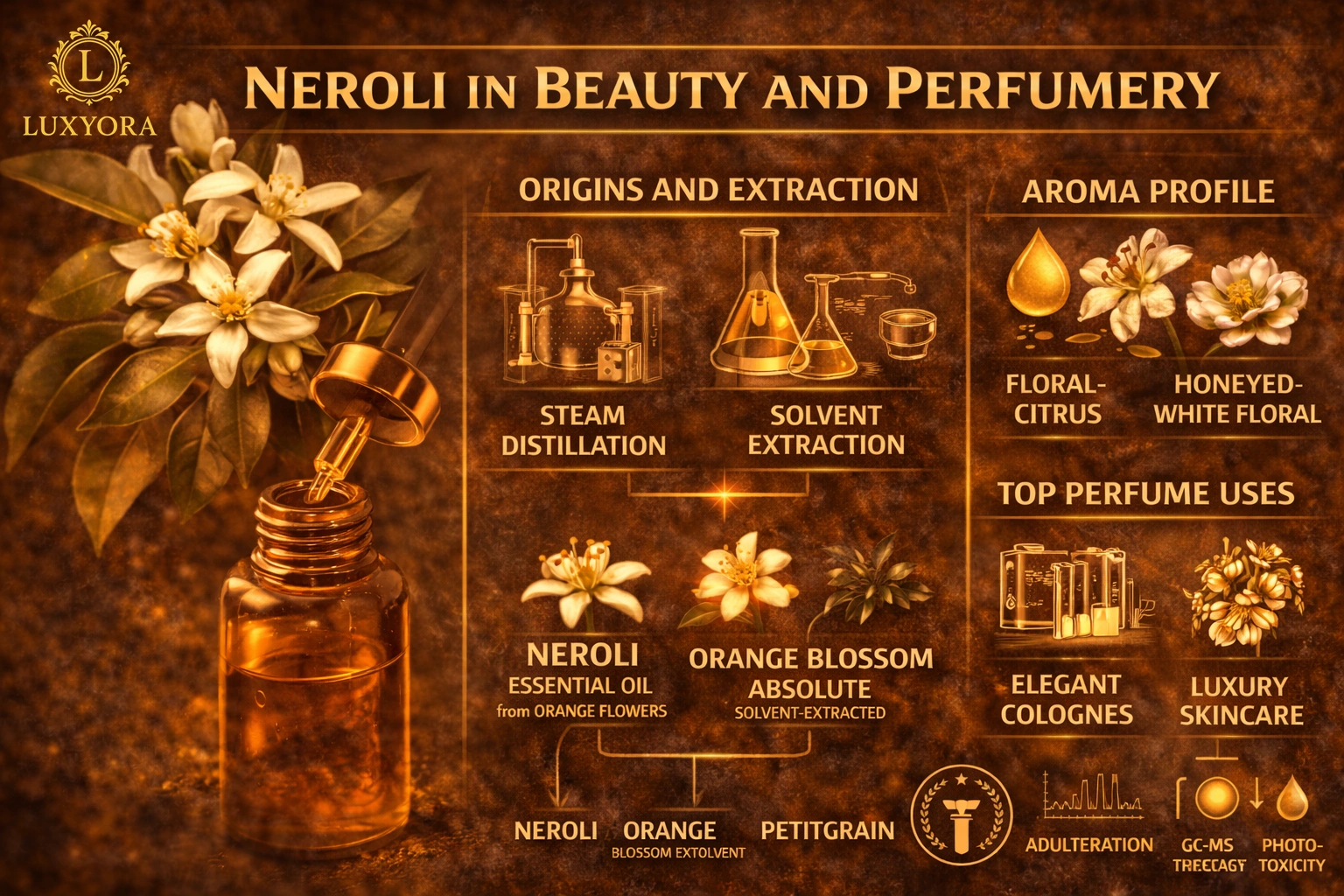
In professional beauty and fragrance language, neroli oil is the steam-distilled essential oil of bitter orange flowers (Citrus aurantium). It is often discussed alongside two related materials from the same tree:
- Orange blossom absolute (also called orange flower absolute): a solvent-extracted material from blossoms, usually richer, heavier, and more intensely floral than neroli.
- Petitgrain: an essential oil typically distilled from the leaves and twigs, usually greener and more herbaceous than neroli.
A key industry insight is that the same botanical source can yield markedly different scent materials depending on the extraction technique and plant part used. This is why perfumers treat neroli and orange blossom absolute as distinct creative tools.
2) How Neroli is Produced: Why It’s a Premium Ingredient
Steam distillation (classic neroli)
Most commercial neroli is produced by steam distillation of fresh blossoms. Distillation typically yields a material that appears bright, fresh, and airy, with a slightly green hue, which is why neroli is frequently used to create clean, radiant top-to-heart transitions in fragrance.
Solvent extraction (orange blossom absolute)
Orange blossom absolute is commonly produced by solvent extraction, which captures heavier aromatic compounds. In perfumery discussions, it’s often described as more narcotic, sweet-floral, and dense compared to neroli despite coming from the same blossoms.
Beauty keyword cluster: steam-distilled essential oil, solvent extraction, absolute, floral-citrus, green facets, diffusion, sillage, top notes, heart notes.
3) Aroma Profile: What Does Neroli Smell Like?
Neroli is typically described as:
- citrusy and luminous
- lightly bitter/green
- honeyed white-floral
- clean and aromatic
Consumer-facing fragrance databases classify neroli within citrus and highlight its “light, slightly bitter” orange blossom character.
A perfumer interview in a mainstream beauty publication also describes neroli as a fresh, citrusy, slightly green distillation from orange flowers, contrasted with the heavier orange-flower absolute.
Where it appears in perfume structures
- Colognes and “eau fraîche” styles: for clean, sparkling lift
- White-floral bouquets: to add transparency and realism
- Chypres / modern musks: neroli can brighten mossy/woody bases
- Mediterranean-style compositions: paired with bergamot, petitgrain, herbs, and woods
4) Chemistry and Quality Markers: What’s Inside Neroli?
From a chemistry standpoint, bitter orange flower essential oil is often rich in linalool and related aroma compounds, with contributions from limonene, linalyl acetate, and other terpenes and oxygenated compounds. A 2025 scientific review of Citrus aurantium flowers summarizes this general compositional pattern and notes variability across geographic regions, harvests, and processing methods.
Authenticity and adulteration (a major industry topic)
Because neroli is expensive, adulteration and non-compliance are real commercial risks. A 2021 study analyzing neroli essential oils discusses the use of reference specifications and chemical profiling to evaluate authenticity and detect adulteration patterns.
Beauty keyword cluster: GC–MS profiling, authenticity testing, adulteration, traceability, batch variability, terroir, compliance.
5) Neroli in Beauty Products: Why Brands Use It
A) Fine fragrance and body mists
Neroli is valued for “instant freshness” and elegant diffusion. It is often used to make fragrances feel:
- cleaner
- more natural and sunlit
- more sophisticated (especially in premium colognes and modern florals)
B) Skincare (fragrance + sensorial positioning)
In skincare, neroli is used primarily as:
- a fragrance ingredient (providing a premium sensorial identity)
- a storytelling ingredient (heritage, Mediterranean botanicals, “self-care” ritual)
The broader essential-oil literature in cosmetics and personal care notes that essential oils are widely employed for fragrance and sensory effects, with careful safety evaluation and formulation discipline.
C) Haircare and scalp products
Neroli appears in shampoos, conditioners, and scalp oils mainly for:
- luxury scent profile
- “fresh-clean” aromatic styling
pairing well with citrus/herbal notes and musks
6) Aromatherapy and Wellbeing Claims: What Does Evidence Suggest?
Neroli is frequently marketed as calming, but the evidence quality varies by context and study design. Still, recent clinical research continues to explore neroli-containing aromatherapy for stress and discomfort. For example, a 2025 randomized trial using lavender–neroli aromatherapy reported reductions in anxiety-related measures in a dental setting compared with control conditions.
Another 2025 clinical study examined inhalation aromatherapy with neroli oil for dysmenorrhea pain intensity.
Practical, reader-safe framing: These studies support potential calming/comfort associations, but they do not guarantee outcomes for all users or across all cosmetic product formats.
7) Safety in Cosmetics: Sensitization, Phototoxicity, and Responsible Formulation
Phototoxicity: neroli vs citrus peel oils
A common consumer confusion is mixing up bitter orange peel oil (more associated with phototoxic furocoumarins in some citrus materials) with flower-derived neroli. A 2021 Cosmetic Ingredient Review (CIR) safety assessment of citrus flower- and leaf-derived ingredients provides safety context for cosmetic use of these materials, including discussion of phototoxicity/photosensitization evidence across the ingredient group.
Fragrance allergens and oxidation
Like many essential oils, neroli contains constituents (e.g., linalool, limonene) that can oxidize over time and may increase the risk of skin sensitization in susceptible individuals. One reason good manufacturing practices, antioxidants, proper packaging, and compliant labeling matter in beauty formulation is that they help ensure product safety and quality. Broader cosmetics-focused reviews discuss essential oils and their constituents in cosmetic contexts, including safety considerations.
IFRA: category-based usage guidance
Fragrance industry practice often references IFRA guidance and category limits for fragrance materials. Supplier-issued IFRA conformity certificates (based on IFRA amendments) illustrate how neroli is commonly treated within category-specific maximum use levels for different product types.
Consumer guidance (educative tone):
- If you have sensitive skin, prefer leave-on products, and the brand discloses compliant fragrance usage, patch-test first.
- Keep essential oils properly stored (cool, dark, sealed) to reduce the risk of oxidation.
- “Natural” does not automatically mean “non-irritating” dose and formulation matters.
References
Başer, K. H. C., & Buchbauer, G. (Eds.). (2021). Handbook of Essential Oils: Science, Technology, and Applications (3rd ed.). CRC Press. (Routledge)
Sarkic, A., & Stappen, I. (2018). Essential oils and their single compounds in cosmetics—A critical review. Cosmetics, 5(1), 11. (MDPI)
Abdalhai, R., et al. (2025). Lavender–neroli aromatherapy for reducing dental anxiety: A randomized controlled trial. [Journal/Repository]. (PMC)
Burnett, C. L., et al. (2021). Safety assessment of citrus flower- and leaf-derived ingredients as used in cosmetics. International Journal of Toxicology. (SAGE Journals)
Fernández-Cabal, J., Avilés-Betanzos, K. A., Cauich-Rodríguez, J. V., Ramírez-Sucre, M. O., & Rodríguez-Buenfil, I. M. (2025). Recent developments in Citrus aurantium L.: An overview of bioactive compounds, extraction techniques, and technological applications. Processes, 13(1), 120. (MDPI)
Pierson, M., et al. (2021). Type and magnitude of non-compliance and adulteration in essential oils. [Open-access repository article]. (PMC)
Seyyedi-Mansour, S., et al. (2025). Citrus aurantium flowers: Overview of chemistry and bioactivity. [Open-access review article]. (PMC)
Zanjan University of Medical Sciences. (2025). Effect of inhalation aromatherapy with neroli oil on dysmenorrhea pain intensity: A randomized clinical trial (PDF). (nmcjournal.zums.ac.ir)
Allure. (2019). Perfumer interview discussing neroli vs orange flower absolute and related bitter orange materials in fine fragrance. (Allure)
Fragrantica. (2018–2026). Neroli note profile (industry-facing consumer reference). (Fragrantica)
NHR Organic Oils. (2024). IFRA 51 conformity certificate: Organic neroli essential oil (supplier documentation). (nhrorganicoils.com)