Natural vs Synthetic Perfumes : Which Is Better for You? | Luxyora
Somewhere along the way, “natural perfume” became the beauty world’s shorthand for cleaner, safer, more virtuous. And “synthetic” got treated like the villain in a glass bottle, mysterious, chemical, suspicious.
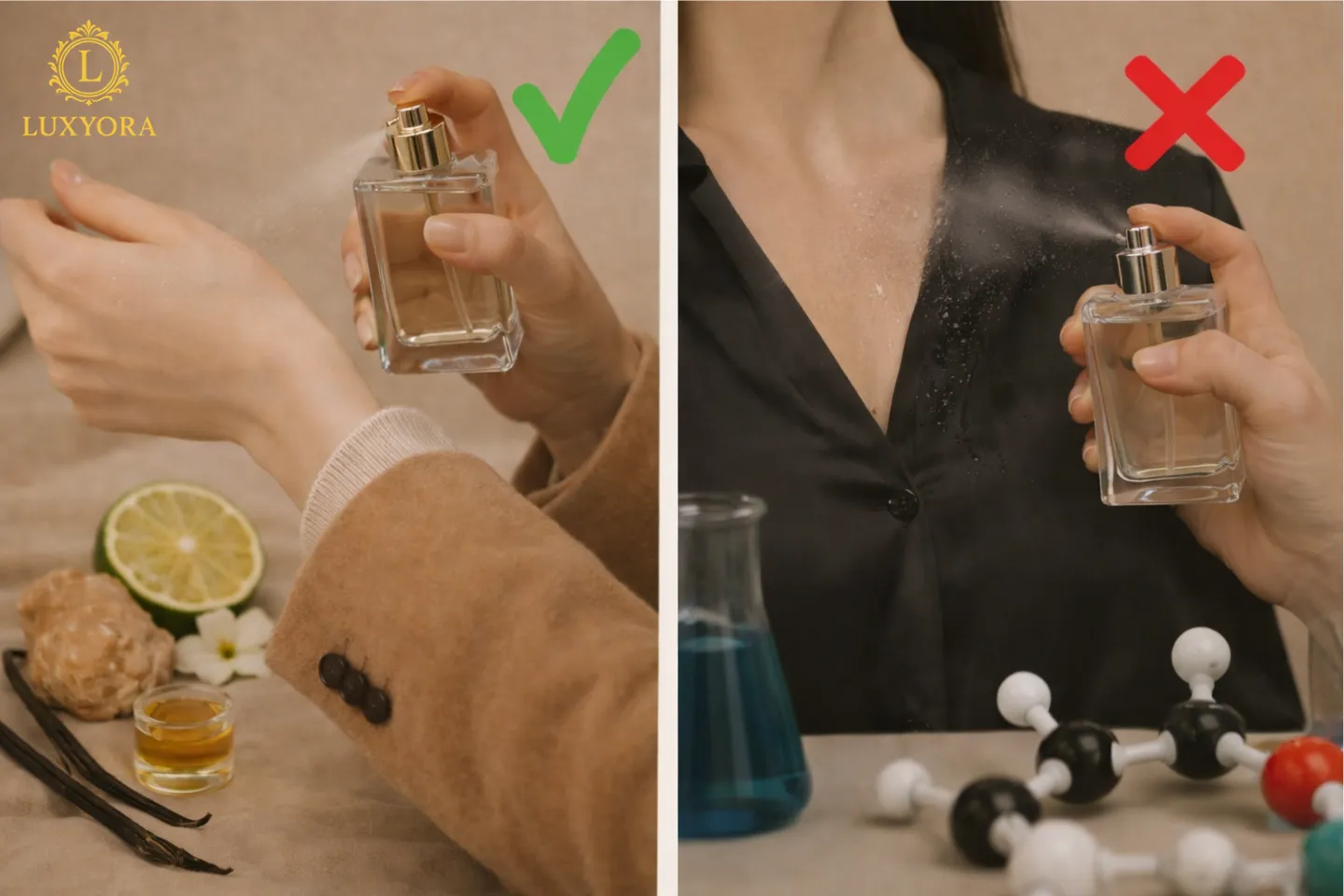
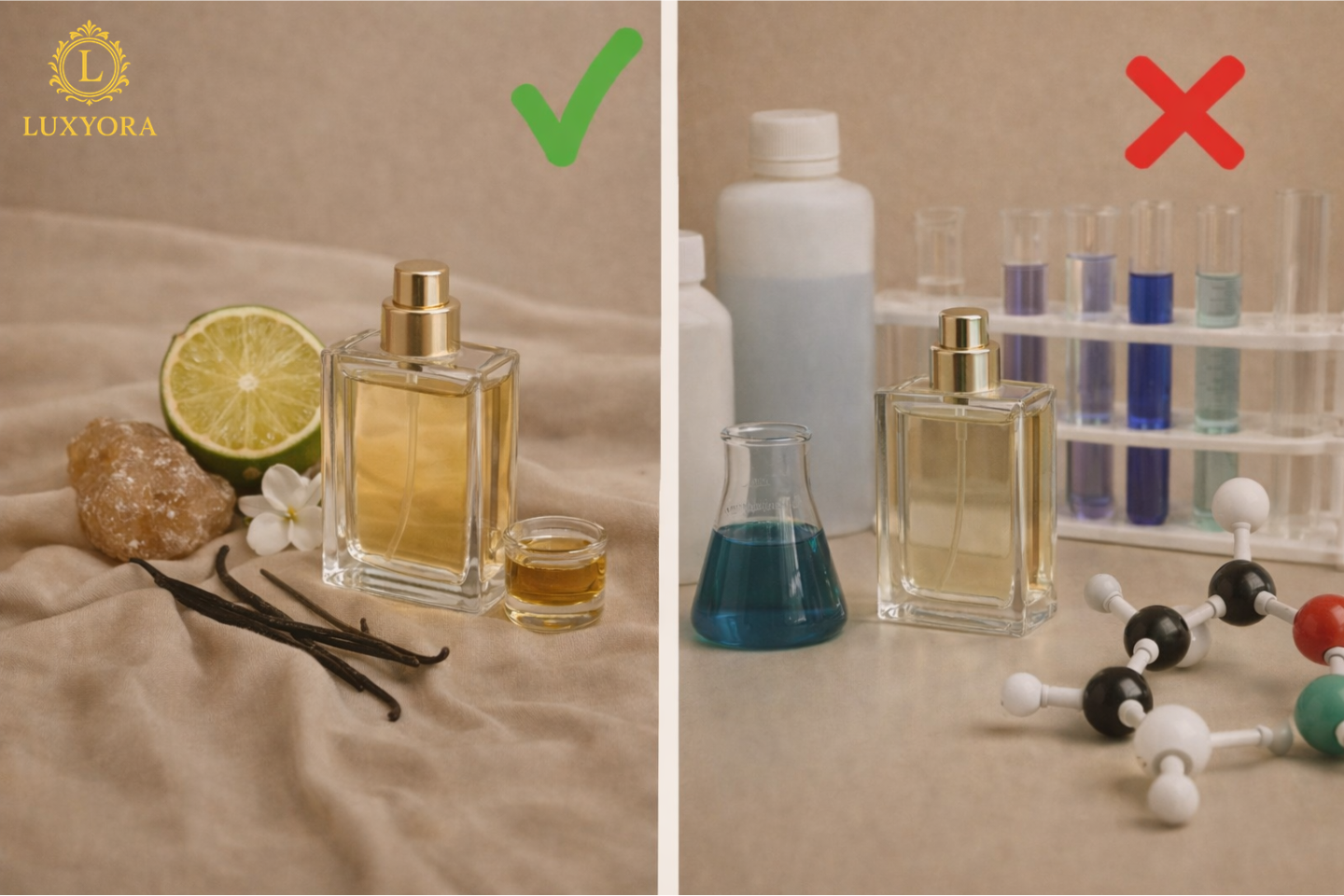
But fragrance is a little more nuanced (and a lot more interesting) than that. In perfumery, natural vs synthetic isn’t a moral debate; it’s a toolkit choice. And the “better” perfume for you depends on your skin, your values, and how you actually want your scent to perform from 9 a.m. to last call.
Let’s decode it in a way that feels like Vogue: polished, practical, and gently glamorous without falling for myths.
First, what do “natural” and “synthetic” actually mean?
Natural perfume ingredients typically come from plants (and sometimes other natural sources) via methods like steam distillation (essential oils) or solvent extraction (absolutes). These materials can be complex, meaning a single essential oil may contain dozens (even hundreds) of naturally occurring chemical constituents.
Synthetic perfume ingredients are aroma molecules made in a lab. They might:
- replicate a scent found in nature (nature-identical), or
- create smells that don’t exist naturally (the “perfumer’s imagination” category).
Modern perfumery relies on both. As Chemical & Engineering News describes, perfumers work with thousands of compounds, and only a small fraction comes directly from natural sources because chemistry has dramatically expanded what fragrance can be.
Myth #1: “Natural perfumes are safer”
Not necessarily.
Safety in fragrance is about dose, exposure, and how an ingredient behaves, not whether it grew in soil or was made in a beaker. IFRA (International Fragrance Association) addresses this directly in its consumer Q&A, noting that “natural” doesn’t automatically mean safer; natural ingredients can still be allergenic or irritating.
A key point many people miss: because naturals are complex mixtures, they can contain naturally occurring allergens (like certain citrus or floral constituents) that are also regulated and managed in perfumery. IFRA’s Standards and guidance include attention to “natural complex substances” (like essential oils) and their restricted constituents.
Translation:
If you have sensitive skin, eczema, fragrance allergies, or migraines, “natural” isn’t automatically your safest bet. What matters more is:
- how the perfume is formulated,
- whether allergens are managed responsibly,
- and how your body responds to that specific blend.perfu
Myth #2: “Synthetic perfumes are harsher”
Also, not necessarily.
“Synthetic” gets blamed for irritation because it’s vague; people imagine it means “unknown chemicals.” But synthetic aroma materials are often used for consistency, stability, and safety control. As experts explain, the industry uses standards based on scientific evaluation to manage safe use levels.
And from a perfumer’s perspective, synthetics can be the reason a fragrance feels smooth rather than sharp because they help balance compositions and create cleaner transitions.
The world of fragrance is filled with widely accepted beliefs, yet some of the most repeated perfume “facts” are far more complicated than they seem. Discover what is true and what deserves a second look in Common Perfume Myths: True vs False.
That said, any fragrance (natural or synthetic) can irritate someone. Your skin doesn’t care about marketing; it cares about chemistry and exposure.
Performance: what lasts longer (and smells more “expensive”)?
If you’re choosing purely by performance longevity, projection, and staying power, synthetics often have an edge. Many synthetic molecules are designed to be stable and persistent, while natural materials can be more delicate and variable from batch to batch.
This is why purely natural perfumes sometimes:
- fade faster,
- smell softer and closer to the skin,
- change more noticeably between batches or seasons.
That isn’t a flaw; it can be part of the charm. Natural perfumes can feel alive and intimate, like a silk slipdress instead of a structured blazer. But if you want a scent that stays put through a full day, a formula that includes synthetics (or is primarily synthetic) may be more satisfying.
Sustainability: the answer isn’t as simple as “natural = green”
This is where things get really interesting.
Natural ingredients can face real environmental pressures: land use, water use, crop vulnerability, and sometimes overharvesting. Synthetic alternatives can reduce demand for scarce natural resources and protect biodiversity, which is one reason the industry tries to balance both approaches.
On the flip side, synthetics have their own footprint: energy use, chemical feedstocks, and manufacturing impacts. “Better for the planet” depends on how something is produced, not just what category it falls into.
A modern, responsible take is often:
The most sustainable perfume is the one made with transparent sourcing, smart formulation, and responsible manufacturing, whether natural, synthetic, or blended.
Creativity: naturals feel “real,” synthetics feel “editorial”
Here’s the fun part: aesthetics.
- Naturals tend to feel textured and nuanced: a rose that smells like petals and stems, citrus that feels like zest and sunshine, woods that feel slightly smoky and worn-in.
- Synthetics unlock the high-fashion side: clean musks that smell like “skin but better,” sparkling aldehydes, futuristic ambers, and notes that don’t exist in nature but feel emotionally real.
If naturals are couture embroidery, synthetics are architectural tailoring. Both can be gorgeous.
The beauty of a perfume often lies in its transformation from the fleeting opening impression to the lingering trail that remains hours later. Explore the hidden structure behind this evolution in Understanding Perfume Notes: Top, Middle & Base Notes Explained.
So… which is better for you?
Choose mostly natural perfume if you:
- love soft, botanical, “close to nature” scent profiles
- don’t mind reapplying (and prefer intimate projection)
- care deeply about plant-based sourcing and can verify the brand’s transparency
- tolerate essential oils well on your skin
Pro tip: Patch test first. Naturals can still trigger reactions.
Choose mostly synthetic (or blended) perfume if you:
- want stronger longevity and consistent performance
- love modern “skin scents,” clean musks, or complex abstract notes
- want formulas that can be carefully controlled for allergens and stability
- prefer reliability (same bottle, same scent, every time)
Choose a blended perfume if you:
- want the best of both worlds (this is the most luxurious fragrance, honestly)
- like naturals for beauty and depth, and synthetics for structure and staying power
- want a perfume that feels rich, balanced, and wearable daily
How to shop smarter (and avoid being fooled by labels)
- Don’t worship the word “natural.” It’s not a safety guarantee.
- Look for transparency: allergen info, IFRA compliance language, sourcing, or sustainability statements. Test on skin for a full day. The “right” perfume should still feel like you at hour six.
- If you’re sensitive: consider fragrance-free body care and keep perfume on clothes (if safe for fabric), or use lighter application.
Luxyora Philosophy: Nature and science aren’t rivals; they’re collaborators. Choose the perfume that respects your skin, suits your life, and makes you feel unmistakably like yourself.
References:
- Bomgardner, M. M. (2019, April 21). How perfumers walk the fine line between natural and synthetic. Chemical & Engineering News. (Chemical & Engineering News)
- International Fragrance Association. (n.d.). IFRA Standards. Retrieved December 21, 2025, from IFRA website. (IFRA)
- International Fragrance Association. (n.d.). Questions about fragrance: Are natural fragrances better or safer than synthetic ones? Retrieved December 21, 2025, from IFRA website.(IFRA)
- International Fragrance Association. (n.d.). Allergens. Retrieved December 21, 2025, from IFRA website. (IFRA)
- Research Institute for Fragrance Materials (RIFM) & International Fragrance Association (IFRA). (2019). Guidance for the use of IFRA Standards (PDF). (RIFM)
- Sharmeen, J. B., Mahomoodally, M. F., Zengin, G., & Maggi, F. (2021). Essential oils as natural sources of fragrance compounds for cosmetics and cosmeceuticals. Molecules, 26(3), 666. (PMC)