No products in the cart.

Miu Miu emerged at a significant point in Miuccia Prada’s career. By the early 1990s, Prada had already developed an influential design language built around unconventional materials, intellectual restraint and a willingness to reconsider accepted ideas of beauty. Miu Miu gave the designer another space in which to work, one that could feel more spontaneous, intimate and emotionally immediate.
The brand’s early collections introduced earthy suede, fringe, cowhide references and prairie-influenced shapes into the luxury conversation. These designs did not follow the polished glamour commonly associated with early-1990s fashion. Instead, they expressed a tactile, characterful form of dressing in which familiar garments were made distinctive through material, proportion and attitude. Contemporary reporting from 1993 noted the prominent use of natural-looking suede and hand-worked fringe, details that helped establish the label’s early identity.
Although Miu Miu was initially priced and positioned differently from Prada, it developed its own visual identity from the beginning. The Prada Group now describes the brand as originating from Miuccia Prada’s independent and unconventional spirit, while Vogue has observed that it has evolved decisively as a stand-alone house. Calling it simply Prada’s “little sister” therefore understates the creative authority Miu Miu has built over time.
The event’s authority is inseparable from the history of organised fashion in France. The FHCM traces its institutional lineage to the Chambre Syndicale de la Couture, established in 1868. It became the Chambre Syndicale de la Couture Parisienne in 1910, while the legal framework governing the haute couture designation was formalised in 1945.
A further structural change occurred on 8 October 1973, when separate organisations representing womenswear and menswear ready-to-wear were created. The federation bringing the different branches together was founded on the same date. In June 2017, it adopted its present name: the Fédération de la Haute Couture et de la Mode.
Today, the federation operates through three constituent bodies devoted to haute couture, womenswear and menswear. It describes itself both as a selective professional organisation serving its members and as an events organisation responsible for coordinating Paris Fashion Week and Haute Couture Week. This dual role explains why Paris Men’s Fashion Week is more than a sequence of individual brand events. It is a formally constructed calendar supported by selection procedures, professional services and shared industry standards.
Miu Miu’s early runway history helped define the house’s personality. By the middle of the 1990s, the brand was presenting collections in New York. Its Spring/Summer 1996 show opened with Chloë Sevigny, then closely associated with the independent cultural energy of downtown New York. Her presence was particularly well suited to a house interested in individuality rather than conventional perfection.
The collection is now remembered as an early expression of the Miu Miu character: youthful without being naïve, feminine without becoming overly formal and carefully styled without appearing rigid. The importance of the show lies not in one garment alone, but in the kind of person it imagined: curious, self-possessed and comfortable with clothes that felt personal rather than prescribed.
A further step towards independence came in 2006, when Miu Miu moved its womenswear presentation from Milan to Paris. After the Fall/Winter 2006 show, Miuccia Prada explained that the move was intended to make Miu Miu more special and important. Staging the collection in the intimate rooms of the Parisian restaurant Lapérouse gave the presentation a world of its own and reinforced the brand’s increasingly autonomous position.
Miu Miu’s identity is often explained through contrast. Tailoring can be worn with delicate knitwear. Practical outerwear may accompany a satin dress. A formal shoe can pair with a ribbed sock, while a polished handbag can be styled with clothes that seem relaxed or gently lived-in. The result is not inconsistency but a deliberate refusal to reduce femininity to one approved image.
This approach also separates Miu Miu from simplistic ideas of youthfulness. The brand does not merely make younger versions of established luxury products. It examines the gestures, memories and visual codes associated with growing up, dressing for work, attending school, playing sport or preparing for an evening out. Uniforms, cardigans, pleated skirts, loafers, lingerie, coats and sportswear are frequently reconsidered as materials for personal expression.
The intelligence of Miu Miu lies in the way these recognisable objects are adjusted. A hem is shortened, a shirt is cropped, a jacket is enlarged, or a traditional shoe is finished in an unexpected material. Small changes in scale or styling can alter the emotional meaning of the entire look. This sensitivity to proportion has become one of the house’s most influential creative tools.
Miu Miu’s Spring/Summer 2022 collection became one of the defining fashion moments of the early 2020s. The collection began with archetypes of everyday dress trousers, shirts, sweaters, blazers and suits and transformed them through cutting and reconstruction. Trousers became abbreviated skirts, shirts and knits were cropped, raw edges remained visible, and elements of construction were intentionally exposed.
The most widely recognised look combined a cropped shirt or sweater with a very low-rise pleated micro-mini. Its impact came from the collision of familiarity and reinvention. Materials associated with conventional office or uniform dressing were changed through proportion, creating an image that was immediately recognisable but difficult to confuse with anything else.
The look travelled rapidly from the runway into magazine covers, celebrity styling, digital culture and fashion retail. According to the Lyst Index, the viral skirt moment contributed to a 400% increase in searches for Miu Miu over three months, moving the brand ten places higher in its ranking during the first quarter of 2022. The collection demonstrated Miu Miu’s ability to create a runway image that could become both a cultural symbol and a commercial catalyst.
Its significance extended beyond the return of a short skirt. The collection proposed that familiar clothing could be made new through decisive editing. It also established a visual vocabulary of cropped layers, visible construction, low waists and contrasts between strict fabrics and exposed skin that influenced fashion imagery well beyond the original season.
Footwear has played an equally important role in Miu Miu’s recent influence. The brand’s satin and leather ballet flats helped bring ballet-inspired dressing back into the centre of fashion during 2022. Styled with socks, casual trousers, knitwear or evening pieces, the shoes were presented not as literal dancewear but as flexible objects capable of moving between softness, practicality and playful elegance. Fashion editors and cultural commentators subsequently identified Miu Miu as an important force within the wider balletcore movement.
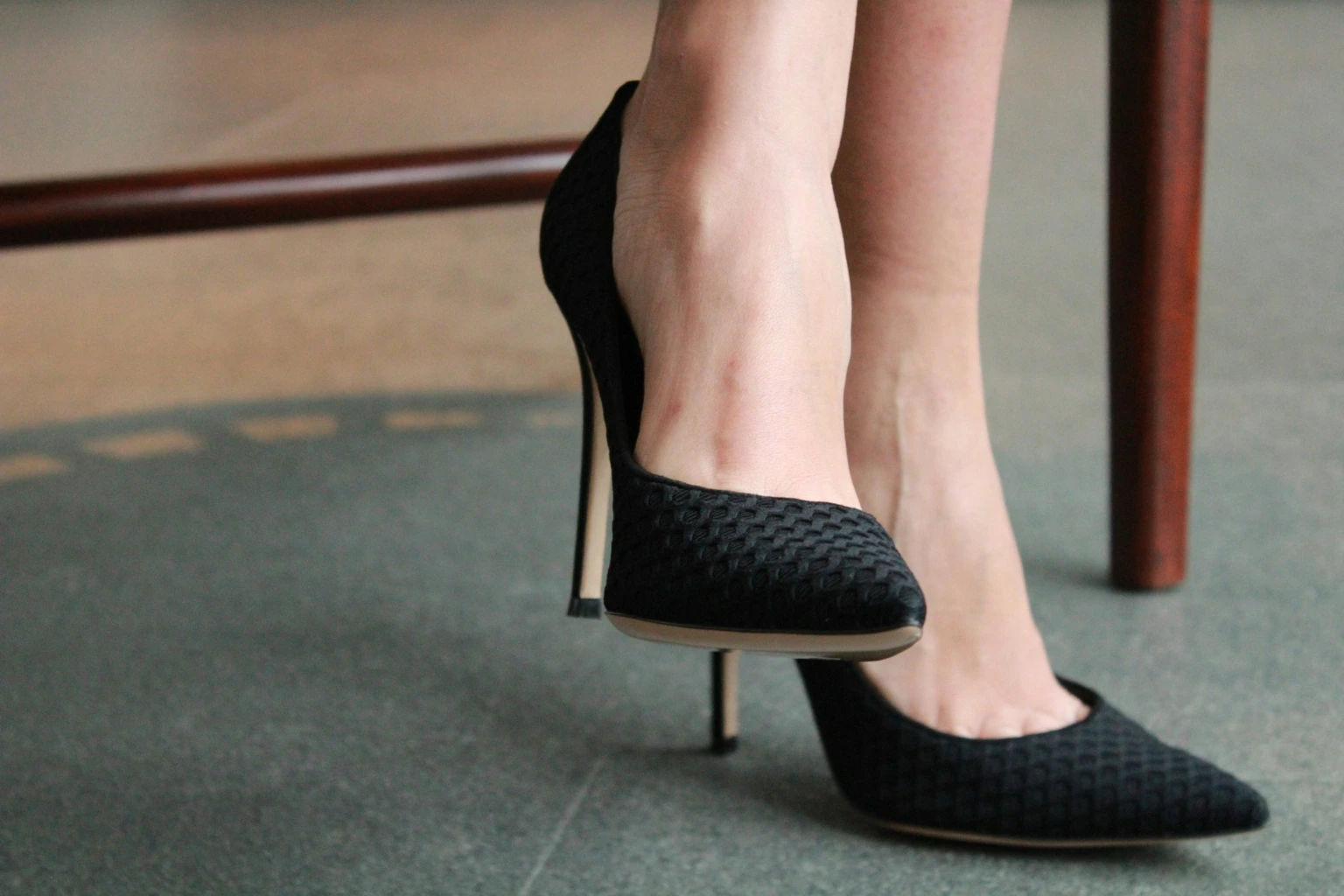
Miu Miu has applied the same transformative instinct to loafers and other traditionally formal shoes. Collegiate, professional and heritage references are retained, but changes in finish, proportion or styling make them feel contemporary. The shoe remains recognisable, yet its character shifts.
The collaboration with New Balance provides another clear example. For Spring/Summer 2022, Miuccia Prada reimagined the New Balance 574, a design originally associated with 1980s running footwear. Miu Miu versions appeared in denim and neutral shades with raw-cut edges, linking the collaboration directly to the reconstructed garments in the collection.
The partnership later expanded through the New Balance 530 SL. Miu Miu renewed the structure of the shoe, producing an ultra-light, low-profile interpretation with contrasting laces and combinations of suede, mesh, leather and technical fabric. The collaboration succeeds because neither partner’s identity disappears: New Balance provides a recognisable sporting foundation, while Miu Miu alters its texture, scale and styling context.
Miu Miu’s leather goods translate the same creative balance into objects designed for everyday use. The Wander is among the brand’s best-known contemporary bag families. Its curved hobo form combines retro associations with a softer modern silhouette, while versions in matelassé nappa leather create a distinctive three-dimensional surface. Miu Miu describes the Wander as both playful and sophisticated qualities that closely reflect the wider identity of the house.
The Arcadie offers a more structured expression. Produced in smooth leather and matelassé finishes, it reinterprets the classic top-handle bag through compact proportions and carefully controlled curves. According to the brand, the design embodies the meeting of classic and contemporary codes at the centre of Miu Miu’s heritage.
Matelassé workmanship has consequently become more than a decorative effect. Its raised, tactile construction gives softness and movement to leather while making a product recognisably Miu Miu. It also captures a central principle of the brand: traditional luxury craftsmanship can feel precise without becoming overly formal.
Miu Miu’s cultural identity extends beyond seasonal collections. One of its most substantial projects is Miu Miu Women’s Tales, a continuing series of short films directed by women. Launched in 2011, the platform invites filmmakers to examine femininity, identity, appearance, and contemporary womanhood through their own cinematic languages. By 2026, Miu Miu described it as a 15-year project comprising more than 30 episodes and the longest-running commissioning platform dedicated to female-led short films.
The films are not presented simply as conventional advertising. Each director is given space to create an individual world, with Miu Miu clothing entering the story as a costume, a symbol, or an expressive device. Filmmakers associated with the series have included Ava DuVernay, Miranda July, Haifaa Al-Mansour, Lucrecia Martel and Chloë Sevigny, demonstrating the breadth of voices invited into the project.
The Miu Miu Literary Club has further developed this cultural approach. Launched in Milan in 2024, the inaugural edition returned attention to the writing of Sibilla Aleramo and Alba de Céspedes. Its second edition, held in 2025 under the title A Woman’s Education, examined girlhood, love and education through the works of Simone de Beauvoir and Fumiko Enchi. The programme combined literary discussion with readings, performance and music.
Miu Miu has also organised Summer Reads, placing literature in public spaces such as newsstands, parks and gardens. Together, these projects position the brand as a cultural convener. Fashion remains central, but it becomes part of a wider conversation about women’s experiences, creativity, memory and authorship.
Miu Miu’s stores provide a physical expression of its identity. A particularly important example is the Aoyama flagship in Tokyo, designed by Herzog & de Meuron and unveiled in 2015. The building uses a smooth, polished steel façade that reflects the surrounding city while preserving a sense of privacy within. The architects deliberately avoided an oversized logo or highly demonstrative exterior, allowing the unusual folded metallic surface to attract attention through form.
The design differs from the transparent Prada building situated nearby. Where glass reveals, the Miu Miu façade is more intimate and enigmatic. This distinction provides an architectural parallel to the relationship between the two fashion brands: connected through ownership and creative leadership, but capable of expressing markedly different personalities.
Miu Miu’s clearest brand-specific circularity initiative is Miu Miu Upcycled, launched in December 2020. The first edition consisted of 80 vintage dresses sourced from clothing stores and markets around the world, then reworked through Miu Miu materials, embroidery and design codes. Each garment retained elements of its earlier history while becoming a new, individual piece.
Subsequent editions expanded the project through denim, vintage leather jackets, collaborative work and accessories. The 2024 edition introduced patch bags made using leather remnants from existing Miu Miu production. This allowed materials already connected to the house to be recomposed into limited products with a different visual identity.
For the 2024 Upcycled collection, Miu Miu partnered with the Aura Blockchain Consortium so that each piece could receive digital verification. Aura verification has also been documented for later-specified Upcycled projects, supporting authentication and providing an additional connection among craftsmanship, product history, and digital traceability.
Miu Miu’s recent commercial performance reflects the strength of its creative positioning. Prada Group reported that Miu Miu’s retail net sales increased by 58.2% in 2023. Growth accelerated dramatically in 2024, when retail sales rose by 93% at constant exchange rates.
The brand continued to expand in 2025, delivering a further 35% increase in retail sales against the exceptionally strong comparison created in 2024. Prada Group stated that the year’s performance was balanced across product categories and geographical regions, suggesting that interest extended beyond a single viral item.
In the first quarter of 2026, Miu Miu retained a positive growth trajectory, with retail sales increasing by 2.4% year on year at constant exchange rates. When considered alongside the scale of the preceding increases, the figures show how the brand converted intense cultural visibility into a broader, more established luxury business.
Product icons have been important to this growth, but they are only one part of the explanation. Miu Miu’s appeal is created through the complete image surrounding each product: runway proportions, casting, campaign photography, socks worn with shoes, charms added to bags and unexpected combinations of formal and informal dress. The house does not merely introduce an object; it proposes a way of seeing and wearing it.
Miu Miu matters because it has developed a language of luxury that feels culturally alert, emotionally expressive and unmistakably its own. It can draw on uniforms, sportswear, vintage dresses, evening clothes and traditional leather goods without allowing any one category to define the brand completely.
Its most successful ideas often begin with familiar objects. A pleated skirt, ballet flat, hobo bag, cardigan or running shoe is not rejected. Instead, it is reconsidered in terms of scale, texture, context, and styling. This ability to make the recognisable feel newly desirable is one of Miu Miu’s greatest strengths.
The brand’s continuing relevance also rests on its understanding that fashion is connected to more than clothing. Film, literature, architecture, performance and cultural conversation all contribute to its world. Women’s Tales, Literary Club, Summer Reads and Miu Miu Upcycled demonstrate that a luxury house can build cultural depth while continuing to create influential products.
Miu Miu is therefore best understood not as an alternative version of Prada, but as an independent creative proposition within the Prada Group. Personal in origin and global in reach, it has transformed contradiction into a coherent identity refined yet spontaneous, romantic yet self-possessed, nostalgic yet unmistakably contemporary.
Miu Miu and New Balance Dress Coco Gauff for Wimbledon 2026 in an All White Tennis Capsule
How Ralph Lauren, LVMH and Miu Miu Are Changing Luxury Fashion Through Sport
Herzog & de Meuron. (n.d.). 412 Miu Miu Aoyama.
Lyst. (2022). The Lyst Index: First quarter 2022.
Miu Miu. (n.d.). Arcadie.
Miu Miu. (n.d.). Miu Miu sustainability.
Miu Miu. (n.d.). Miu Miu Women’s Tales.
Miu Miu. (n.d.). New Balance x Miu Miu.
Miu Miu. (n.d.). Spring/Summer 2022 fashion show.
Miu Miu. (n.d.). Wander.
Miu Miu. (2024). Miu Miu Literary Club: Writing Life.
Miu Miu. (2025, April 9–10). Miu Miu Literary Club 2025: A Woman’s Education.
Prada Group. (n.d.). Miu Miu: A brand of Prada Group.
Prada Group. (2024, January 8). Miu Miu launches new Upcycled collection.
Prada Group. (2025, March 4). Prada Group’s full-year 2024 financial results.
Prada Group. (2026, March 5). Prada Group’s full-year 2025 financial results.
Prada Group. (2026, April 30). Positive start to the year with net revenues at +14%.
The New Yorker. (2004, March 15). The designer.
Vogue. (2006, March 4). Miu Miu Fall 2006 ready-to-wear collection.
Vogue. (2021, August 30). Six times European brands showed at New York Fashion Week.
Vogue. (2022). Miu Miu’s ballet flats are the shoes to be seen in this season.

Stay inspired with exclusive brand features, luxury insights, and the latest in fine fashion and beauty — directly in your inbox.