Fragrance Pyramid : What is Fragrance Pyramid
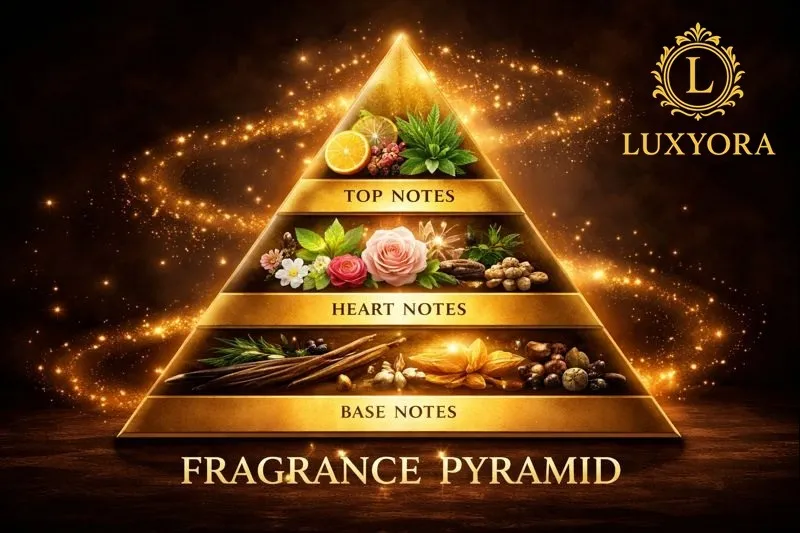
The Fragrance Pyramid is a foundational concept in perfumery that explains how a scent evolves on the skin, from the very first spritz to the final trace that lingers hours later. Rather than smelling the same from start to finish, most perfumes are designed to change gradually, revealing different facets as time passes.
Think of the fragrance pyramid as a story told in three acts, each layer playing a distinct role in the overall experience.
Top Notes: The Opening Act
Top notes are the first impression of a fragrance. They appear immediately upon application and are designed to feel bright, light, and inviting. Because they are made of high-volatility molecules, they evaporate quickly, typically within 5 to 15 minutes.
Common top notes include:
Their role is to capture attention, set the mood, and introduce the fragrance’s overall style.
Heart Notes: The Emotional Core
As the top notes fade, the heart notes, also known as middle notes, begin to emerge. This stage usually becomes noticeable 10 to 20 minutes after application and can last for several hours.
Heart notes define the perfume’s personality and character. They create balance and act as the bridge between the freshness of the opening and the depth of the base.
Typical heart notes include:
- Florals (rose, jasmine, ylang-ylang)
- Spices (cinnamon, nutmeg, cardamom)
- Aromatic and fruity notes
This is the phase where the fragrance feels most expressive and wearable.
Base Notes: The Lasting Impression
Base notes are the foundation of the fragrance. They emerge gradually as the scent settles into the skin and can last six hours or more, sometimes even into the next day.
These notes provide depth, warmth, and longevity, anchoring the entire composition.
Common base notes include:
Base notes are often what people remember most they create the scent’s final signature.
A perfume’s story is written in layers, and knowing how each note unfolds can completely change the way you experience fragrance. Find out why in Perfume Notes Explained: Top, Middle & Base Notes.
Why the Fragrance Pyramid Matters
Understanding the fragrance pyramid explains why a perfume you love in the first few seconds might smell different an hour later. It also helps you choose scents more intentionally:
- If you love freshness, focus on citrus and aromatic top notes
- If you enjoy warmth and sensuality, look for strong base notes like vanilla, amber, or woods
- If you value balance, pay attention to the heart notes
Modern Interpretations
While the traditional pyramid remains a reliable guide, modern perfumery sometimes bends the rules. Some linear fragrances are designed to smell nearly the same from beginning to end, offering consistency rather than evolution. Niche and experimental perfumes may also blur the boundaries between notes.
Still, for most fragrances, the pyramid remains an essential framework for understanding how scent blooms, shifts, and settles on the skin.
Once you grasp this structure, every perfume becomes more than a smell; it becomes a journey.
References
Turin, L., & Sanchez, T. (2018). Perfumes: The A–Z Guide (Revised ed.). Penguin Books.
Nez Éditions. (2020). The Big Book of Perfume: For an Olfactory Culture (J.
Doré, Ed.). Nez Éditions.
Ellena, J.-C. (2022). Perfume: The Alchemy of Scent. Arcade Publishing.
Sell, C. S. (2019). The Chemistry of Fragrances: From Perfumer to Consumer
(2nd ed.). Royal Society of Chemistry.
Encyclopaedia Britannica. (2024). Perfume.
International Fragrance Association (IFRA). (2023). Fragrance composition and evaporation dynamics. IFRA Publications.
Herz, R. S., & Engen, T. (2019). Odor memory and perception. Psychonomic Bulletin & Review, 26(5), 1601–1618.
Spence, C. (2021). Crossmodal influences in scent perception. Cognitive Research: Principles and Implications, 6(1), 46.
Grand View Research. (2026). Fragrance ingredients and formulation trends.
Industry Report.
Burr, C. (2018). The perfect scent: A year inside the perfume industry. Picador.
Edwards, M. (2019). Perfume legends II: French feminine fragrances.
Fragrances of the World.