Balance Wheel : What is Balance Wheel
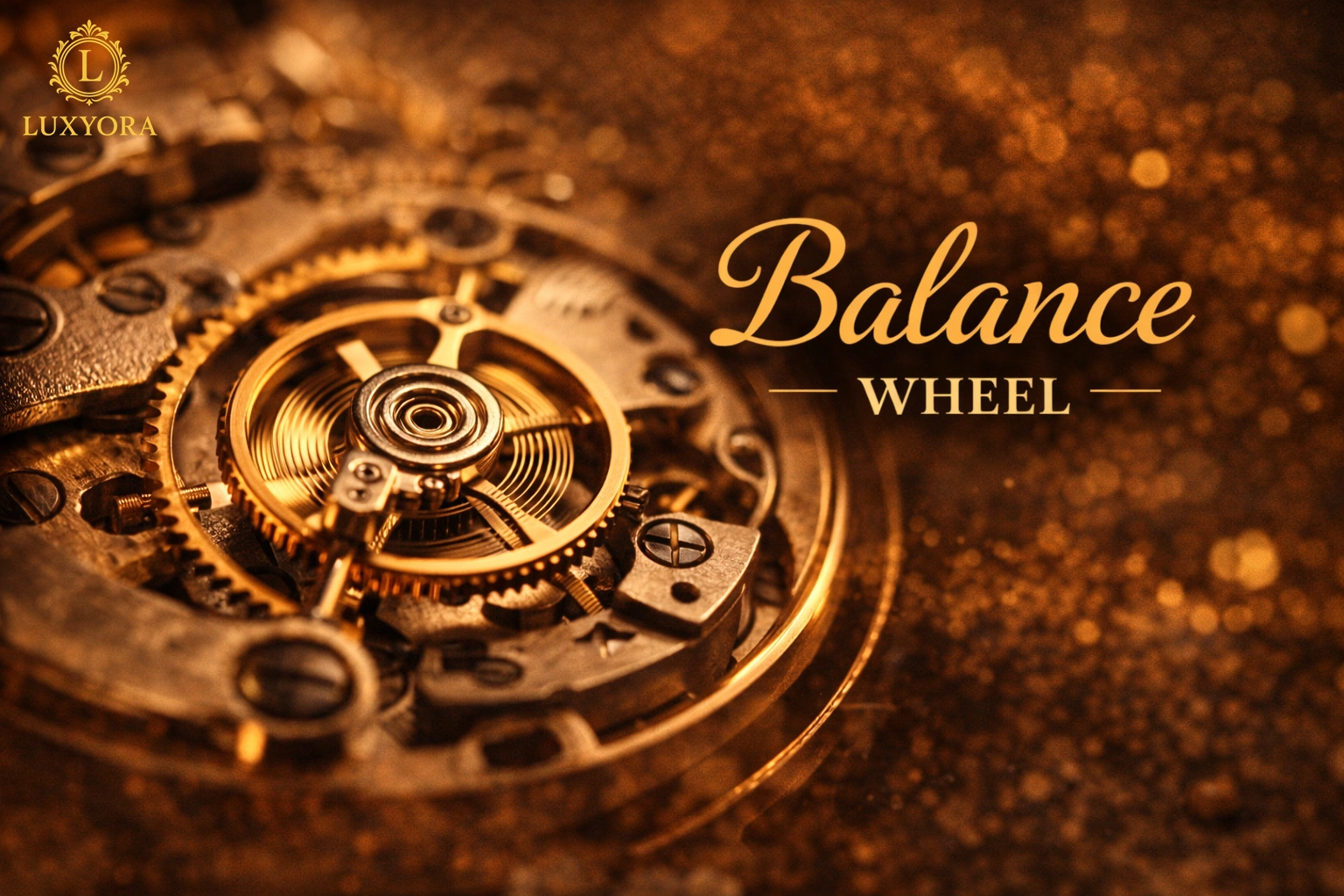
In mechanical watchmaking, the balance wheel is the component most directly responsible for timekeeping accuracy. If the mainspring is the “engine” that provides power, and the gear train is the “transmission” that moves the hands, the balance wheel is the regulating organ, the part that decides how fast that power is released in controlled steps. Many educators describe it as the watch’s heartbeat because its rhythmic back-and-forth motion defines its ticking cadence and rate.
This article explains what the balance wheel is, how it works with the hairspring and escapement, what “beats per hour” means, and why modern designs like free-sprung and variable inertia balances matter in today’s watch industry.
1) What Is a Balance Wheel?
A balance wheel (often just called “the balance”) is a weighted wheel that oscillates back and forth in a mechanical movement. It is paired with a very thin spiral spring, the hairspring (balance spring) that pulls the wheel back toward its center position after each swing. Together, the balance wheel and hairspring form a harmonic oscillator (a stable, repeating system), which is why the timing can be consistent when the watch is properly designed and adjusted.
Core keywords (industry terms): balance wheel, hairspring/balance spring, regulating organ, harmonic oscillator, escapement, beat rate, amplitude, isochronism, free-sprung, variable inertia.
2) How the Balance Wheel Works With the Escapement
A watch would unwind immediately if the mainspring’s power were allowed to flow freely. The escapement prevents that by releasing energy in controlled increments and delivering impulses to the balance wheel. In simple terms:
- Mainspring power travels through the gear train.
- The escapement locks/unlocks and meters that power.
- The escapement’s impulse keeps the balance wheel oscillating.
- Each oscillation advances the gear train by a precise amount, moving the hands forward at a regulated pace.
This is why a balance wheel is not just “moving”; it regulates the release of stored energy, turning mechanical force into measured time.
3) The Hairspring: The Balance Wheel’s “Return Force.”
The balance wheel alone would not keep a stable rate; it needs a restoring force. That restoring force comes from the hairspring, which expands and contracts as the balance swings, gently pulling it back toward the center. The balance + hairspring pairing is widely described as the essential regulating system that determines the watch’s rate.
Why hairspring design matters
Small differences in hairspring geometry and materials can strongly affect:
- isochronism (keeping the same period even as the swing size changes),
- resistance to temperature variation,
- and sensitivity to magnetism and shocks.
4) Beat Rate and “Beats Per Hour” (BPH): What You’re Actually Measuring
Mechanical watches are often described by their frequency in beats per hour (BPH) (also expressed in Hz). The beat rate is the frequency at which the balance swings and influences how the movement responds to disturbances.
Common modern frequencies include:
- 21,600 BPH (6 beats/second),
- 28,800 BPH (8 beats/second),
- and “high-beat” designs such as 36,000 BPH.
Higher frequency is often associated with better potential stability because the oscillator can recover from disturbances more quickly, but it can also increase wear and energy demand if the movement isn’t designed for it.
Important related term: amplitude
Amplitude describes how far the balance rotates per swing (in degrees). Low amplitude can indicate issues such as insufficient power, friction, or lubrication problems, all of which can reduce accuracy and consistency. (This relationship is discussed widely in regulation-focused technical writing.)
5) Regulation Methods: Index-Regulated vs Free-Sprung Balances
Watchmakers must be able to adjust the watch’s rate. Two major approaches dominate:
A) Index-regulated (with a regulator/lever)
A regulator changes the effective length of the hairspring to alter the rate. It’s practical and common, but the regulator mechanism can be more sensitive to shocks and can slightly interfere with the spring’s “breathing” (its natural expansion/contraction), which can affect precision in high-end regulation.
B) Free-sprung (often variable inertia)
A free-sprung balance removes the regulator; instead, the rate is adjusted by changing the balance wheel’s moment of inertia, often using tiny weights or screws on the balance. Technical reports note that free-sprung systems can maintain rate well and be less susceptible to regulator shocks, but they require skill to adjust correctly.
In modern enthusiast vocabulary, free-sprung + variable inertia has become a strong signal of premium engineering, though it’s not automatically “better” in every context. It’s better described as a design choice with trade-offs.
6) Materials and Modern Innovations Around the Balance Wheel System
Today’s balance wheel system is shaped by materials science as much as traditional craft.
Anti-magnetism and new hairspring materials
Magnetism is a major enemy of mechanical accuracy because it can cause the hairspring coils to stick, altering the spring’s effective behavior and rate. Industry coverage of modern balance spring development highlights ongoing efforts to improve consistency and stability through new alloys and design approaches.
Manufacturing consistency
Precise, repeatable manufacturing matters because even microscopic differences in spring elasticity or wheel poise can shift timekeeping. A technical discussion of precision regulation emphasizes how modern process and material controls help brands reduce variation at scale.
7) Why the Balance Wheel Is Central to “Quality” in Mechanical Watches
The balance wheel sits at the intersection of engineering performance and watchmaking identity:
- It determines the watch’s rate stability (how consistently it runs across positions and conditions).
- It influences serviceability and long-term durability (shock resistance, adjustment method, and component wear).
- It is a major design area where brands express technical philosophy, especially through free-sprung systems, escapement efficiency, and regulation strategy.
For learners and collectors, understanding the balance wheel makes it much easier to grasp related watch-industry terms such as chronometer, regulation, timing positions, and high-beat.
Practical Takeaways
- The balance wheel + hairspring is the mechanical watch’s core time regulator.
- The escapement feeds the balance controlled impulses; the balance then “sets the pace” for the whole movement.
- Beat rate (BPH) and amplitude are key performance concepts tied directly to the balance system.
- Free-sprung / variable inertia balances are an important modern trend in precision-focused movements, but they require careful adjustment and design discipline.
References
Brunner, G. L. (2023). The Watch Book: Compendium – Revised Edition. teNeues. (Offline reference)
Define Watches. (2026, January 10). The balance wheel: The heartbeat of mechanical watchmaking. (Define Watches)
Ethos Watches. (2021, August 27). A complete guide to your mechanical watch’s frequency. (ethoswatches.com)
Ethos Watches. (2023). Balance wheel: What is it & its function? (ethoswatches.com)
Foulkes, N. (2019). Time Tamed. Simon & Schuster UK. (Simon & Schuster India)
Hodinkee. (2020, August 21). In-depth: The modern watch escapement, and how it got that way. (Hodinkee)
Hodinkee. (2020, October 19). In-depth: A brief history of modern Rolex balance springs. (Hodinkee)
Monochrome Watches. (2020, April 4). Rewind – A guide to the regulating organ, the heart of the mechanical watch. (Monochrome Watches)
Schmidt, R. (2019). The Wristwatch Handbook: A Comprehensive Guide to Mechanical Wristwatches. ACC Art Books. (Simon & Schuster) (Offline reference)
Watch 101 / Hodinkee. (n.d.). Escapement (Watch 101). (Hodinkee)
Watches by SJX. (2020, October 14). Watchmaking: How the art of precision regulation became more scientific. (SJX Watches)
Wristcheck. (2024, September 29). ABCs of watchmaking. (Wristcheck)