Stone Seats : What is Stone Seats | Luxyora
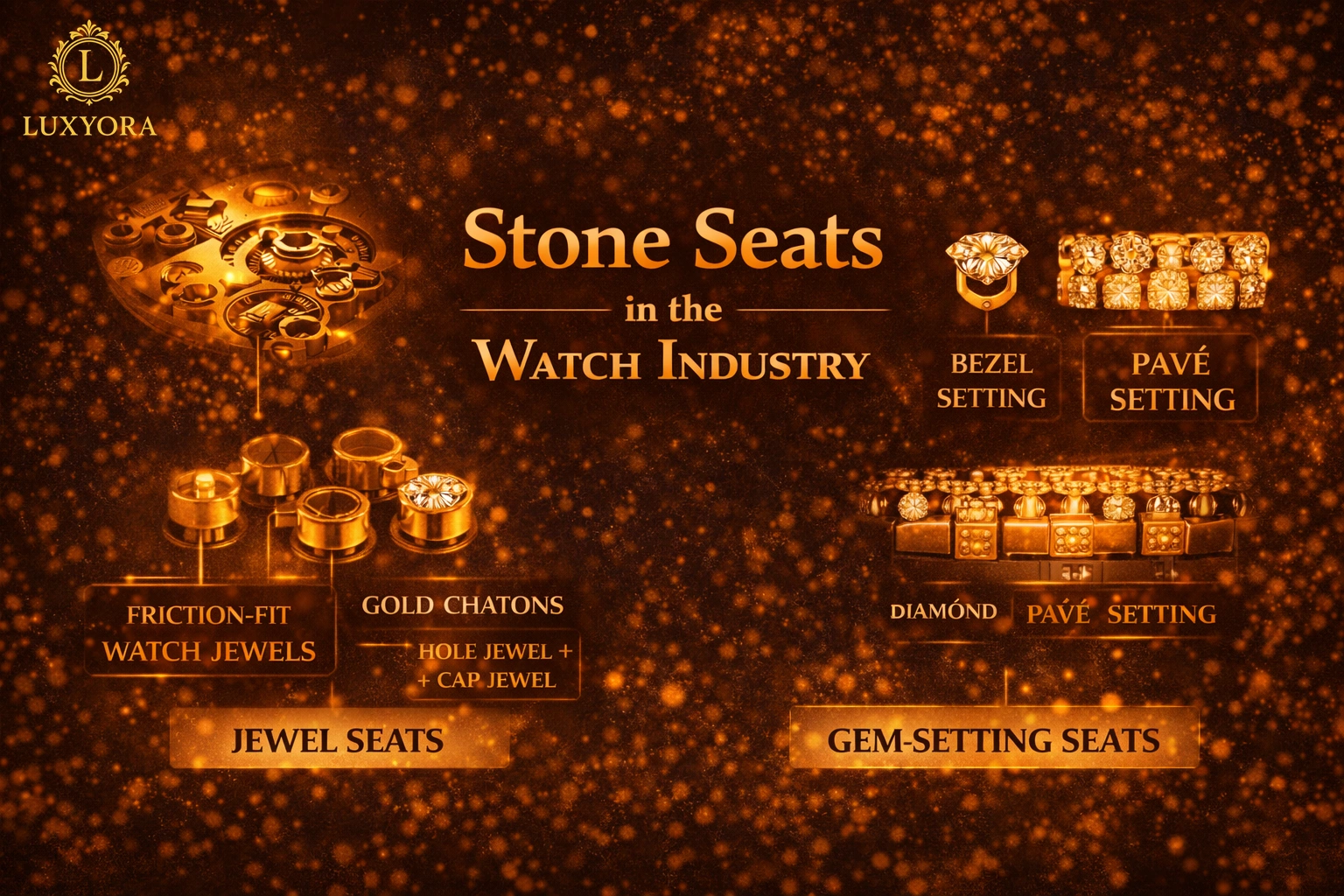
In the watch industry, the term stone seats is used in two closely related but distinct ways:
- Movement stone seats (jewel seats): the precisely machined locations in a watch movement’s plates/bridges (or in metal settings) where watch jewels (synthetic ruby/sapphire bearings) are installed to support pivots, reduce friction, and stabilise endshake.
- Gem-setting stone seats (decorative stones): the micro-machined seats cut into a bezel, case, dial, bracelet, or clasp to hold diamonds or gemstones in settings such as pavé, bezel, channel, snow, or invisible setting.
Both meanings share the same core idea: a seat is the engineered “home” that lets a stone sit flat, secure, aligned, and protected because even tiny dimensional errors can lead to looseness, breakage, or performance problems.
Part 1: Stone Seats in the Movement (Jewel Seats)
Why do watch movements use “stones”
Mechanical movements place jewels at high-friction, high-wear points, especially at wheel pivots and the balance staff, because jewels provide a hard, stable bearing surface and help preserve precision over time
Industry keywords: jewel bearing, hole jewel, cap jewel, endstone, pivot, oil sink, endshake, side-shake.
What a jewel seat actually is
A jewel seat is the geometry in the plate/bridge (or in a separate setting) that positions the jewel at the correct:
- height (endshake control),
- centre alignment (gear train meshing),
- perpendicularity (pivot runs true),
- oil retention geometry (oil sink/countersink holds lubricant).
When the “seat” is wrong, too deep, too shallow, slightly off-centre, accuracy, wear, and even power reserve can suffer.
Common Movement Stone-Seat Architectures
1) Press-fit / friction-fit jewels (modern mainstream)
Many modern calibres use jewels that are pressed into a machined hole in the plate or bridge. This is efficient for production and consistent when tolerances and tooling are correct. Watch repair discussions frequently reference jewelling tools used to press and adjust jewels and to restore endshake after replacement.
2) Rubbed-in jewels (traditional repair and vintage context)
Some movements, especially older ones, use rubbed-in or burnished settings where the surrounding metal is mechanically worked to lock the jewel in place. This method creates its own “seat” by forming a metal lip. It’s a traditional technique often discussed in repair communities and tutorials.
3) Chatons (screwed or set jewel settings)
A chaton is a separate metal setting (often gold in high-end watchmaking) that holds the jewel, and the entire chaton is then fitted or screwed into the plate/bridge. High-end commentary highlights this approach, noting that both functional and aesthetic chatons can enhance serviceability and showcase traditional finishing.
Collector keyword cluster: screwed chatons, gold chatons, jewel settings, traditional construction, haute horlogerie finishing.
Hole Jewels, Cap Jewels, and “Endstone Seats”
A key area where “stone seats” matter most is the balance assembly, where very fine pivots are vulnerable. Many movements use a hole jewel + cap jewel pairing: the hole jewel supports the pivot radially, and the cap jewel controls axial motion and improves lubrication behaviour, often within a shock protection setting.
Here, the “stone seats” include:
- the seat for the whole jewel,
- the seat for the cap jewel/endstone,
- and (in shock systems) the seat geometry that allows controlled movement under impact.
Typical Movement Problems Caused by Poor Stone Seats
When movement stone seats wear, deform, or are incorrectly serviced, you’ll see issues such as:
- excess endshake (loss of positional stability),
- insufficient endshake (binding, low amplitude),
- off-centre jewel (gear train friction, poor rate),
- cracked jewel (stress from incorrect pressing or burrs),
- oil migration (poorly formed oil sink or damaged seat).
These are not “minor” faults; jewel seating errors can cascade into timing instability and premature wear.
Part 2: Stone Seats for Gem-Setting (Diamonds and Decorative Stones)
Where gem “stone seats” appear on watches
In gem-set watches, stone settings are cut into:
- bezels,
- lugs and case sides,
- dials,
- bracelets and clasps.
They are critical because luxury watch gem-setting must withstand daily wear while maintaining perfect alignment and brilliance.
Why gemstone seats demand extreme precision
Modern manufacturing discussions emphasise that the stone seat must be extremely precise: even tiny deviations can loosen a stone or cause cracking during setting.
Watch-focused gem-setting guides also stress that different setting styles (pavé, snow, invisible, bezel, claw) depend on seat geometry and consistent depth to maintain both security and visual uniformity.
Gem-setting keywords used in watch retail: pavé setting, snow setting, invisible setting, bezel setting, channel setting, bead setting, grain setting, micro-pavé.
How Stone Seats Are Made (Gem-Setting Workflow)
In a simplified but realistic workflow, gem-set watch parts typically follow:
- Layout and calibration: selecting stone sizes and patterns.
- Drilling and cutting seats: creating the cavity/ledge where the stone girdle sits.
- Setting method execution: beads/grains raised, bezel metal pushed, prongs formed, rails used (in invisible setting).
- Finishing: polishing without loosening stones, maintaining symmetry and sparkle.
Watch gem-setting explainers highlight that the “seat” stage is where craftsmanship becomes measurable: depth, consistency and angle control define the final look.
Why “Stone Seats” Is an Important Industry Term
Understanding stone seats helps readers interpret both movement quality and luxury finishing:
- In the movement, stone seats are fundamental to low friction, correct endshake, and long-term reliability.
- In gem-set watches, stone settings determine durability, alignment, and the premium “perfect surface” appearance expected at high price points.
In other words, stone seats are where precision engineering meets craftsmanship and where “small tolerances” turn into big differences in performance and value.
References
Flashforge. (2025). An introduction to diamond setting in jewelry manufacturing. Flashforge Enterprise. (Flashforge-enterprise)
Hunt, M. (2022). Stonesetting for jewellery makers (New edition). Search Press. (Amazon India)
Kaplan, B. B. (2022). Horology: An illustrated primer on the history, philosophy, and science of time, with an overview of the wristwatch and the watch industry. Schiffer Publishing.
Oracle of Time. (2021, November 8). A brief guide to diamond gem-setting techniques for watches. (Oracle Time)
Outlook Luxe. (2025, December 9). What role do jewels play in horology? Understanding watch jewels and their importance. (Outlook Luxe)
Quill & Pad. (2018, June 29). The number of jewels in a watch movement indicates value—or does it? (Quill & Pad)
Stone, G., & Pulvirent, S. (2018). The watch, thoroughly revised: The art and craft of watchmaking. Abrams.
Teddy Baldassarre. (2023, February 24). Watch jewels: What do they do and why do they matter? (Teddy Baldassarre)
The 1916 Company. (2022, March 31). Watch jewels 101: What they are & why they matter. (The 1916 Company)
Watch Affinity. (2023). Exploring gem-setting in watchmaking. (watchaffinity.co.uk)
Watch Repair Talk. (2019, December 7). Chinese clone Horia tool (discussion of jewelling tools and jewel seating work). (Watch Repair Talk)
Watch Repair Talk. (2021, April 11). Making a jewel setting – Detailed tutorial. (Watch Repair Talk)