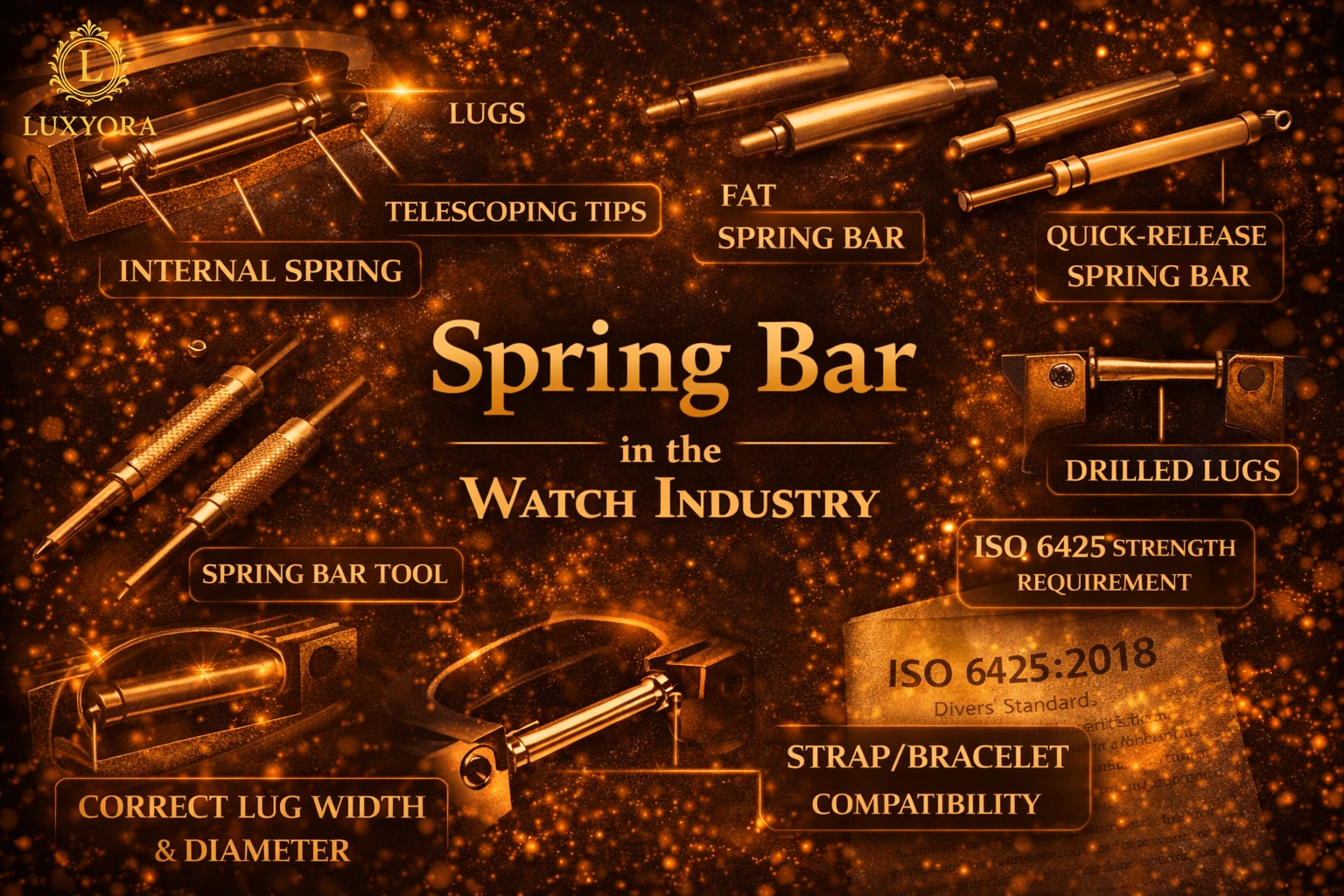
Spring Bar : What is Spring Bar?
A spring bar (also called a spring pin or watch band pin) is a small, spring-loaded metal tube used to attach a watch strap or bracelet to the watch case. It sits between the x he two “horns” extend from the case, and locks into tiny lug holes via telescoping tips pushed outward by an internal spring.
In watch industry terms, the spring bar is a load-bearing retention component. It’s inexpensive, easy to overlook, and absolutely critical: if a spring bar fails or pops out, the watch can fall off, often resulting in scratches, case damage, bezel impact, or a shattered crystal.
Why Spring Bars Matter So Much
Spring bars are vital for three main reasons:
1) Security
Your watch’s “wearability” depends on the spring bars maintaining a solid connection under daily motion, impacts, and strap flex. For diving watches designed to meet ISO criteria, spring bars must withstand significant forces.
2) Serviceability and customisation
Spring bars enable fast strap changes. This is especially important today because strap swapping (leather to rubber, bracelet to NATO, etc.) is a major part of modern watch culture.
3) Safety for tool watches
Tool watches, dive, field, and sports watches use spring bars as a practical engineering link. ISO-focused discussions specifically highlight spring bar force testing requirements in divers’ watch standards.
How a Spring Bar Works
A traditional spring bar consists of:
- A hollow tube (outer body)
- An internal spring
- Two telescoping end tips that compress inward when pushed and extend outward into lug holes
When installed correctly, each tip snaps into the lug holes, holding the strap/bracelet end link in place. Removal is done by compressing one side (or both) with a spring bar tool, so the tip clears the lug hole.
Common Types of Spring Bars (Industry Terminology)
Spring bars are not “one size fits all.” In watch and strap retail, you’ll see these major categories:
1) Standard spring bars (double-flange / shouldered)
These have tiny “shoulders” (flanges) near the tips, providing the tool something to grip. They’re common on most watches and are widely compatible.
2) Shoulderless spring bars (for drilled lugs)
Some watches have drilled lug holes that go through the lug exterior, allowing removal with a pusher from the outside. These often use shoulderless bars because the drilled lug itself becomes the access point.
3) “Fat” spring bars (heavy-duty)
Often used for dive watches and larger tool watches, “fat bars” have a thicker diameter to improve strength. Strap specialists commonly describe these as thicker than standard and preferred for heavier-duty use (Watchstraps.com.au, 2023). The guidance on selection also notes typical diameter ranges: standard bars are typically 1.2 mm to 1.8 mm, while heavy-duty/fat bars can be 2.0 mm or more, assuming the lugs and strap holes can accommodate them.
4) Curved spring bars
Curved bars bow outward to clear tight-fitting cases or allow strap/bracelet geometry to sit properly. They’re used when straight bars cause rubbing or a poor fit.
5) Quick-release spring bars
These include a small built-in lever that lets you remove/install straps without tools, a featurepopular in modern watches and strap systems.
6) Screw-in bars (a different “bar philosophy”)
Some watches use screw-in bars rather than spring-loaded bars for extra security. These are typically found in certain sports/dive designs and require the correct screwdriver(s) rather than a spring bar tool.
Spring Bar Sizing: Length, Diameter, and Fit
Lug width (the most important measurement)
Spring bar length corresponds to lug width (e.g., 18 mm, 20 mm, 22 mm). The bar should fit snugly between lugs without side play.
Diameter matters (strength vs compatibility)
Thicker bars can be stronger, but they must match:
- lug hole diameter
- strap hole size
- end link tolerances (for bracelets)
Selection guides warn that forcing a bar that’s too thick can damage lug holes or reduce security if it doesn’t seat correctly.
Keyword cluster: lug width, spring bar length, spring bar diameter, fat bars, drilled lugs, end links, strap fitment.
ISO 6425 and Spring Bar Strength (Why Divers Care)
A key reason spring bars get serious attention is dive-watch safety. In an ISO 6425 explainer, Fratello notes that spring bars are tested against an external force of 200 newtons in each direction.
Even if you never dive, this is useful knowledge: it explains why reputable dive watches often use thicker bars and why strap choice matters. A weak bar or incorrect strap fit can undermine the practical ruggedness a dive watch is supposed to deliver.
How to Choose the Right Spring Bar (Practical Buyer Guidance)
A strong selection process looks like this:
1) Match the lug width exactly
If your watch is 20 mm, use a 20 mm bar (unless the watch manufacturer specifies something different).
2) Pick the correct style for your lug design
- Drilled lugs: shoulderless or drilled-lug-friendly bars
- Standard lugs: shouldered/double-flange bars
- Tight clearance: curved bars
3) Choose a diameter based on the watch's purpose
- Dress watch / light wear: standard diameter is usually fine
- Dive/tool watch / heavy watch head: consider heavy-duty (“fat”) bars if compatible
4) Consider convenience vs security
Quick-release bars are convenient and can reduce the risk of scratching lugs during changes (Vercors Store, 2025). However, many collectors still prefer traditional bars for maximum universality, especially with bracelets and tight end links.
Installation and Removal: Tools and Best Practices
Tools used in the industry
- Spring bar tool (forked end + pin end)
- Lug protectors (thin plastic sheets to prevent scratches)
- Tweezers (sometimes used by professionals for fine control)
Best practices
- Work on a soft surface.
- Compress the tip fully before levering the strap out.
- Avoid twisting the bar, as bending weakens it.
- Replace bars that feel “gritty,” bent, rusty, or loose.
Common Spring Bar Problems (And the Vocabulary You’ll Hear)
- Bent spring bar: usually from incorrect removal or impact
- Collapsed tips / weak spring: leads to accidental release
- Bar pop-out: often caused by wrong length, wrong diameter, strap hole mismatch, or incomplete seating
- Corrosion: especially if exposed to sweat/saltwater and not rinsed/dried properly
For collectors, a cheap spring bar is not a cheap failure; dropping a watch can be far more expensive than using correct, quality bars.
Why “Spring Bar” Is a Core Watch Industry Term
The spring bar is a small engineering component with outsized importance. It’s central to:
- strap/bracelet compatibility
- tool watch security
- service and daily ownership
- dive-watch standards and rugged-use expectations
Understanding spring bars helps readers make smarter decisions about strap upgrades, dive-watch readiness, and basic maintenance, with applications across nearly every watch category.
References
A Blog to Watch. (2023, May 9). How to make sure you choose the right spring bars. (A Blog to Watch)
Daniel Wellington. (2025). Different types of watch spring bars. (Daniel Wellington)
DrWatchstrap. (2023, July 14). Watch band spring bars type: Quick release, curved. (Drwatchstrap)
Fratello Watches. (2022, May 30). The dry facts about the ISO 6425 divers’ watch standard. (fratellowatches.com)
Gnomon Watches. (n.d.). Screw-down crown watch: What it is and how it works (Includes related watch hardware explainers). (Daniel Wellington)
HÄNDDN Help Center. (n.d.). What different from quick release spring bars and regular spring bars. (help.handdn.com)
Stone, G., & Pulvirent, S. (2018). The watch, thoroughly revised: The art and craft of watchmaking. Abrams.
TimeTrek. (n.d.). The ultimate guide to choosing the right spring bars for your watch. (TIMETREK)
Vercors Store. (2025, May 27). Everything you need to know about quick-release spring bars. (Vercors)
Watchstraps.com.au. (2023, May 5). The ultimate guide to watch spring bars: Types and designs. (Watch Straps Australia)