Pusher : What is a pusher on a watch?
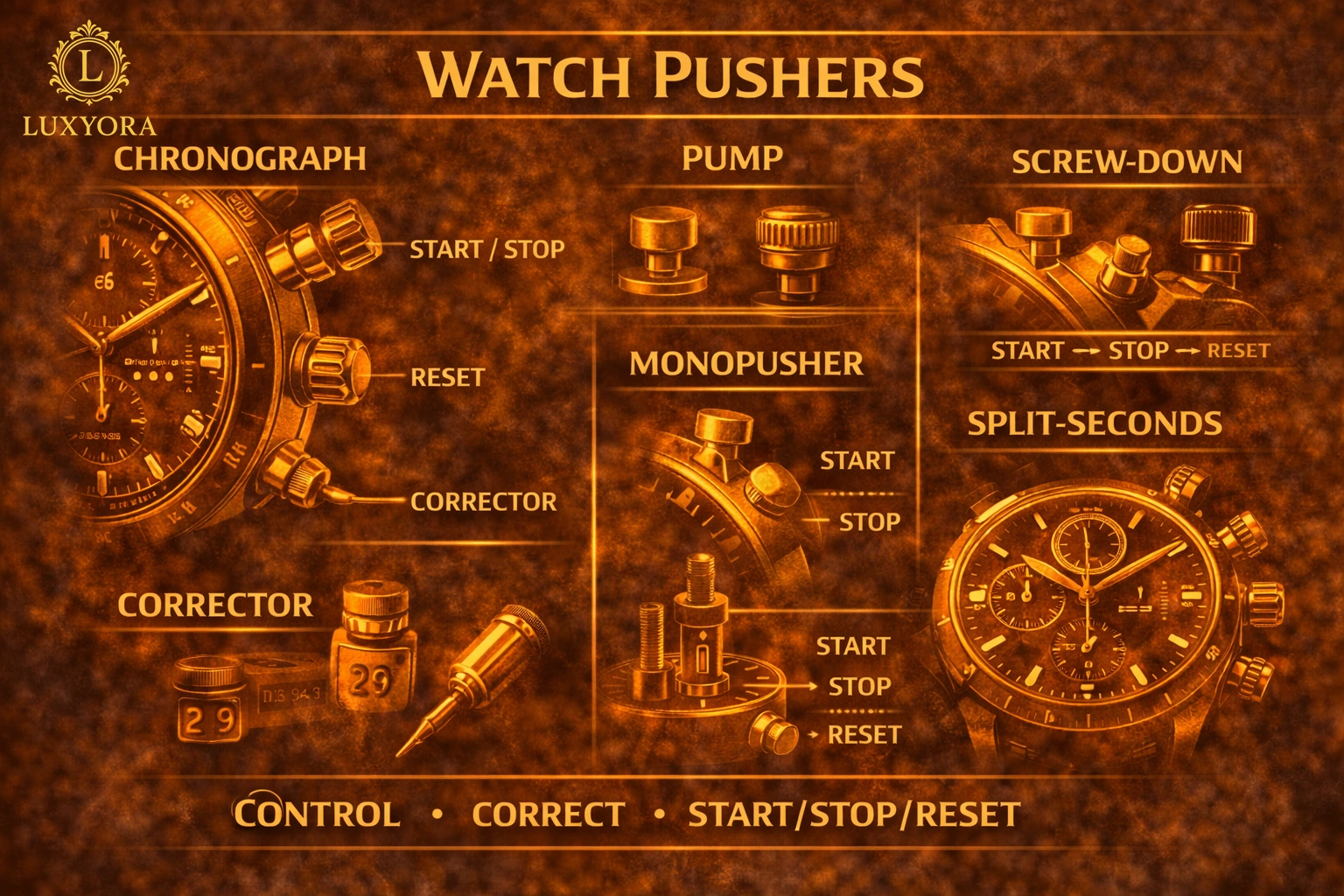
In the watch industry, pushers are the button-like actuators on a watch case that let the wearer trigger a function, most famously the start/stop/reset controls of a chronograph, but also the correctors used to adjust complications like calendar displays, moonphases, and GMT functions. Pushers may look like simple “buttons,” but they are precision-engineered interfaces that connect the outside world to a delicate movement while still maintaining case integrity, water resistance, and tactile quality.
Because pushers involve both mechanical control and sealing, they’re a major point where design, user experience, and durability meet.
Whether a watch uses pump pushers, screw-down pushers, monopushers, or recessed correctors, the pusher system strongly influences how a watch feels to operate and how safe it is in daily wear.
1) What is a Pusher?
A pusher is a case-mounted control that transmits a press action through the case to the movement via a stem/lever system. In practical watchmaking language, pushers are used to:
- Start/stop/reset the chronograph timing mechanism
- Activate specialized chronograph functions like split-seconds (rattrapante)
- Correct or advanced displays like date, day, month, moonphase, or other complications (often via recessed correctors)
The industry distinguishes pushers from the crown, which is primarily used for winding and time-setting, while pushers typically trigger discrete actions.
2) Chronograph Pushers: The Most Common Use-Case
The classic two-pusher chronograph layout
Most modern chronographs use two pushers:
- 2 o’clock pusher: Start/Stop
- 4 o’clock pusher: Reset
When you press these pushers, you’re engaging a control system inside the movement that couples and uncouples the chronograph train and returns hands to zero. Hodinkee’s Chronograph Watch 101 explains the functional sequence start/stop changes the control state (often via a column wheel), and reset returns the chronograph hands to zero.
How the pusher “feels” relates to movement design
Watch enthusiasts often talk about the tactile feel of chronograph pushers: crisp, smooth, mushy, heavy, or snappy. That feel is strongly influenced by whether the chronograph uses a column wheel or a cam (coulisse) system.
- Column wheel chronographs are often described as providing smoother, more refined pusher action because the column wheel precisely coordinates levers during start/stop/reset.
- Cam systems can be robust and cost-effective, but their pusher feel is often described as less “silky” than a well-executed column wheel design.
Keyword cluster: chronograph pushers, start/stop, reset-to-zero, column wheel, cam-actuated chronograph, clutch engagement, brake lever, pusher feedback.
3) Monopusher Chronographs: One Pusher, Multiple Actions
A monopusher chronograph uses a single pusher to cycle through functions in sequence, typically start → stop → reset with repeated presses. This style has historical roots and remains popular in some high-end watches because it offers a clean look and a distinctive interaction pattern. Discussions of split-seconds and historic chronographs often highlight how early systems used single-pusher control logic and later evolved into multi-pusher layouts.
4) Advanced Chronograph Pushers: Split-Seconds and Special Controls
In a split-second (rattrapante) chronograph, pushers can do more than start/stop/reset. For example, some watches add a dedicated pusher to freeze one second’s hand while the other continues, allowing intermediate timing.
Hodinkee’s look at an A. Lange & Söhne split-seconds chronograph describes a configuration where:
- One pusher starts/stops,
- another reset,
- An additional button controls the split-second action.
This highlights an important principle: pusher count and placement reflect the complexity of the complication.
5) Types of Pushers by Construction: Pump vs Screw-Down
A) Pump pushers
Pump pushers are the classic press-and-release buttons. You simply press them to operate the function. They’re common on many chronographs because they’re fast and intuitive.
B) Screw-down pushers
Screw-down pushers must be unscrewed before they can be pressed. Their main purpose is to improve sealing when locked, especially on sports watches, by compressing gaskets and preventing accidental operation.
However, there’s a crucial real-world point: many chronographs (even with screw-down pushers) are not intended to be operated underwater. Watches by SJX explicitly note that chronographs with screw-down pushers (e.g., Rolex Daytona) are generally not meant to be used underwater, advising users to follow the manufacturer’s guidance and, if uncertain, avoid operating the chronograph submerged.
Keyword cluster: pump pusher, screw-down pusher, gasket compression, sealing, sport chronograph, underwater operation caution.
6) Corrector Pushers: Pushers aren’t Only for Chronographs
In many complication watches, you’ll find corrector pushers, small buttons (often recessed) used to advance displays like:
- date/day/month (calendar correctors)
- moonphase corrector
- sometimes a secondary timezone indicator
These correctors are often designed to be pressed with a special tool to prevent accidental changes. The glossary notes that pushers can provide precise control for complex displays such as perpetual calendars.
Why it matters: Correctors are part of user interface design for high complications, balancing convenience with protection against accidental adjustment.
7) Pusher Sealing and Water Resistance: Why Pushers are Engineering Hotspots
Every pusher is a potential entry point for dust and moisture because it creates a moving interface through the case. That’s why pusher systems typically involve:
- pusher tube/stem
- internal springs
- gaskets / O-rings
- sometimes additional sealing sleeves or locking mechanisms
In water-resistance best-practice discussions, chronograph pushers are repeatedly singled out as a “do not misuse” area. Watches by SJX emphasize the conservative rule: don’t operate pushers underwater unless the manufacturer explicitly states it’s designed for that.
8) Pusher Design Language: How Pushers Shape a Watch’s Identity
Pushers also carry strong visual and historical cues:
- Mushroom pushers (rounded caps) often reference vintage chronographs and can be easier to press.
- Rectangular pushers can signal a dressy or retro style (common in some heritage chronographs).
- Flush pushers offer a sleeker profile and can reduce snagging.
- Integrated case pushers (especially on modern sports watches) can look seamless but require careful sealing engineering.
Many pusher-focused guides categorize designs by both function and style, showing how case ergonomics and brand DNA influence shape and placement.
9) Practical Buying and Ownership Tips
If you’re evaluating a watch with pushers, check these points:
- Function clarity: Which pusher does what? (chronograph vs corrector)
- Feel: Does the start/stop feel crisp and consistent? Column-wheel chronographs are often praised for their smoother pusher action.
- Water-use habits: If it’s a sport chronograph, read the brand’s guidance avoid operating pushers underwater unless explicitly allowed.
- Screw-down pushers: Are you comfortable unlocking/locking them regularly?
Service implications: Pusher gaskets wear over time. Pressure testing and gasket replacement are critical to water resistance.
References
Schmidt, R. (2018). The Wristwatch Handbook: A Comprehensive Guide to Mechanical Wristwatches. ACC Art Books.
Stone, G., & Pulvirent, S. (2020). The Watch: Thoroughly Revised. Abrams.
Ethos Watches. (2023, May 31). What a chronograph is, and all the different types.
Italian Watch Spotter. (2021, July 26). A complete guide to chronograph pushers.
Hodinkee. (2021, July 27). Inside an A. Lange & Söhne split-seconds chronograph.
Oracle Time. (2022, April 20). A beginner’s guide to chronograph pusher design.
Reservoir Watch. (n.d.). Understanding pusher functions for luxury mechanical watches (glossary article).
Swisswatches Magazine. (2025, March 4). Everything you need to know about chronograph watches.
Watches by SJX. (2018, May 20). The beginner’s guide to water-resistance and wristwatches.