How to Identify Well-Made Garments While Shopping | Luxyora
Shopping for clothes can feel like speed dating: you’ve got three seconds to decide if something is the one, and the dressing room lighting is… emotionally unhelpful. But here’s the secret, stylish people rarely say out loud: the most “expensive-looking” outfit isn’t always the most expensive, it’s the one that’s constructed well. The kind of piece that hangs beautifully, survives real life, and still looks chic after the tenth wear, not the first selfie.
The good news? You don’t need a fashion degree to spot quality. You just need a sharp eye, a quick touch test, and a tiny habit of flipping garments inside out.
Start With the Fabric: The First Test of Quality
Before you even look at seams, look at the fabric behavior, how it falls, how it moves, how it feels. As designer Anju Modi put it, fabric can make or break a garment, no matter how good the stitching is.
In-store fabric checks (fast and foolproof):
- The “scrunch test”: Gently scrunch a section in your fist for 3 seconds. If it comes out looking permanently crushed (and it’s not meant to be), it may wrinkle excessively or be poorly finished.
- The “rub test”: Lightly rub the fabric between fingers. If it looks fuzzy immediately, you’re meeting future pilling.
- The “light test”: Hold it up to the light. Sheerness isn’t automatically bad (hello, summer), but if a garment isn’t supposed to be sheer and it is, it may be cheap yarn, low density, or poor lining choices.
Fiber content matters, too. Natural fibers and well-engineered blends often breathe better and age more gracefully, but composition alone doesn’t guarantee quality construction. Elizabeth L. Cline’s work on mindful shopping emphasizes learning to value learning materials and buying fewer, better pieces instead of chasing constant replacements.
Learning to spot well-made clothing changes the way you shop, but understanding the fabrics behind lasting pieces changes the way you build a wardrobe. Read more about the Sustainable fabrics you’ll want in your closet right now.
Flip It Inside Out: Construction Never Lies
Luxury brands know a truth: the inside of a garment is where quality shows up because that’s where corners can’t hide.
1) Seams should look calm, not chaotic
A well-made seam is straight, even, and cleanly finished. The seam allowance (the fabric beyond the stitch line) shouldn’t be wildly uneven or fraying.
Why it matters: seam quality is directly tied to durability, comfort, and overall garment performance. Research on seam quality highlights how stitching choices, thread, fabric, and machine settings all interact to affect strength, puckering, slippage, and damage.
Look for:
- Neat overlocking/serging with no loose “tails.”
- Flat seams that don’t twist
- Reinforcement at stress points (underarms, pockets, crotch seam, zipper base)
2) Stitching should be consistent
Stitch length shouldn’t jump around. Uneven stitching can mean rushed production, and it often shows up later as popped seams.
Industry testing standards exist precisely because seam strength is measurable and important. ASTM’s seam failure test method, for example, focuses on how seams hold up when force is applied and notes that improper stitching can compromise seam integrity.
Quick consumer hack: gently pull the fabric on either side of a seam. You should see minimal “laddering” (threads showing) and no strain marks.
3) Pattern matching is a quiet luxury signal
On stripes, checks, and bold prints, look at side seams and pockets. If the pattern matches cleanly, someone cared. If it looks like a visual jump-scare, it’s usually cost-cutting.
Pattern matching takes extra fabric and time, two things fast fashion avoids.
Hems, Linings, and Interfacing: The Details That Make It Look Expensive
Hems
A quality hem lies flat and feels intentional. Blind hems, wide hems, or neatly topstitched hems usually wear better than narrow, wavy ones.
Watch out for:
- rippling at the hem (can signal poor tension or cheap fabric)
- uneven hem lengths on skirts/trousers
Linings
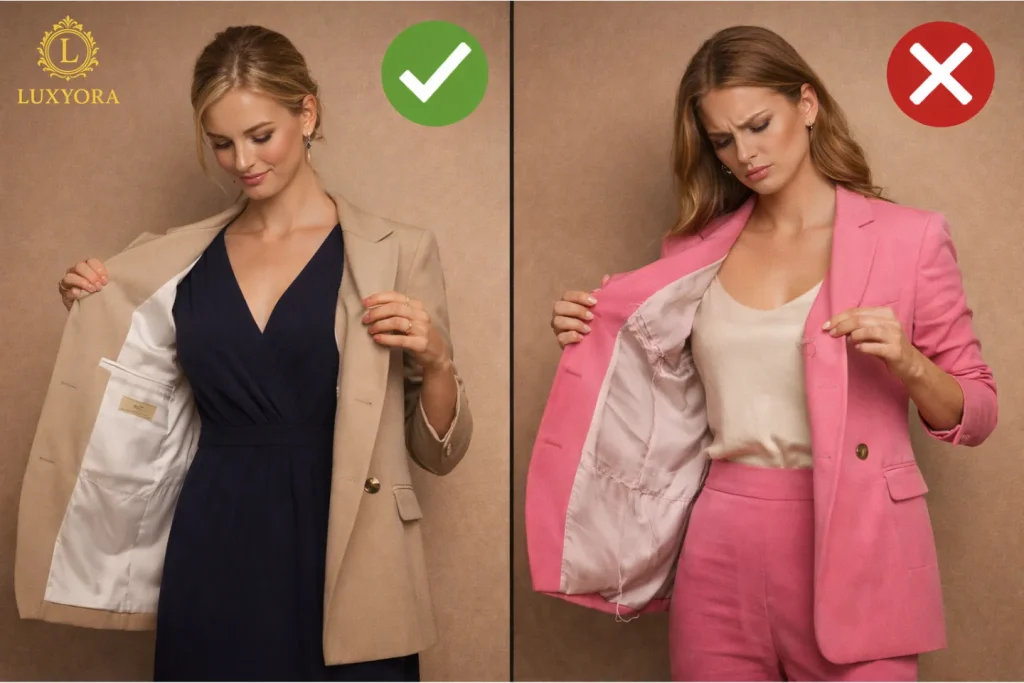
A lining isn’t just “extra”, it’s structure, comfort, and longevity. A lined garment often drapes better and reduces stress on the fabric. For dresses, skirts, blazers, and coats, lining is a major indicator of quality.
Green flags:
- smooth lining that’s attached cleanly
- lining that allows movement (not pulling across shoulders/hips)
Interfacing (aka the hidden backbone)
Collars, lapels, button plackets, waistbands- these areas should feel supported, not floppy. Cheap fusing can bubble after washing, which is why high-end pieces often use better-quality interfacing or more stable construction.
Closures & Hardware: Buttons Don’t Get a Free Pass
Closures are where “looks good” becomes “works well.”
Buttons
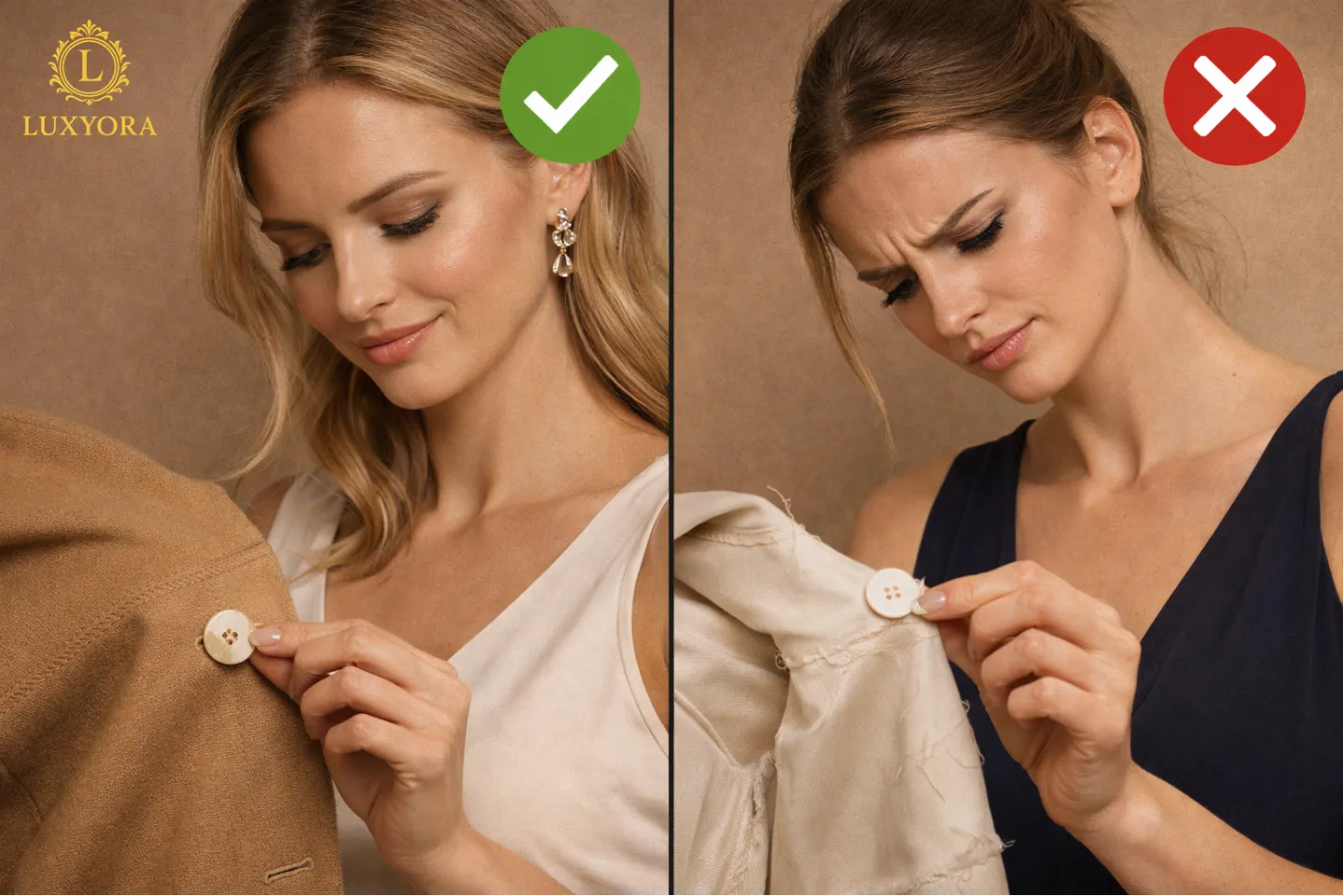
- Tug gently. If it feels wobbly, the threadwork may be weak.
- Look for a shank (space under the button) on thicker fabrics, which prevents strain.
- Spare buttons are a nice sign of brand care, though not mandatory.
Zippers
A smooth zipper is a luxury you feel instantly. It should glide without catching, waving, or gaping. Invisible zippers should lie flat and not ripple the fabric.
Hooks, snaps, and clasps
Check alignment. If a closure pulls the garment off-center, it’s either poor placement or a fit issue.
Fit & Balance: The “Mirror Truth” Test
A well-made garment tends to sit correctly on the body: shoulder seams land at the shoulder, waistlines align, sleeves hang cleanly, and the piece feels balanced front-to-back.
Fit is also where longevity lives. The more a garment strains, the faster seams, fabric, and closures break down. The broader sustainability conversation increasingly points to durability and repairability as essential, because clothing that falls apart fast leaves the “circulation” of use just as fast.
Good construction matters, but the real test often happens in the fitting room. The difference between a nice piece and a great one can be smaller and more transformative than you think. Explore How proper fit changes the way clothes look.
Labels, Care, and the “Future You” Factor
Read the care label like a love contract. If something is “dry clean only” but feels flimsy, ask yourself if you’ll actually maintain it or if it will become a closet ghost.
Orsola de Castro’s work on keeping and caring for clothes frames longevity as a real act of responsibility: making garments last longer through care and repair changes your relationship with consumption.
Smart shopper mindset: Buy for the life you actually live, then choose quality that can keep up.
A 30-Second Luxury Quality Checklist (Use It Every Time)
Before you buy, do these quick checks:
- Fabric feels dense enough for its purpose (not thin and sad)
- Seams are straight, finished, and reinforced at stress points.
- Stitching is even; no loose threads
- Pattern matches at seams/pockets (if applicable)
- Hem lies flat; no rippling
- Lining (if needed) is smooth and well attached
- Buttons/zippers feel sturdy and operate cleanly
- The garment hangs balanced and comfortable on your body
Shopping for quality isn’t always about labels or price tags. Sometimes the difference between an ordinary purchase and a forever piece comes down to noticing the right details. Read more about What to look for when buying quality apparel.
Luxyora Philosophy: True luxury isn’t a logo, it’s craftsmanship that lasts. Buy fewer pieces, choose them wisely, and let your wardrobe earn its place through beauty, integrity, and time.
References:
- ASTM International. (2022). D1683/D1683M-22: Standard test method for failure in sewn seams of woven fabrics. ASTM International. (ASTM International | ASTM)
- Cline, E. L. (2019). The conscious closet: The revolutionary guide to looking good while doing good. Plume. (Penguin Random House Higher Education)
- de Castro, O. (2021). Loved clothes last: How the joy of rewearing and repairing your clothes can be a revolutionary act. Penguin. (cdn.penguin.co.uk)
- Modi, A. (2018, November 20). Designer Anju Modi on the intricacies of fabric and beautiful design. Vogue India. (Vogue India)
- Yıldız, E. Z., & Pamuk, O. (2021). The parameters affecting seam quality: A comprehensive review. ResearchGate (full-text upload). (ResearchGate)
- Bethell, S. (2023, January 11). The fashion exec’s guide to circularity. Vogue. (Vogue)