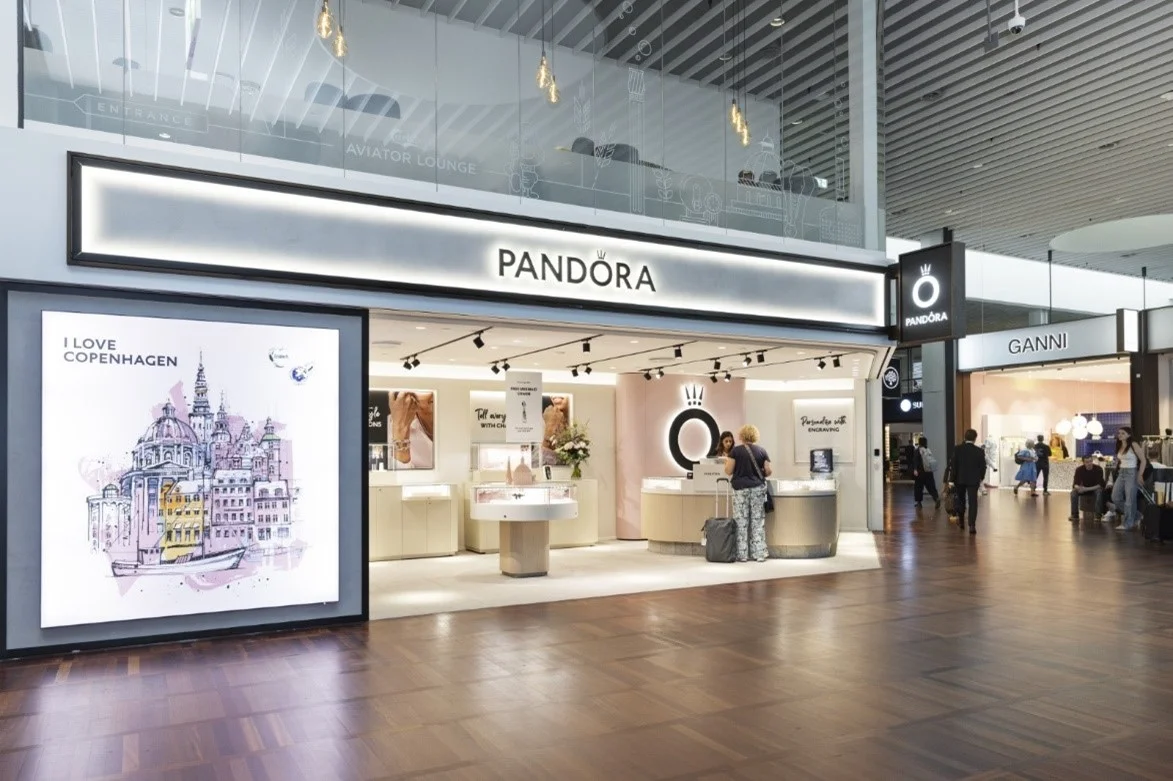
The Danish jewellery brand landed on Corso Vittorio Emanuele II on Friday, opening a 250-square-metre flagship across two levels of a 1930s rationalist building in Milan’s Piazza San Babila. It is the first Italian flagship in Pandora’s history, and it arrives alongside the Italian launch of the brand’s lab-grown diamond collection.
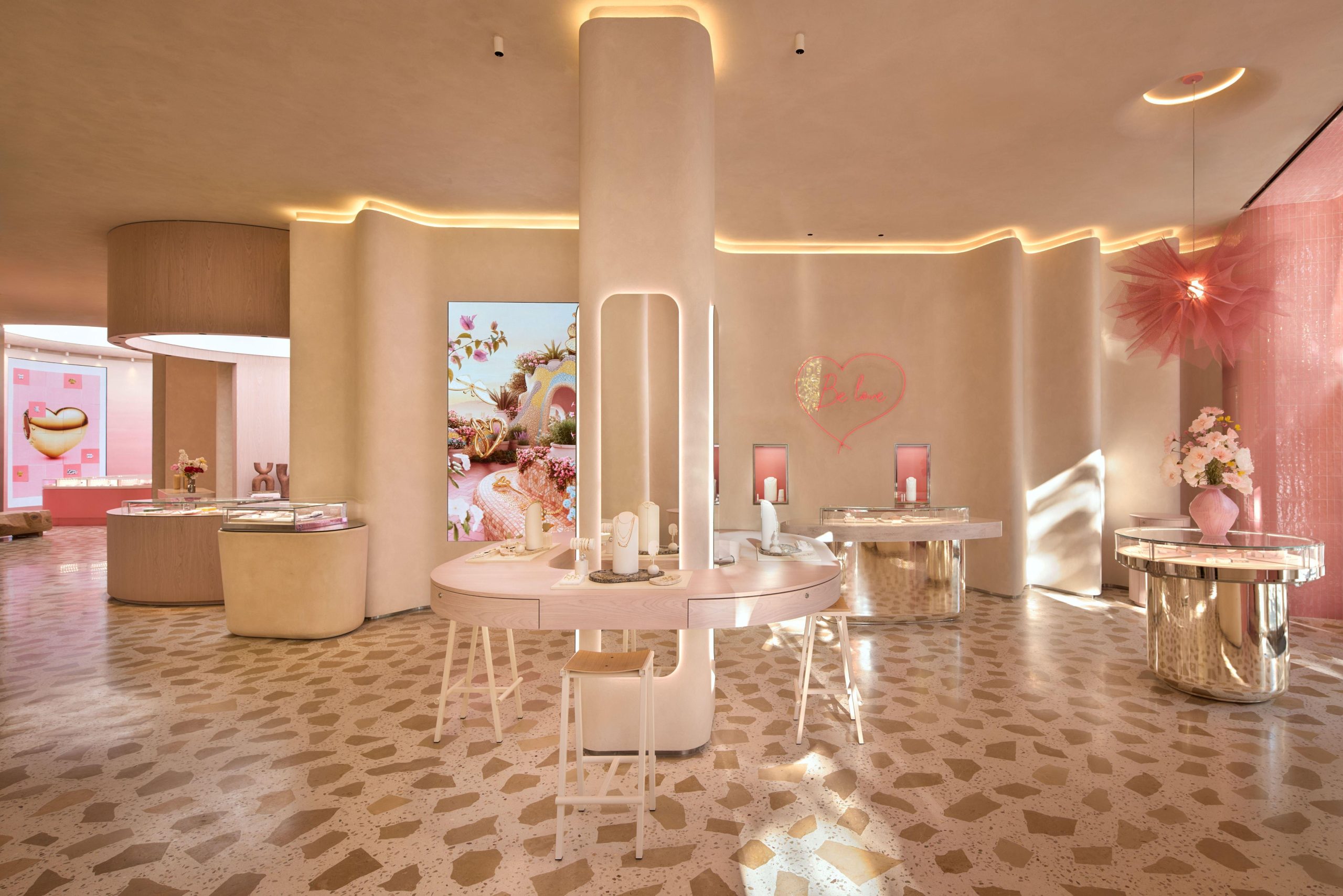
The interior takes Milan seriously. Pink marble floors reference the distinctive interiors of 1980s Italian design. A Louis Poulsen Artichoke lamp hangs overhead. On the mezzanine, a heart-shaped sculpture nods to one of the brand’s oldest charms. The planters use recycled blown glass and offcuts of Carrara marble. These are considered choices; the space reads as a deliberate argument that Pandora belongs in the company of the brands surrounding it on one of the city’s most competitive retail streets.
The address helps make that argument. Piazza San Babila sits at the eastern edge of the Quadrilatero della Moda, linking the Duomo to Milan’s luxury retail corridor and drawing both international visitors and local shoppers throughout the year. For a brand investing in how it is perceived rather than simply where it can be found, there are a few more legible locations in Italy to plant a flag.
The store has been a long time coming. Italy accounts for roughly 7 per cent of Pandora’s global revenues, which reached 32.55 billion Danish kroner in 2025, and one in three Italian women already owns a Pandora product. For a brand with more than 190 concept stores already open across the country, this was never about filling a gap in distribution. Chief marketing officer Jennie Farmer has been clear that the flagship is about brand perception. What it looks like, and where it sits, matters as much as what it sells.
The Milan opening is part of a broader flagship strategy that has accelerated over the past year. Barcelona opened just last week. Copenhagen came before that. Pandora is clearly investing more heavily in destination stores rather than simply expanding its door count, and Milan is the most significant address in that sequence so far.
The lab-grown diamond range launching alongside the opening is part of a push the brand has been making for several years, and the Italian launch brings the collection to the flagship and to 40 other points of sale across the country. What makes the approach here slightly different is the level of specificity. Pandora has calculated that a one-carat lab-grown diamond from its collection emits approximately 12.58 kilograms of CO₂ equivalent. A mined stone of the same size emits roughly 90 per cent more. Publishing those figures on individual pieces, rather than burying them in a corporate responsibility report, is a different kind of commitment. Whether the customer buying a diamond in Piazza San Babila on a Saturday afternoon is thinking about this is another matter. But the data is there.
The move also positions Pandora within a broader shift in accessible jewellery. More brands at this end of the market are looking beyond traditional charms and silver collections, using lab-grown diamonds to reach customers who might previously have entered fine jewellery through a different door entirely. The lab-grown conversation in fine jewellery remains unsettled; the establishment argument has always been that scarcity is what gives a diamond meaning, and that a stone produced in weeks cannot carry the same weight as one formed over billions of years underground. Pandora has chosen its side regardless.
There is also a personalisation space inside the store and a Milan-exclusive charm: a Duomo di Milano design in 14-carat gold with a lab-grown diamond. Something to pick up if you are in the city, rather than something you could order from anywhere. That distinction matters more than it might sound. It gives the flagship a reason to exist beyond the 40 other Pandora doors already open in Italy.
Italy is the hardest market to make this argument right now. Sara Bergiotti, Pandora’s general manager for Southern Europe, the Middle East and Africa, told MFF on Friday that consumer demand in Italy is softer than in other territories, with spending still under pressure. Spain is performing considerably better. Opening a flagship in Milan while the domestic market is struggling is a forward bet on recovery, on perception, on the idea that what a brand looks like in a difficult period shapes how it is remembered when conditions improve.
Whether the proximity to Saint Laurent and Bottega Veneta lifts Pandora’s standing with a customer who was already loyal or draws in someone who would not previously have walked through the door is genuinely open. What Friday confirmed is that the brand is asking the question in the most visible location it could find.